The Ministry of Justice (MOJ) has unveiled a draft amendment to the Law on Grassroots Mediation, aiming to significantly reform the country's local dispute resolution system. A central tenet of the proposed legislation is to enhance the selection process and elevate the quality of grassroots mediators to meet evolving practical demands. This initiative seeks to professionalize mediation activities at the community level, ensuring disputes are resolved promptly and legally, thereby upholding the Constitution and the rule of law.
Under the new proposal, the current model of grassroots mediation teams would be abolished. Instead, Community Mediation Centers would be established at the commune level. Mediators working in these centers would be required to hold a university degree, possess a professional certificate, and be employed by the local authorities. The MOJ stated that linking mediator selection to educational qualifications and assessing their capacity aligns with the specific characteristics of different localities and types of cases. This policy draws inspiration from mediation models in Singapore and Australia.
The draft law also introduces clear accountability for mediators regarding the quality of mediation cases. A periodic evaluation mechanism for mediators would be implemented, based on mediation outcomes, community trust levels, and compliance with legal regulations. This system is designed to incentivize improved mediation performance.
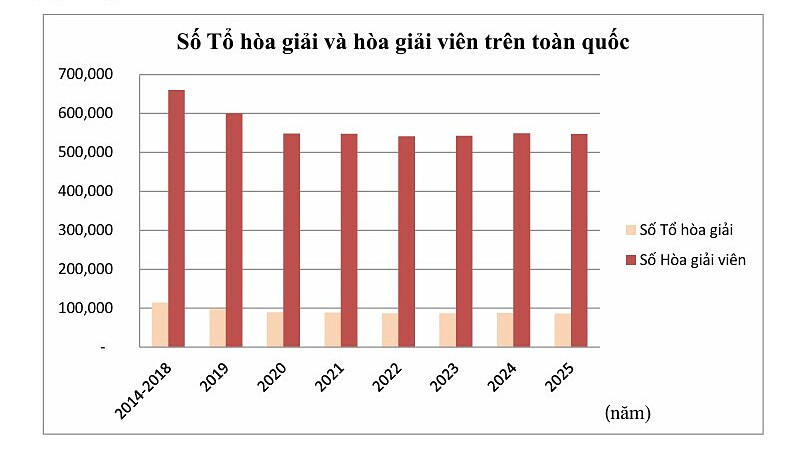
Currently, grassroots mediation serves as a mechanism to resolve minor conflicts within residential communities, involving respected individuals such as neighborhood leaders, village chiefs, women's union members, veterans, or locally recognized mediators. The existing Law on Grassroots Mediation, effective since 2014, mandates that each mediation team consist of at least three mediators. The chairperson of the commune-level People's Committee determines the number of mediation teams and mediators within each team based on local characteristics and circumstances. Under current regulations, mediators must be Vietnamese citizens residing in the locality, possess good moral character, enjoy community prestige, demonstrate persuasion skills, and have legal knowledge.
 |
Source: Ministry of Justice
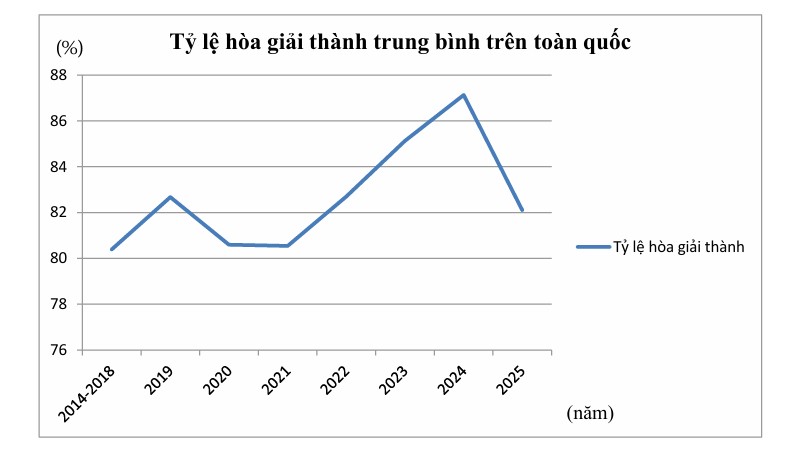
From 1/2014 to 12/2025, a total of 906,763 mediation cases were handled nationwide, averaging 90,676 cases per year. Of these, 735,785 cases were successfully mediated, achieving a success rate of 80,22%. Several provinces reported high success rates, including Lao Cai (88,46%), Tay Ninh (88,32%), Tuyen Quang (87,27%), Dong Thap (85,84%), Lai Chau (85,80%), TP HCM (85,24%), An Giang (85,17%), and Quang Ngai (84,96%). These efforts have significantly contributed to the timely resolution of disputes, reducing complaints to state agencies and preventing escalation. Grassroots mediation also plays a vital role in fostering community solidarity and building peaceful, happy neighborhoods.
The MOJ noted that most conflicts mediated primarily arise in land, civil, and marriage and family matters. Other common disputes stem from differing lifestyles, disagreements over shared pathways, or the use of common utilities like electricity and water.
 |
Source: Ministry of Justice
Despite its achievements, the law, after more than 10 years of implementation, has revealed several outdated provisions. Mediators currently receive a nominal fee of 300,000-400,000 VND per case, which serves more as encouragement than adequate compensation. This has led to difficulties in resolving complex disputes, particularly those involving many parties, as grassroots mediators often lack the necessary capacity and legal knowledge. This limitation is particularly evident in land disputes, which often involve complex origins and land policies, sometimes lacking a clear legal basis for resolution.
Furthermore, current regulations on the rights and duties of mediators are not comprehensive. This often makes mediators hesitant and less proactive in mobilizing professional consultation resources or inviting influential individuals to assist in complex cases. The absence of a mechanism linking information provision to the courts also creates a bottleneck in recognizing successful mediation outcomes, reducing the enforceability of mediation agreements and impacting the legitimate rights of the disputing parties.
Son Ha