The Vietnam Road Administration recently submitted a pre-feasibility study report to the Ministry of Construction for approval. The report outlines a project to upgrade and expand national route 1 across Ha Tinh, Quang Tri, and Hue city.
This project focuses on expanding urban bypasses and segments passing through existing economic zones. These sections, currently with two lanes, will be widened to four lanes and include a median strip. The objective is to alleviate congestion and enhance traffic safety along the vital North-South corridor.
In Ha Tinh, the proposed expansions include the Ha Tinh city bypass, over 16 km long, which traverses Thach Ha, Toan Luu communes, and Thanh Sen, Ha Huy Tap, Cam Binh wards. Additionally, the Ky Anh town bypass, nearly 29 km long, will pass through Ky Van, Ky Hoa communes, and Song Tri, Vung Ang, Hoanh Son wards.
The section of national route 1 running through the Vung Ang economic zone, spanning over 26 km, is also slated for expansion. This segment covers Ky Van, Ky Hoa communes, and Song Tri, Vung Ang, Hoanh Son wards.
Further south, the project encompasses the Hien Luong bridge bypass, nearly 12 km long, passing through Vinh Linh commune in Quang Tri province. It also includes the Hue city bypass, nearly 36 km long, which runs through Huong Tra ward.
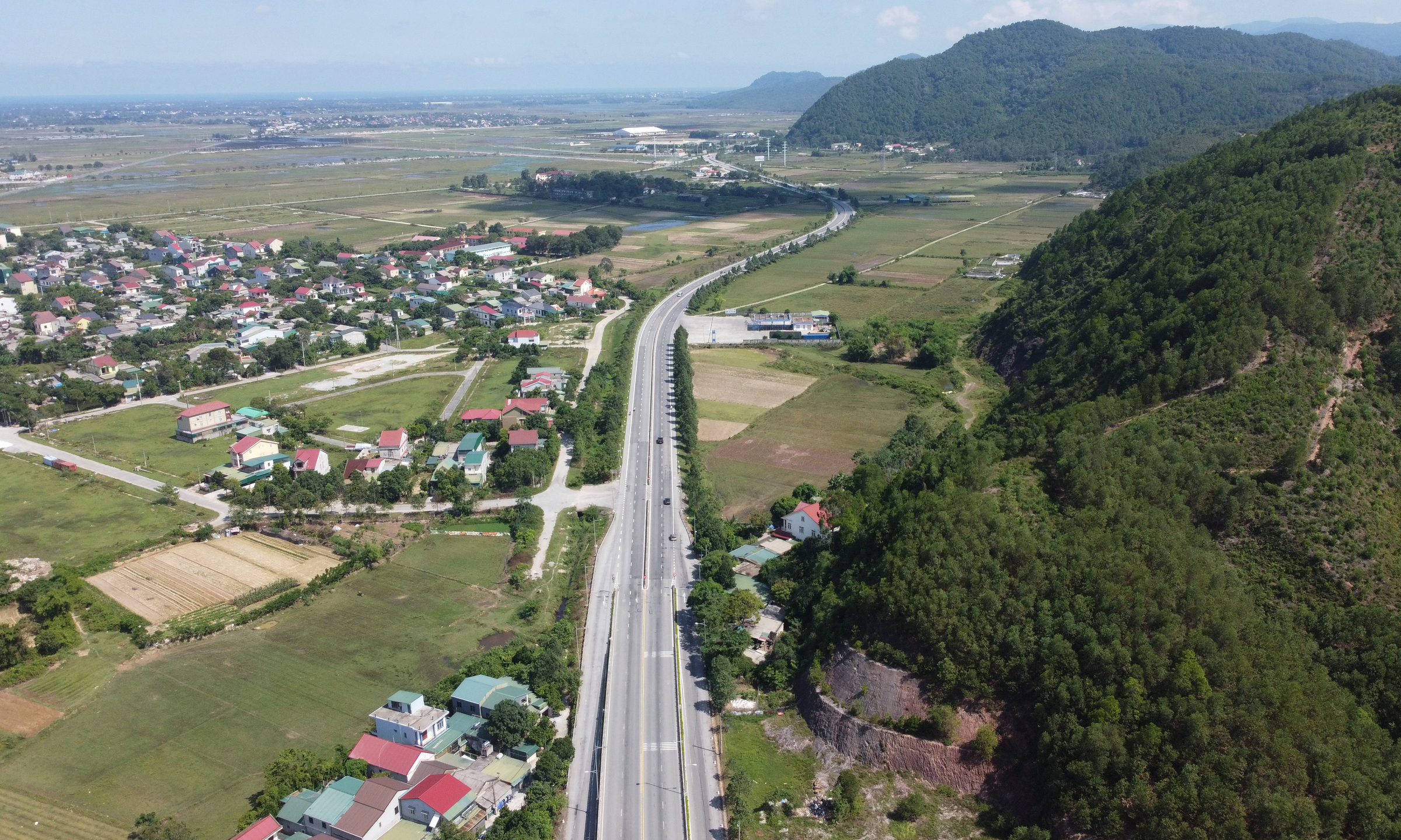 |
National route 1 from the south of Ben Thuy 2 bridge to the north of Ha Tinh city bypass. *Photo: Duc Hung*
These route sections will be developed according to varying design standards based on their operational characteristics. The Ha Tinh city bypass, Hien Luong bridge bypass, and Hue city bypass are designed as class three roads, allowing a speed of 80 km/h.
The Ky Anh town bypass will be built as a class one road, with a design speed of 120 km/h. Meanwhile, the section through the Vung Ang economic zone will be constructed as a secondary main street, with a design speed of 60 km/h.
The preliminary total investment for this project is approximately 9,960 billion VND, sourced from the state budget. Completion is anticipated in 2029.
According to the project developer, despite the operation of many expressways and coastal roads, traffic volume on national route 1 in this region continues to increase rapidly. This is particularly noticeable on urban bypasses, which currently feature only two lanes.
Many older sections of national route 1 that once ran through urban areas have been re-designated by local authorities as urban roads. This change restricts large trucks and passenger buses from entering city centers. Consequently, bypasses often become overloaded, posing traffic safety risks.
The project developer emphasizes that expanding these bypasses to four lanes is essential. This expansion will meet the growing demand for passenger and freight transport and further complete the North-South transport network in the coming phase.
Anh Duy