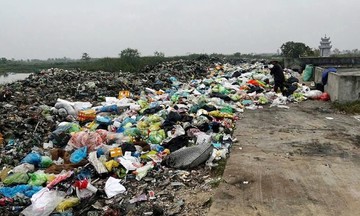
The Department of Agriculture and Rural Development informed the Ho Chi Minh City People's Committee (UBND) that the Da Phuoc landfill, located in Hung Long commune, Binh Chanh district, will only accept waste from 18h to 6h the following day. This facility handles waste from 14 former districts, processing an average of 4,550 tons daily, equivalent to 443 truck trips. Currently, waste is transported in two shifts: 1,800 tons during the day and 2,750 tons at night.
The cessation of daytime reception at Da Phuoc means all morning shift waste must be diverted to the evening. Waste trucks, however, face significant traffic restrictions, raising concerns about their inability to complete rounds promptly. This could necessitate rerouting to the Tay Bac Waste Treatment Area in Cu Chi district, increasing transport distances by 22-47 km per trip and placing considerable strain on both waste transport companies and road infrastructure.
Waste being transported to the Da Phuoc treatment area, Binh Chanh district. *Giang Anh* |
The Department of Agriculture and Rural Development highlighted that many areas lack transfer stations, requiring direct transport to the treatment site. Central districts, such as District 1 and District 3, demand continuous collection to prevent waste accumulation from markets and businesses. If Da Phuoc stops daytime reception, collection efforts risk disruption due to truck ban hours, leading to waste buildup in the inner city. Furthermore, the concentrated influx of trucks during nighttime hours could cause congestion at the landfill's gate and on nearby roads.
To alleviate these pressures, the department proposed four solutions, including diverting a portion of daytime waste from Districts 1, 3, 6, and 10 to the Tay Bac Waste Treatment Area, while the remaining waste would still go to Da Phuoc during the nighttime hours. The department also recommended that the city prioritize waste trucks for continuous circulation or relax truck ban hours. Additionally, it suggested exempting waste trucks from inner-city circulation permits, classifying them as essential service vehicles.
An aerial view of the Da Phuoc landfill, 2018. *Quynh Tran* |
The Da Phuoc Solid Waste Treatment Complex project began its first phase of operation in 2007, with a total investment exceeding 32 million USD. It is Ho Chi Minh City's largest waste treatment facility, processing 4,000-5,000 tons daily using landfill technology under a contract with Vietnam Waste Solutions (VWS).
Previously, VWS announced an adjustment to waste reception hours, limiting it to a single night shift (18h-6h), initially planned for 15/8. However, this was temporarily postponed, and 24-hour operation continued until the end of November. The company stated the need to narrow operating hours because, from early 2025, the volume of waste delivered to Da Phuoc is expected to decrease to approximately 4,000 tons per day. Maintaining 24-hour operation would increase operating costs.
Giang Anh