The pagoda is located in An Nhon Nam ward (Nhan Thap hamlet, Nhon Hau commune, An Nhon town, Binh Dinh province) and was recognized as a national architectural and artistic relic in 2001. The structure is considered a typical cultural intersection between Vietnamese and Cham cultures, still clearly evident in the central region.
In the main hall, the pagoda preserves two Dvarapala stone statues – guardian deities of Cham temples, dating back to around the 13th century. These statues belong to the Thap Mam art style, a late and brilliant period of Cham Pa art. In 2020, the pair of statues was recognized as national treasures.
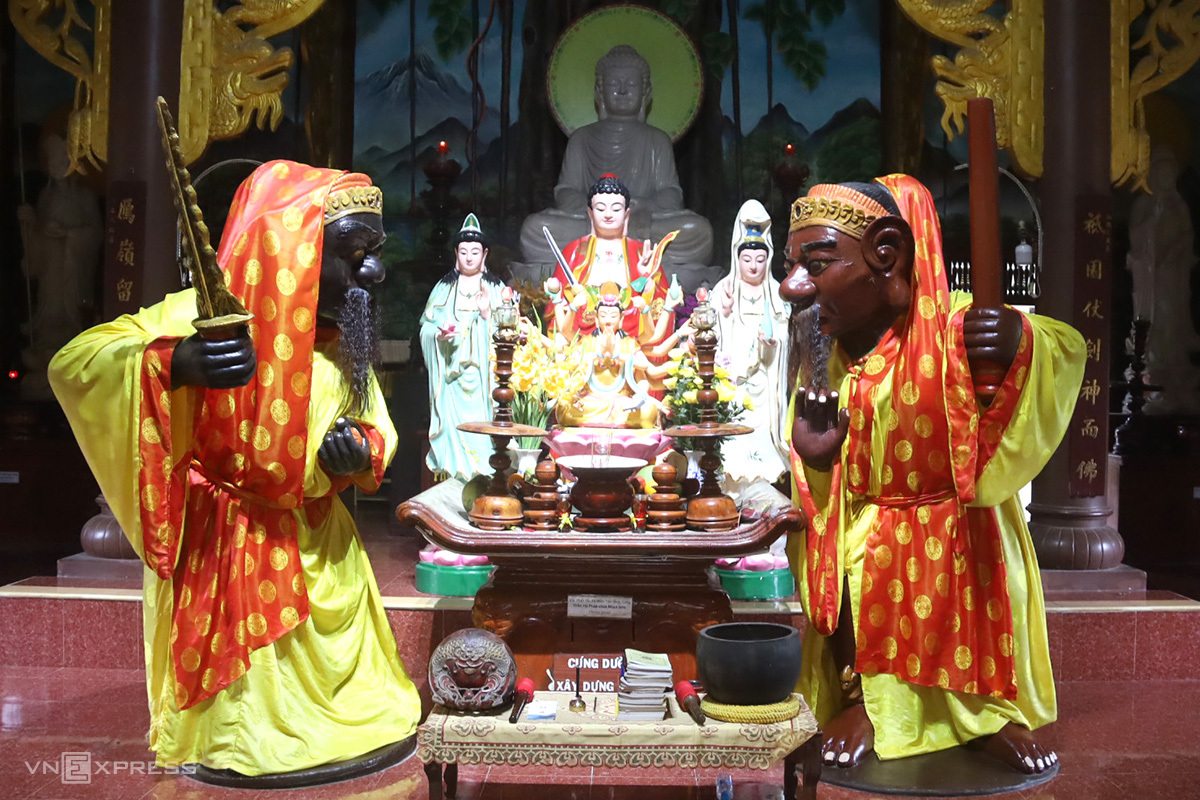 |
The statues of Ong Do and Ong Den at Nhan Son Pagoda. *Tran Hoa*. |
The two ancient statues, approximately 700 years old, stand on round pedestals. Each statue features a muscular figure and weighs about 800 kg. The Ong Do statue is 2.42 m tall, and the Ong Den statue is 2.45 m tall. Both wear crowns, have round bun hairstyles, thick eyebrows, and large eyes, noses, and ears. Ong Den holds a sword, while Ong Do holds a 'gian' stick – symbolizing the authority of a civil mandarin.
According to records from the Department of Cultural Heritage, this is the largest and most intact pair of guardian statues remaining in the Thap Mam style. This site was once an important religious and artistic center for the Cham people.
Beyond their artistic value, the two statues are also associated with many folk legends. Venerable Thich Thi Hoang, abbot of Nhan Son Pagoda, said that legend has it Ong Do was named Huynh Tan Cong, the son of a poor scholar from Quang Nam, while Ong Den was Ly Xuan Dien, who lived during the Tran dynasty.
On their way to Thang Long to take the imperial examination, Ong Cong fell seriously ill, fainted in Quang Binh, and was rescued by a landowner. The landowner's son, Ly Xuan Dien, was also preparing to go to the capital for the examination, so the two embarked on the journey together and became sworn brothers.
Afterward, both successfully passed the examination and were highly esteemed by the imperial court. Ong Cong became a civil mandarin, holding a 'gian' stick – a symbol of imperial authority; Ong Dien became a military mandarin, holding a ceremonial sword.
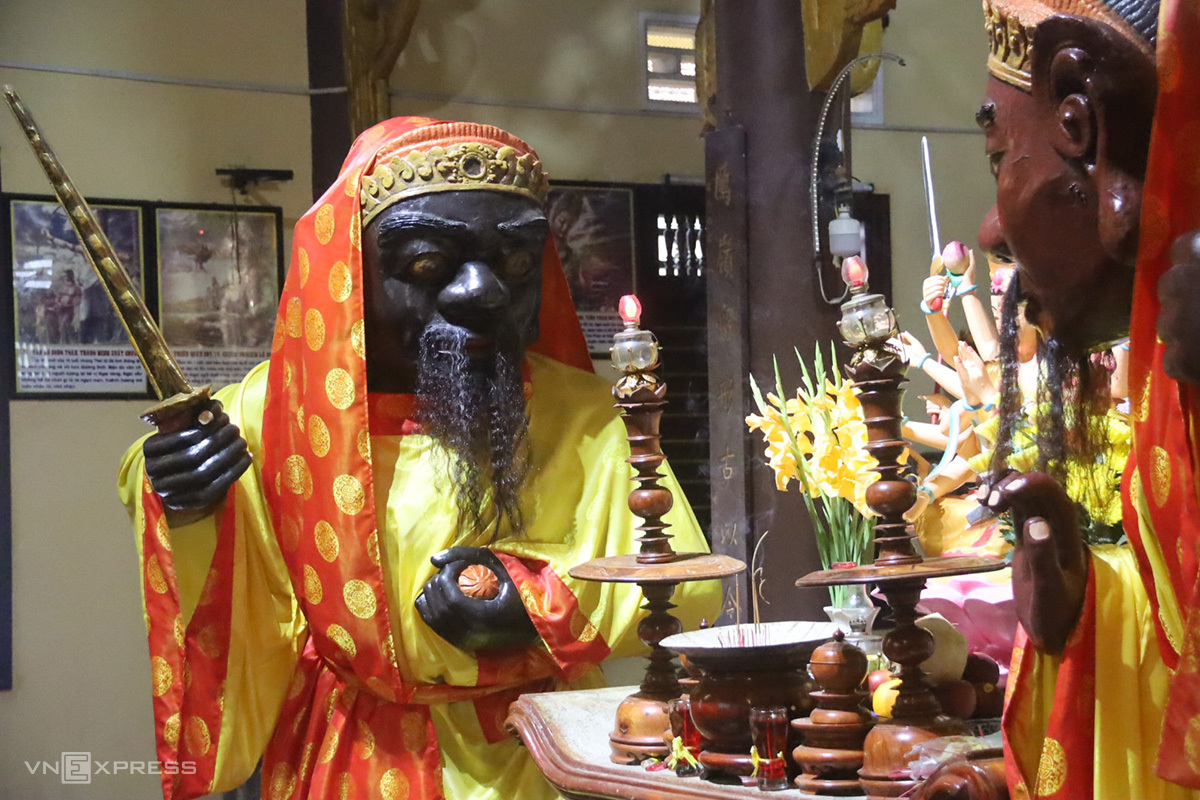 |
Ong Den, or Ly Xuan Dien, holding a ceremonial sword, indicating his role as a military mandarin. *Tran Hoa*. |
During an envoy mission to Chiem Thanh (Champa), the two men used traditional Vietnamese medicine to cure the king. They also led troops to repel Siamese invaders at the border. Despite their victory, Ong Dien was captured by Siamese forces. Later, a Siamese prince proposed marriage to Ong Cong's younger sister, offering the return of Ly Xuan Dien as a bridal gift. The two met again and returned together to Dai Viet.
Impressed and grateful for their contributions, the King of Chiem Thanh commissioned two stone statues to be carved for worship. Through many historical upheavals, the pair of statues lay buried underground for hundreds of years. When locals discovered them, they established a pagoda for worship, calling it Thach Tu Cong, meaning 'pagoda dedicated to the stone deity'.
Later, local people added beards, hats, and robes to the two statues, making their appearance more familiar to indigenous beliefs. By the 16th century, when a prolonged drought occurred in the An Nhon region, Venerable Chi Man established an altar to pray for rain, successfully ending the drought. The local governor invited him to stay and establish a pagoda, naming it Song Nghia Tu, which was later changed to Nhan Son Linh Tu. Locals commonly refer to it as Ong Do and Ong Den Pagoda.
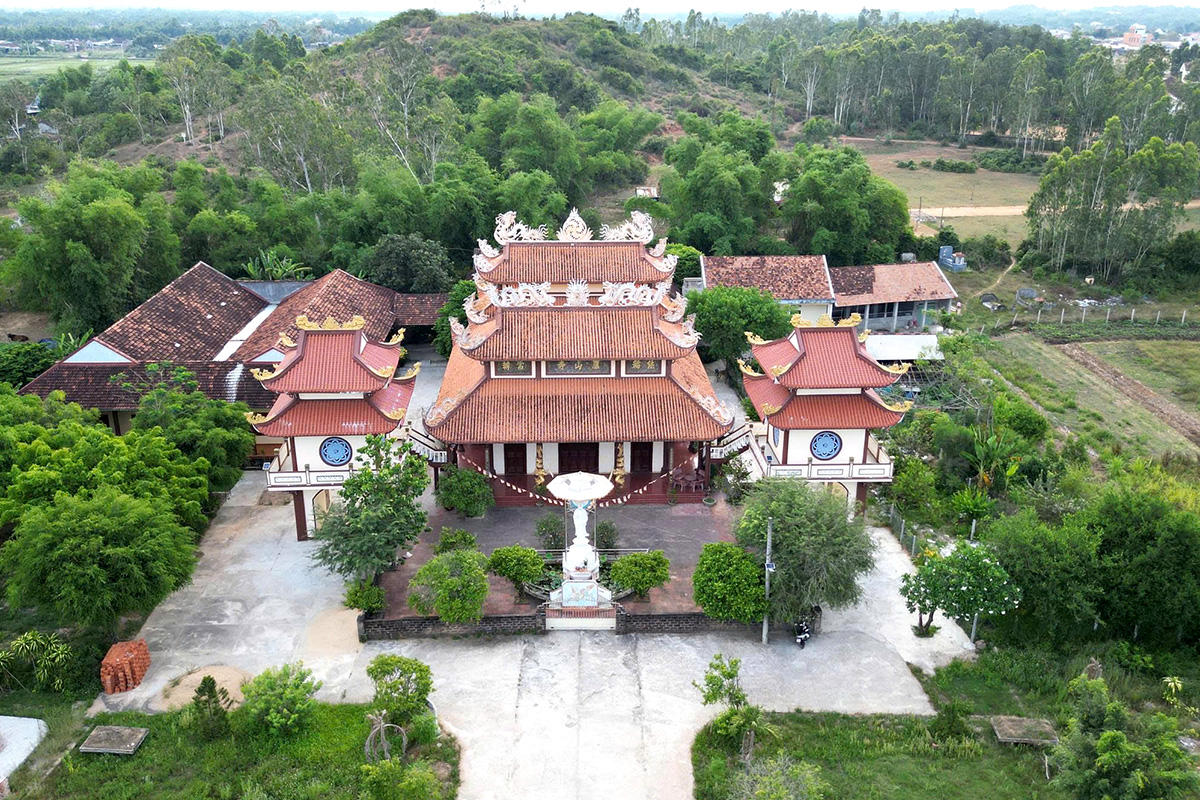 |
Nhan Son Pagoda, covering about 3 hectares, is commonly known by locals as "Ong Do and Ong Den Pagoda". *Tran Hoa*. |
The story of the two statues was recorded by Bui Van Lang in his book 'Dia Du Mong Hoc Tinh Binh Dinh', published in 1933. Although there are several different versions, all the stories aim to explain the origin of the ancient statues at Nhan Son Pagoda.
Today, local people believe that the two statues are very sacred. Many come to worship, praying for wealth, peace, and academic success. Families with young or frequently ill children often bring them to Nhan Son Pagoda to "offer them to Buddha and the two deities", hoping their children will be protected, healthy, and grow up well.
Tran Hoa