Hoang, 27, (name changed) from Xuan Huong Ward, Da Lat, reported his mother acquired a plot of land exceeding 450 square meters in 2017. The property already featured three three-needled pine trees.
After the family purchased the land, one pine tree died. Hoang secured official approval to remove it.
In early September, after several days of strong winds, another pine tree, about 5 meters tall with a 35-centimeter trunk diameter, began leaning towards a neighboring house. Neighbors, fearing the tree could fall, urged Hoang to contact authorities.
Hoang stated his family notified the ward, and officials inspected the tree. However, while awaiting permit processing, he decided to fell the tree, fearing it could collapse and harm people or property.
Hoang documented the tree felling in two short videos. He used tools to carve around the trunk, showing how to effectively kill the pine, then used a chainsaw to cut it down. He intended to use the wood for furniture. He posted the videos on TikTok to boost engagement for his business.
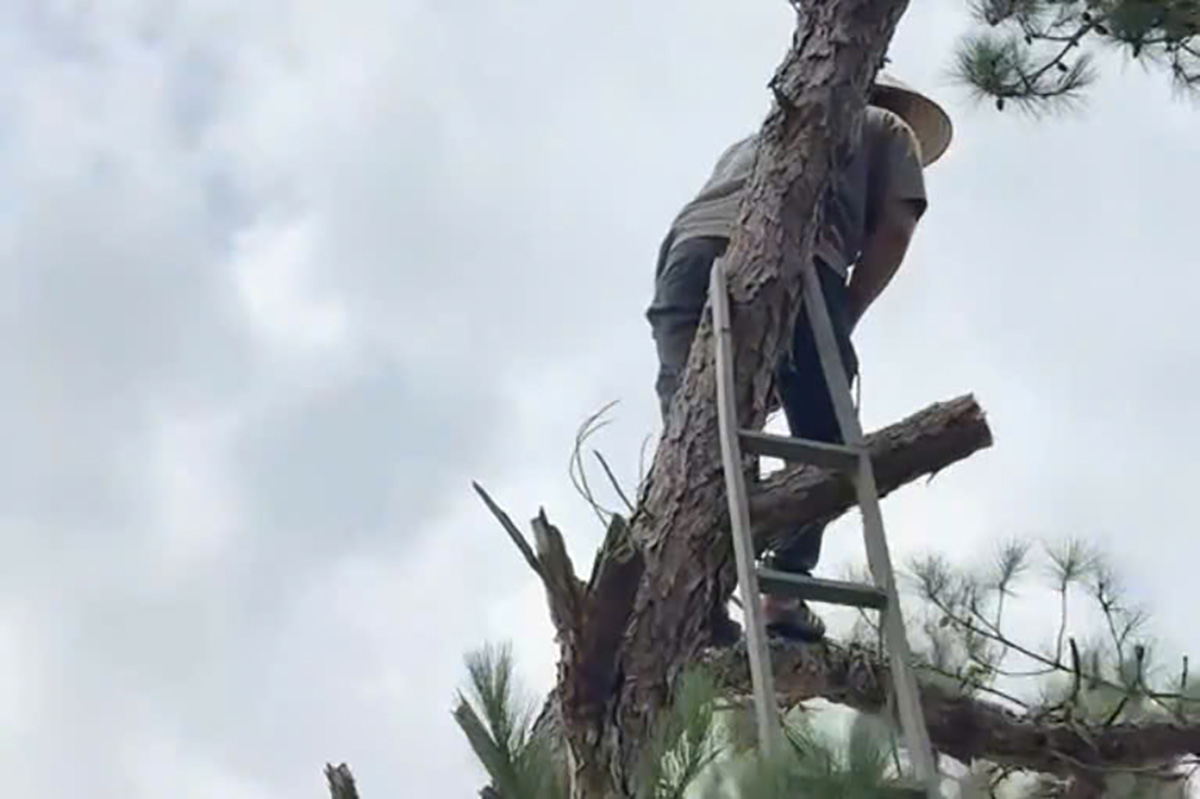 |
Hoang fells the pine tree in his garden. Photo: *Screen capture from video* |
On 7/9, after discovering the videos, Xuan Huong Ward authorities in Da Lat summoned Hoang for questioning. Two days later, officials issued an administrative violation report.
"I live in Da Lat and understand the regulations requiring permits to fell pine trees, but I did not wait for official approval", Hoang stated.
On 13/9, the Xuan Huong Ward People's Committee in Da Lat fined Hoang 35 million dong for felling the tree without a permit. This action falls under point a, clause 3, Article 50 of Government Decree 339/2026, which specifies fines ranging from 30 to 50 million dong for such violations.
Nguyen Ngoc Hau, Vice Chairman of the Xuan Huong Ward People's Committee, clarified that while the pine tree was on residential land, not forest land, local regulations for green tree management still apply to its felling.
Residents wishing to fell a tree must notify authorities. This allows relevant agencies to verify the tree's origin, condition, and management category before issuing a permit. "In this instance, the homeowner cut the tree without authorization", Hau explained.
Not all garden trees require permits
Cao Son Dung, Acting Director of the Lam Dong Department of Construction, emphasized the distinction between trees planted and legally owned by residents, and those classified as landscape trees, conservation trees, or trees under forestry management.
Fruit trees, industrial crops, or trees cultivated for production by residents on their own land — such as mango, jackfruit, guava, coconut, areca nut, coffee, and rubber — are generally considered the planter's property. Dung confirmed that landowners may fell these trees if they are not designated for conservation or subject to specific regulations.
However, trees on private land are not automatically owned by the landowner. A local management official noted that many natural pine trees in Da Lat predate the granting of land use rights to households and remain under State management.
Obtaining a land use rights certificate does not automatically transfer ownership of existing landscape trees to the landowner. Consequently, authorities must verify a tree's origin and management classification before approving its removal.
Similarly, residents cannot arbitrarily fell trees on land with forest origins or those under forestry management if the trees are not their property.
In Lam Dong, Provincial People's Committee Decision 19/2026, effective from 4/5/2026, outlines green tree management. The Department of Construction issues permits for felling or relocating trees on the conservation list, while commune-level People's Committees permit other regulated trees within their jurisdictions.
Three-needled pine, two-needled resin pine, and horsetail pine are listed as local public green trees in the decision. However, inclusion on this list does not automatically designate all trees of these species on private land as public property. Authorities must ascertain each tree's origin and management status.
Generally, dead, fallen, or emergency-risk trees due to natural disasters may be exempt from permit requirements. However, such felling necessitates documentation, witnessed by the management unit and community representatives, and reported to the green tree management agency. Hoang lacked documentation confirming his tree qualified for emergency permit exemption before felling.
Dung advised residents to contact local specialized agencies for guidance regarding trees with pre-existing or unclear origins, ownership, or management status. He reiterated that a tree's presence on private land is not the sole determinant for a landowner's decision to fell it.
Truong Ha