While performance is measured by completion time, average speed rarely determines a marathon runner's result. Instead, it is the strategic distribution of energy throughout the race that matters. This approach explains why an average runner can outperform a physically stronger competitor if they employ the right strategy.
In the initial 10km, runners should maintain a pace 5-10 seconds slower than their target. This isn't due to a lack of strength but to conserve glycogen for the crucial final 10km.
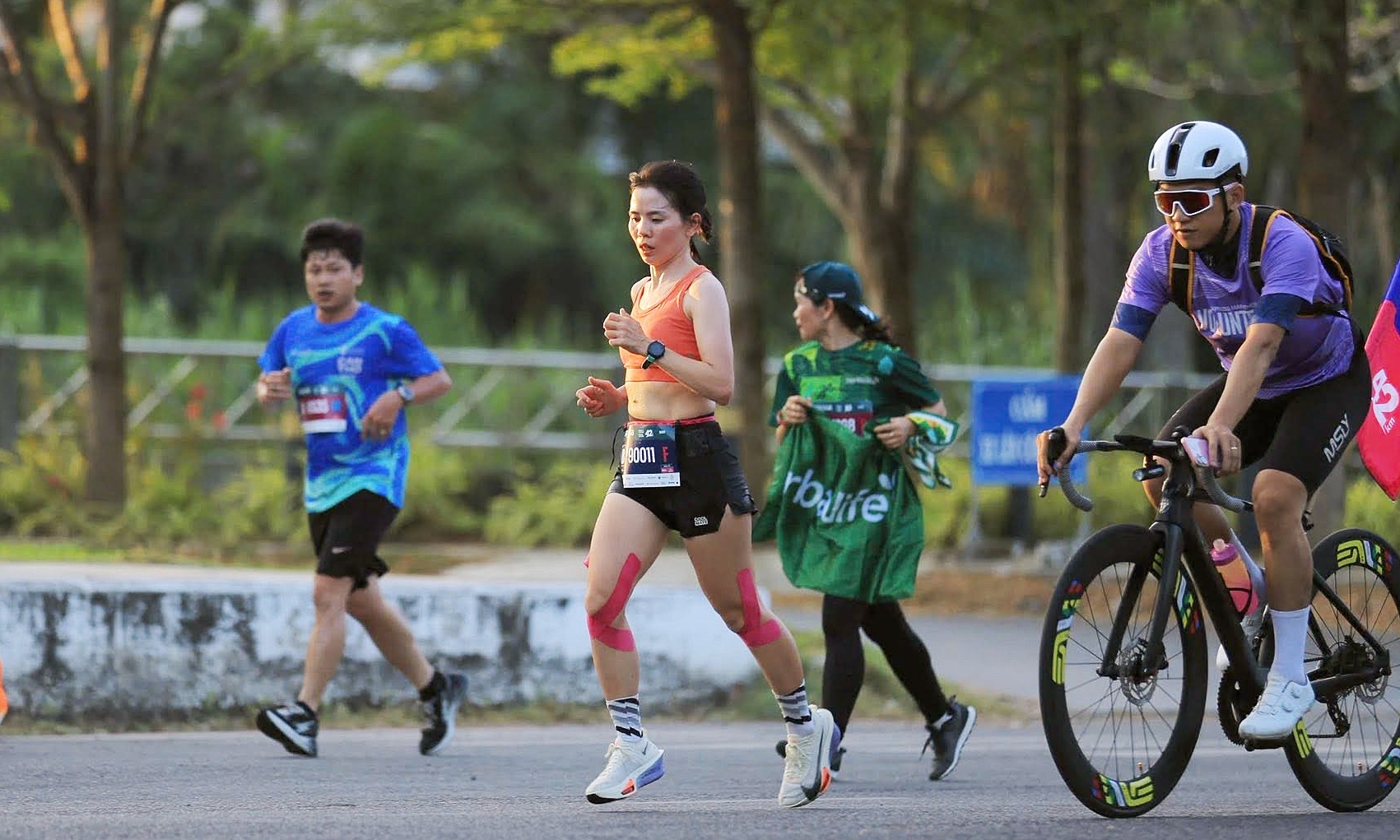 |
Nguyen Thi Ngoc Lan competes in the full marathon distance at VnExpress Marathon Can Tho. Photo: VnExpress Marathon
Research by Doctor Benjamin Rapoport from Harvard University, published in the scientific journal PLOS, indicates that elevating heart rate too high from the start rapidly depletes the body's 2,000 calories of stored glycogen. A study by Professor Edward F. Coyle of the University of Texas, published in Sports Medicine, confirms this process stimulates early lactic acid accumulation. Lactic acid is a primary factor causing muscle stiffness and "hitting the wall" in the latter half of the race.
Participating in a race is an excellent way to boost morale, but it can also lead runners into a "psychological trap". Cool morning weather and the vibrant atmosphere at the starting line can inadvertently cause runners to exceed their target pace without realizing it.
As runners enter the second half of the race, they need to gradually increase their speed, avoiding sudden bursts that could strain the body. From the 22nd kilometer onward, runners should divide the remaining distance into smaller segments of 3-5 km. After each segment, they should actively shorten their pace by about 5 seconds. This method allows the quadriceps and calf muscle groups to adapt progressively, minimizing the risk of cramps.
According to the journal Medicine & Science in Sports & Exercise, when runners reach the 30th kilometer, their energy reserves begin to deplete, forcing the body to switch to fat burning. This process is less efficient for energy conversion, leading to a sudden drop in physical performance. However, by conserving energy during the first half of the race, runners can maintain a steady stride and have enough power to accelerate towards the finish line.
To maintain speed late in the race, adjusting running technique is also vital. Runners should avoid overstriding, which increases impact force on joints and raises the risk of knee injuries by 15%. Instead, focus on increasing cadence to 180 steps per minute while shortening the stride. This technique allows the body to glide faster, reduces ground reaction force, and shortens foot contact time.
Optimizing arm swing is also essential for runners to distribute pressure away from the lower body. Biomechanics research on running at the University of Colorado demonstrates that runners who swing their arms decisively backward with a 90-degree elbow angle can counteract rotational forces in the hip region. This action helps maintain body balance, pulls the center of gravity forward, and reduces 7-10% of the direct pressure on the thigh muscles.
Duc Anh
The VnExpress Marathon Da Nang International Marathon Herbalife Cup 2026, scheduled for 19/7, is an international race within the VnExpress Marathon series. The event will gather 13,000 athletes and is a key highlight in the city's summer tourism development strategy. The course guides athletes across iconic bridges and Da Nang Bay, offering an opportunity to explore the central coastal city at dawn.