Eng English
China 中国人

Eng English
China 中国人
  • News
  • World
  • Business
  • Entertainment
  • Sports
  • Law
  • Education
  • Health
  • Lifestyle
  • Travel
  • Science
  • Digital
  • Automobiles
  • Trở lại Thể thao
  • Travel
Wednesday, 15/4/2026 | 09:02 GMT+7

Deciphering the 233 Water Vats in the Forbidden City

Over 200 vats, scattered throughout the Forbidden City, served as an important layer of protection for the imperial family.

In ancient China, placing large vats in courtyards often symbolized good fortune, believed to protect the home and enhance the owner's luck. The imperial palace was no exception. However, the primary purpose of the water vats in the Forbidden City was fire prevention.

The Forbidden City's architecture, constructed primarily from wood, faced fire as its greatest threat. Consequently, large vats were strategically placed throughout palace courtyards and along pathways, kept full of water year-round. Each vat could hold hundreds to thousands of liters of water, comparable to the capacity of a small fire truck today.

In the event of a fire, soldiers and eunuchs could immediately access water from these vats for firefighting. These vats were also known by evocative names, such as: "Mon Hai" (sea before the gate), "Cat Tuong Cuong" (auspicious vat), and "Thai Binh Cuong" (peaceful vat).
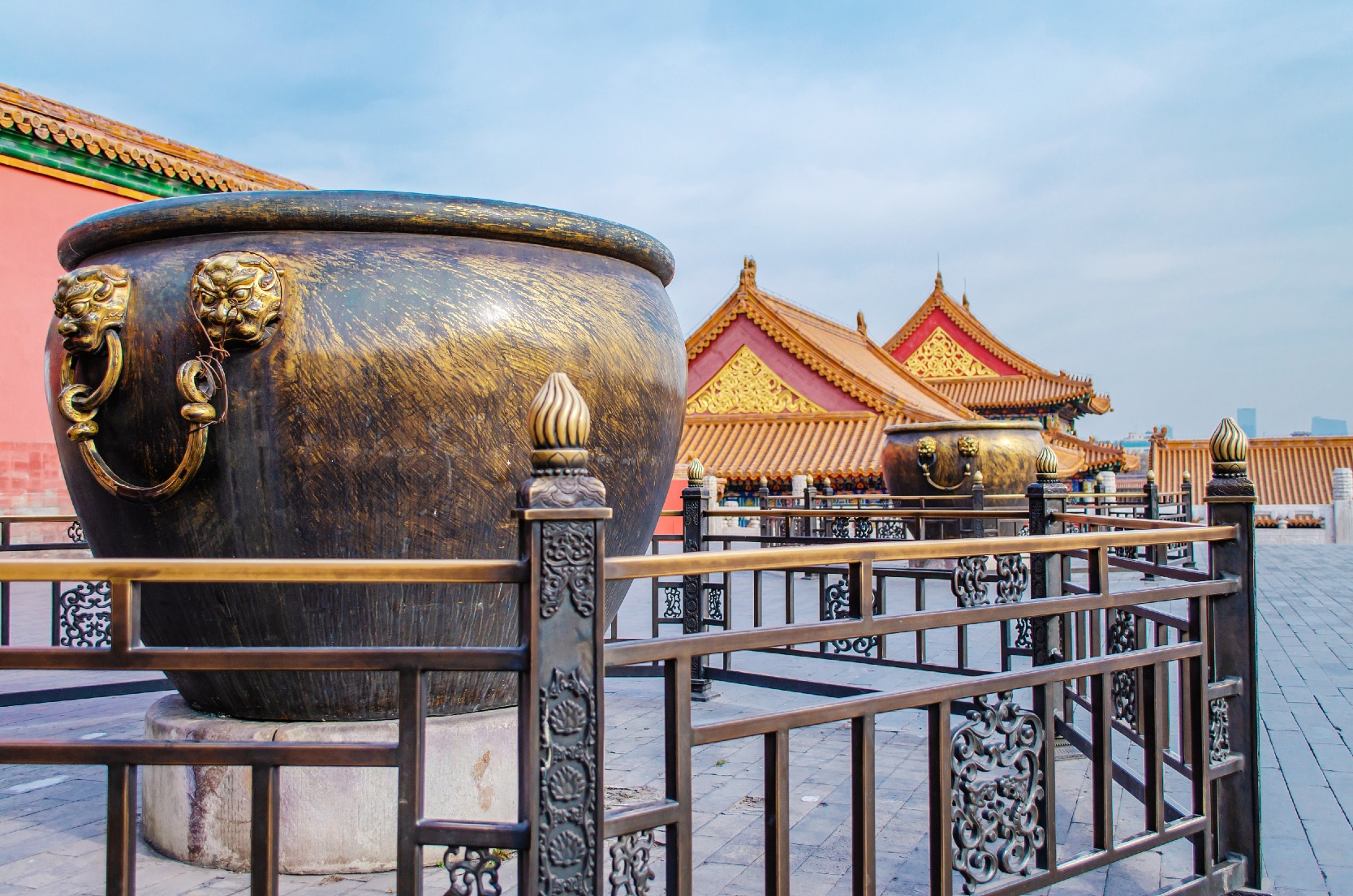
A vat in the Forbidden City today. Photo: VCG

During Beijing's harsh winters, palace staff implemented ingenious heating methods to prevent the water from freezing and ensure its readiness for firefighting. They placed burning charcoal inside hollow stone bases situated beneath the vats. Furthermore, the vats were tightly covered and insulated with "cotton jackets"—thick fabric coverings designed to retain warmth. This meticulous approach ensured the water remained liquid and accessible, even in sub-zero temperatures.

Historical records from the "Dai Thanh Hoi Dien" indicate that the Forbidden City once housed 308 large vats. Over time, only 231 of these remain preserved today.

These vats are categorized into three main types based on their material: bronze, iron, and gilded bronze. During the Ming Dynasty (1368-1644), iron vats were prevalent. The Qing Dynasty (1644-1911) saw the introduction of gilded bronze vats.

The gilding process was elaborate and complex: gold was dissolved in mercury, applied to the bronze surface, then heated. This heating evaporated the mercury, leaving a durable layer of gold that created a brilliant, shimmering appearance.

The Forbidden City's strict architectural hierarchy extended even to the vats. Gilded bronze vats, considered the most prestigious, with only 18 remaining, were positioned at the entrances of key palaces like Taihe Hall and Baohe Hall. Bronze and iron vats were located in less prominent palaces and along pathways.

Towards the end of the Qing Dynasty, invading forces plundered the Forbidden City. Unable to carry away the heavy vats, they resorted to using bayonets to scrape off the gilded surfaces. Today, visitors can still observe these bayonet marks etched onto the vats, a tangible reminder of that historical period.

The Forbidden City, also known as the Imperial Palace, began construction during the Yuan Dynasty (approximately 1271-1368). This expansive complex, covering about 720,000 square meters, consists of numerous palaces and served as the residence for 24 emperors of the Ming and Qing Dynasties. It was fortified by a 10-meter-high wall, watchtowers, and a wide moat. Today, the Forbidden City stands as a renowned tourist attraction, drawing most visitors to Beijing.

Hoai Anh (According to Our China Story, Trip)
By VnExpress: https://vnexpress.net/giai-ma-233-chum-nuoc-trong-tu-cam-thanh-5062338.html
Tags: tourism Forbidden City China's Forbidden City Beijing China travel

News in the same category

Cinema requires patrons to wear raincoats in screening room

Cinema requires patrons to wear raincoats in screening room

A 7D cinema in Vinh Tuy ward requires patrons to wear raincoats to experience water spray and foam effects throughout the film.

A cafe decorated with old iron and steel in Ho Chi Minh City

A cafe decorated with old iron and steel in Ho Chi Minh City

Mai Dinh Vinh spent over one billion dong to purchase old corrugated iron, scrap materials, iron, steel, and antique items for recycling and decorating his cafe.

Ironic life in a town spanning two nations

Ironic life in a town spanning two nations

The two villages of Baarle-Hertog and Baarle-Nassau straddle the Belgium-Netherlands border, leading to many ironic situations for residents.

Ly Son bans tourists from climbing To Vo Arch

Ly Son bans tourists from climbing To Vo Arch

Ly Son authorities have requested tourists to stop climbing and standing on the To Vo Arch rock formation to protect this national monument ahead of the peak tourist season.

Personalized letter helps Vietnamese traveler secure 3-year Japan visa

Personalized letter helps Vietnamese traveler secure 3-year Japan visa

Thang Nguyen shares how a personalized letter helped persuade the consulate to grant a multi-entry visa, rather than relying solely on financial documents.

Eating colorful thang den at night in Ha Giang

Eating colorful thang den at night in Ha Giang

Locals prepare thang den, a small glutinous rice flour dessert, served with aromatic roasted ginger-sugar syrup to cater to tourists.

Vinhomes Green Paradise's vision for a "future green urban area"

Vinhomes Green Paradise's vision for a "future green urban area"

Guided by the ESG++ model, Vinhomes Green Paradise integrates green planning, synchronous infrastructure, and smart operations, gradually forming a sustainable living space connected to nature.

Thailand warns of accident risks during Songkran festival

Thailand warns of accident risks during Songkran festival

Thailand's ministry of transport advises residents and tourists against standing in the road or splashing water on motorcyclists to mitigate the sharp increase in traffic accidents during the Songkran festival.

A nocturnal spectacle: Chasing fireflies in Cuc Phuong forest

A nocturnal spectacle: Chasing fireflies in Cuc Phuong forest

Tourists and photographers are flocking to Cuc Phuong National Park to witness and capture images of thousands of fireflies glowing at night.

Vietnamese travelers pivot to short trips for 30/4 holiday

Vietnamese travelers pivot to short trips for 30/4 holiday

The 30/4-1/5 holiday period reveals a growing trend among Vietnamese travelers to opt for micro-holidays and short trips, diverging from the longer excursions typically planned for the Lunar New Year.

Eng English
China 中国人
  • News
  • World
  • Business
  • Entertainment
  • Sports
  • Law
  • Education
  • Health
  • Lifestyle
  • Travel
  • Science
  • Digital
  • Automobiles
FPT Tower, 10 Pham Van Bach Street, Dich Vong Ward,
Cau Giay District, Hanoi, Vietnam
Email: contacts@vnportal.net
Tel: 028 7300 9999 - Ext 8556
Advertise with us: 090 293 9644
Register
© Copyright 2026 vnnow.net. All rights reserved.
Terms of use Privacy policy Cookies