At the Qicai Danxia tourist area in Zhangye city, Gansu province, many visitors hold textbooks, aligning the geomorphological images on the book covers with the colorful hills before them to take photos.
Xu Yan, a high school student from Guangdong, said observing the landscape firsthand helps her better understand the Danxia terrain.
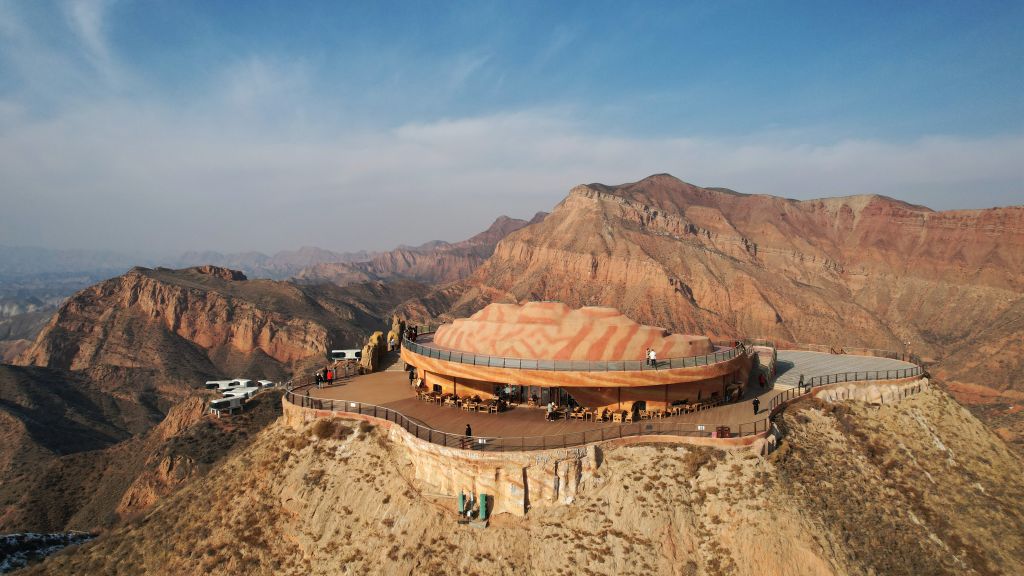 |
An panoramic view of the colorful geological layers at Qicai Danxia scenic area in China. *Photo: Xinhua* |
The "textbook check-in" trend has emerged on Chinese social media platforms in recent years, transforming Qicai Danxia into a popular destination for young people. During the recent summer holiday, many students and tourists brought high school English textbooks, carefully framing shots to match the Danxia images in their books with the actual landscape.
According to Chinese media, this alignment reflects a growing geotourism trend in many Chinese localities. Activities such as hiking, trail running, photography, camping, and scientific exploration are combined into a single itinerary.
"Tourists no longer just want to visit; they also want to learn more deeply about the landscape", said Ly Tuan Linh, Deputy Head of the General Management Department at the Qicai Danxia tourist area.
To meet these new preferences, destinations have proactively refreshed their service ecosystems, focusing on enhancing the depth of visitor experience.
At Qicai Danxia, the management board offers in-depth tours that take visitors into the core area to directly observe the inclination of rock layers and the stratified structure of the geomorphology. At the Bingshanhu Grand Canyon in Zhangye, the natural landscape is integrated into role-playing games, allowing participants to wear ancient costumes and solve puzzles along cliff trails.
Meanwhile, the Shuimo Danxia tourist area in Lanzhou city operates a 3,5 km long wooden plank bridge along the mountainside, combined with an exhibition hall featuring rock samples and paleontological fossils, creating an "indoor exhibition linked with field survey" model.
Product innovation has significantly boosted visitor numbers and research activities. In 2025, the Qicai Danxia tourist area welcomed over 3,42 million visitors, while the Shuimo Danxia tourist area surpassed the 1 million visitor mark.
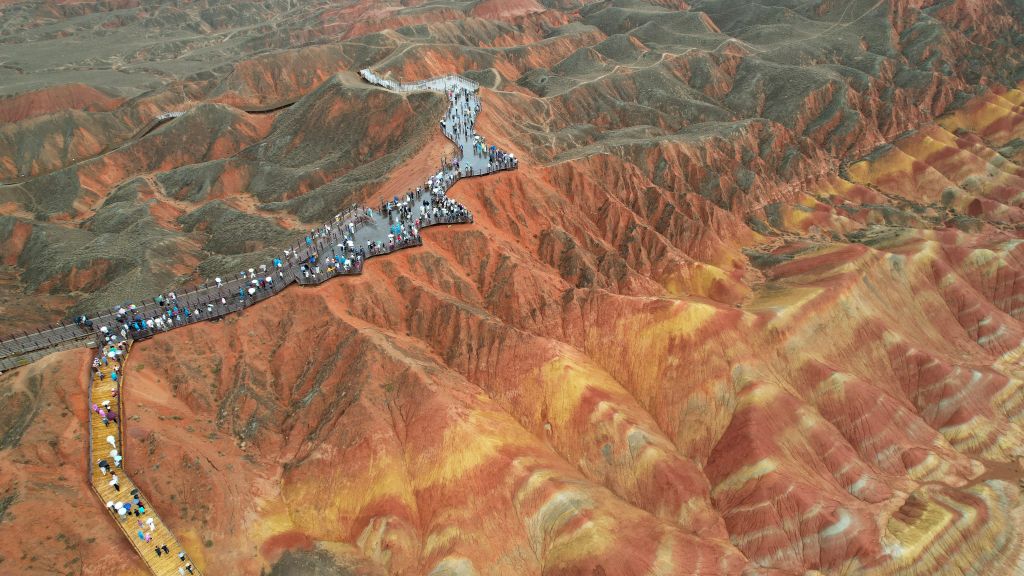 |
Visitors at the Qicai Danxia scenic area in China. *Photo: Xinhua* |
Notably, the experiential learning tourism model has seen significant growth, with Zhangye Global Geopark hosting 216 research groups and 170,000 students participating in experiences like using geological hammers and identifying iron and manganese minerals that color the rocks.
Associate Professor Cheng Hongyi of Lanzhou University noted that compared to traditional sightseeing tourism, immersive exploration activities like field research or geological walks have transformed how knowledge is conveyed. This offers visitors richer experiences and a deeper understanding of Earth's formation over billions of years.
China currently has 51 global geoparks, the highest number worldwide. These sites serve as key platforms for developing geotourism.
Tuan Anh (According to Xinhua)