Oman and Iran issued a joint statement on August 27, announcing a framework agreement to establish a temporary maritime corridor and a joint mine-clearing project. This initiative aims to allow safe passage for vessels through the Strait of Hormuz.
Mohsen Rezaei, Secretary of Iran's Supreme National Security Council, stated that the corridor would traverse both Iranian-controlled waters and Omani waters.
Kazem Gharibabadi, Iran's Deputy Foreign Minister, later added that under the interim agreement, commercial vessels entering the Persian Gulf would use Iranian maritime channels, while departing ships would navigate through both Iranian and Omani waters. All warships, including US naval vessels, would be prohibited from using these maritime routes.
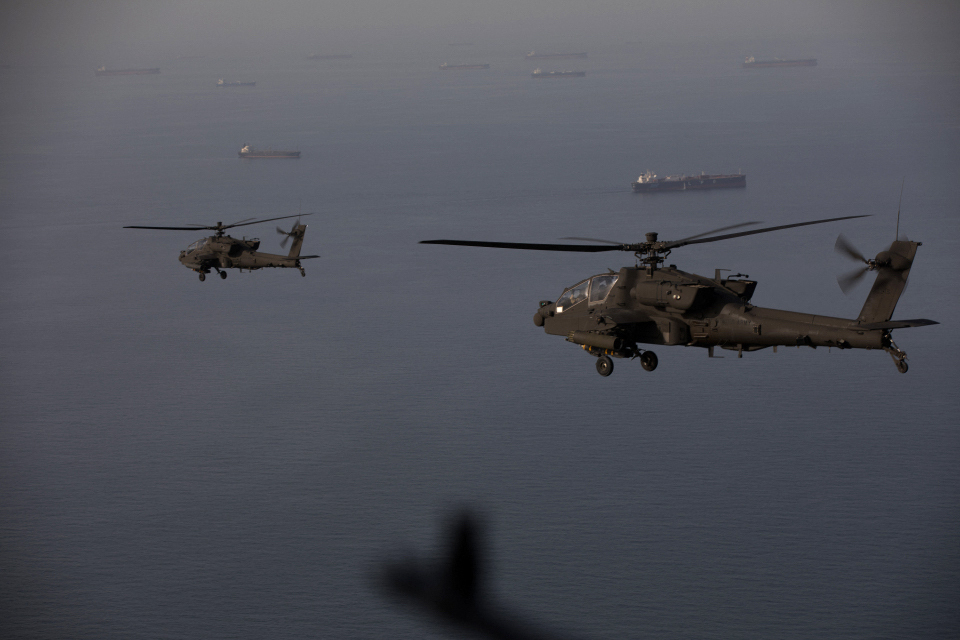 |
US military AH-64 helicopter patrolling above the Strait of Hormuz on April 17. *Photo: AFP*
However, Iran declared that this framework agreement does not mean the situation in Hormuz will soon return to normal. Omani mediators subsequently requested Iran to clarify the conditions it seeks for reopening the strait.
"The US must first take practical steps to meet Iran's conditions, and then Iran will proceed with opening Hormuz," Rezaei stated, outlining Tehran's demands, which include ending all regional conflicts, the US lifting its blockade of Iranian seaports, and providing economic support and compensation.
Rezaei also warned that Iran would target US economic interests if the blockade campaign continues.
A senior Iranian official disclosed that Tehran and Muscat are still finalizing the details of the maritime route agreement. Previously, Iran's Islamic Revolutionary Guard Corps (IRGC) unilaterally announced that the two countries had agreed on how to share control of the strait and revenue from maritime activities.
General Rezaei stated that Iran exported 70-80 million barrels of oil during the ceasefire, bringing production back to pre-sanction levels. "In addition to releasing oil stockpiled on vessels, we have established new export routes and are gradually expanding them," he said.
This information emerged as three countries: Qatar, Pakistan, and Oman intensified their mediation efforts between Iran and the US. Qatar's Prime Minister visited Tehran for discussions, becoming the third mediating nation to visit Iran within the past week, following visits from leaders of Pakistan and Oman.
The White House declined to comment when Fox News inquired whether President Donald Trump's administration would accept the prohibition of US warships passing through Hormuz under the Iran-Oman agreement.
Meanwhile, the US Central Command declared that Iran "does not control Hormuz," asserting that the strait is international waters where commercial vessels can continue to pass with the support of the US navy.
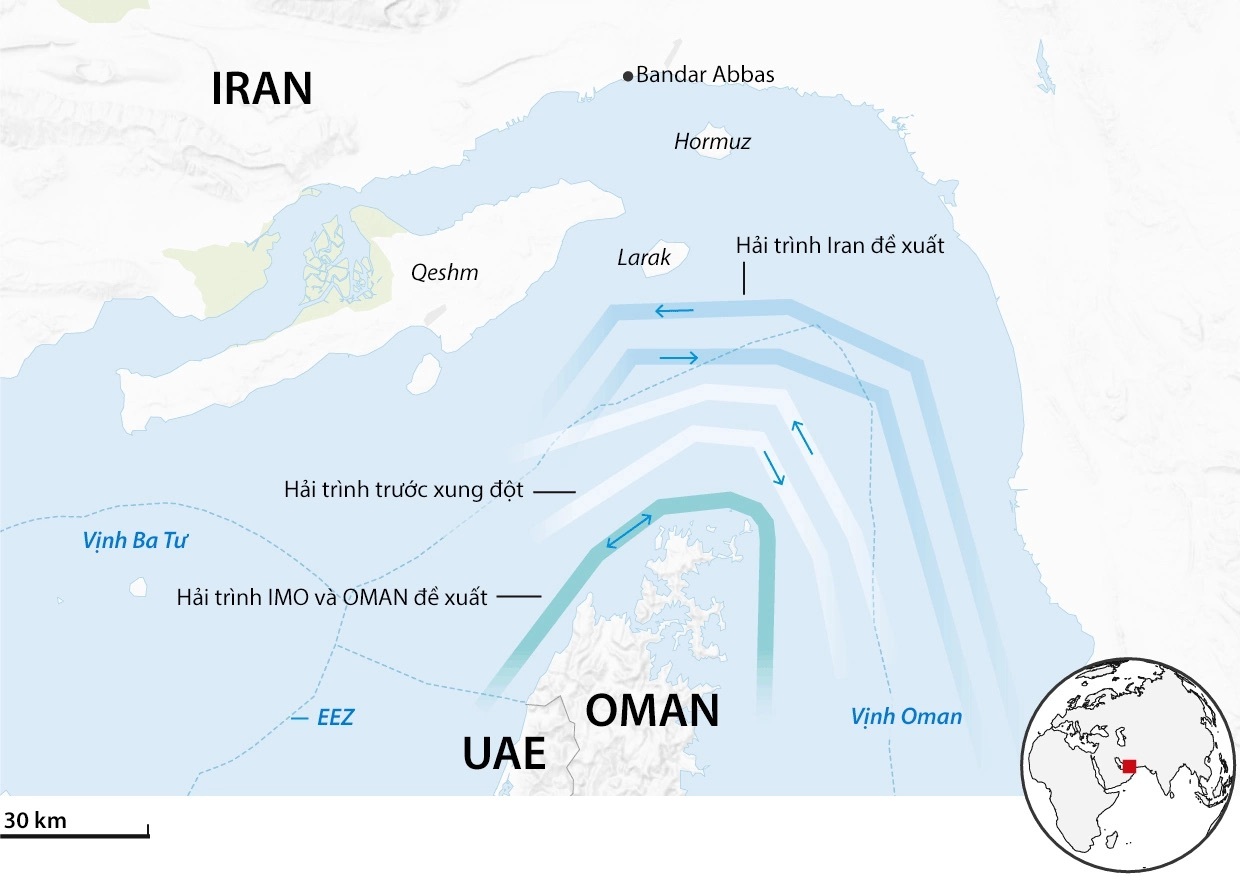 |
Maritime routes through the Strait of Hormuz. *Graphic: Guardian*
Iran closed the Strait of Hormuz after US and Israeli airstrikes began on February 28. Before the conflict, this maritime route transported about 20% of the world's oil and liquefied natural gas.
The strait was briefly reopened in June under a memorandum of understanding (MoU) signed by Iran and the US, mediated by Pakistan and Qatar. Under the agreement, Iran would clear mines and allow free passage for vessels for 60 days, while Washington would lift blockades and ease sanctions.
However, Tehran accused Washington of failing to implement key provisions and declared the strait closed again. The US subsequently reimposed blockades on Iranian ports. The MoU expired on August 17, although both sides had ceased complying with the agreement weeks prior amidst reciprocal attacks.
By Thanh Danh (Reuters, Al Jazeera, TRT)