Vietnam Electricity (EVN) and Vietnam National Oil and Gas Group (PVN) have been granted significant sea areas totaling 63,811 hectares for offshore wind power project surveys. This allocation, decided by Minister of Agriculture and Environment Tran Duc Thang, exempts both groups from sea usage fees, with a survey period set for 36 months.
Specifically, EVN has been allocated 24,000 hectares off the Long Chau archipelago and Bach Long Vi island in Hai Phong city. This area is designated for surveying and developing the Bac Bo 1.3 and Bac Bo offshore wind power projects. PVN, on the other hand, received over 39,811 hectares off Lam Dong province to survey for the Nam Trung Bo 1 offshore wind power project.
These two designated sea areas feature an average depth of up to 140 meters, with structures and equipment projected to extend up to 40 meters above sea level.
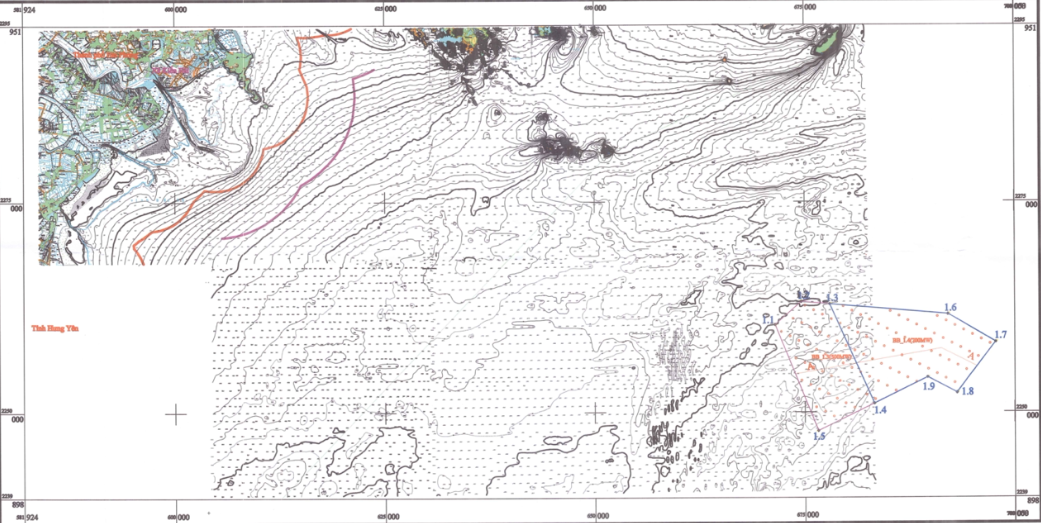 |
Sea area allocated to EVN for surveying offshore wind power projects. *Photo: MAE* |
The allocation of sea areas for enterprise surveys represents a crucial initial phase in the development of offshore wind power projects. This step provides the legal framework necessary for collecting essential data, assessing project feasibility, and preparing comprehensive investment documents. Furthermore, this process enables management agencies to effectively control maritime space, thereby minimizing potential overlap with other exploitation activities.
The Ministry of Agriculture and Environment has imposed strict conditions on EVN and PVN regarding these allocated areas. Both groups are prohibited from transferring, leasing, mortgaging, or contributing capital using their sea usage rights. The Ministry also mandates strict adherence to all national defense, security, and marine environmental regulations. "If environmental pollution or coastal erosion occurs, sea usage activities must immediately cease until the issues are resolved," the Ministry of Agriculture and Environment stated. The Ministry further noted that if cultural heritage is discovered during the survey, companies must inform local authorities and specialized agencies for appropriate handling.
In late February 2025, the Ministry of Industry and Trade proposed postponing offshore wind power development beyond 2030. This proposal stemmed from the high initial investment costs, estimated at 60-70 billion USD, and the lack of any approved projects by that time. However, the Standing Government instructed the Ministry not to delay these projects, underscoring the nation's commitment to renewable energy.
Under the revised Power Plan VIII, Vietnam aims for 6,000 MW of offshore wind power by 2030, increasing to 17,500 MW by 2035. By 2050, this capacity is projected to reach an impressive 113,000-139,000 MW, marking a significant step towards a sustainable energy future.
Gia Chinh