At a seminar on E10 gasoline supply on 5/6, Mr. Dao Duy Anh, Deputy Director of the Department of Innovation, Green Transformation, and Industrial Promotion (Ministry of Industry and Trade), referenced international experience and data from the Vietnam Register, indicating that most vehicles manufactured after 2000 are compatible with E10 gasoline.
Mr. Dao Duy Anh reported that over 141 million liters of E5 biofuel were consumed in the initial days after it completely replaced mineral gasoline in the market. This volume accounted for over 93% of the total gasoline sold nationwide.
"We have not recorded negative feedback from consumers," he stated, adding that information on social media about vehicles experiencing issues after refueling with E10 gasoline "needs specific cause verification, rather than hastily blaming fuel quality."
 |
Mr. Dao Duy Anh, Deputy Director of the Department of Innovation, Green Transformation, and Industrial Promotion (Ministry of Industry and Trade), speaking at the seminar on 5/6. *Photo: Tien Phong Newspaper*.
From the perspective of distribution enterprises, Mr. Do Hoang Ha, Head of the Business Department at Petrolimex, noted that E10 gasoline consumption is stable and gradually increasing daily. "Consumers initially approached the product cautiously, with some concerns. However, user reactions have become more positive with access to complete information," Mr. Ha said.
According to him, the most frequent customer inquiries concern E10's compatibility with older vehicles, fuel consumption rates, and whether fuel tank flushing or parts replacement is needed during the transition.
Statistics from the Vietnam Automobile Manufacturers' Association (VAMA) show that most vehicle models currently produced, assembled, and distributed in Vietnam by association members are designed to be compatible with biofuel, including E10. Mr. Dao Cong Quyet, Head of VAMA's Communications Subcommittee, explained that newer vehicle models use materials resistant to ethanol's effects on fuel pumps, injectors, fuel lines, and specialized rubber and plastic components. Consequently, the risk of corrosion or impact on engine durability is very low, provided the fuel meets standards.
For some vehicles manufactured before 2005 or those still using carburetors, E10 compatibility requires thorough inspection. This is because manufacturers did not account for the use of fuel with a high ethanol content during design. VAMA recommends that vehicle owners take their vehicles to authorized dealerships or service centers for technical assessment.
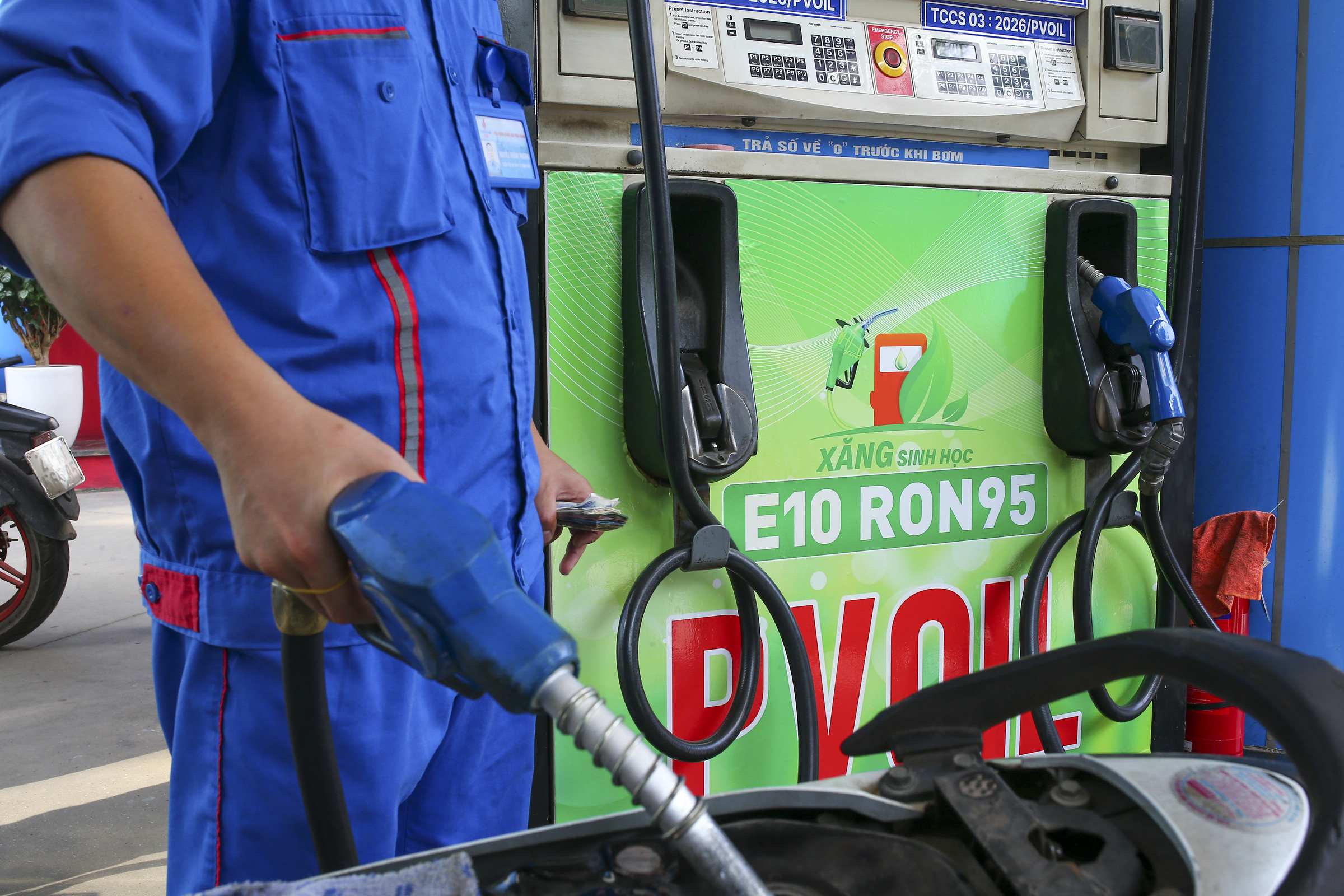 |
Residents refueling with E10 gasoline on Thai Thinh Street, Hanoi, 5/2026. *Photo: Pham Chieu*.
Regarding E10's fuel consumption, VAMA indicates that the difference after switching fuels is negligible. Conversely, ethanol promotes cleaner fuel combustion, contributing to reduced emissions and enhanced environmental protection.
Associate Professor, Doctor Dam Hoang Phuc, Director of the Automotive Engineering Training Program (Hanoi University of Science and Technology), shared a similar view, stating that the issue with E10 is not its power output or fuel consumption, but ethanol's ability to clean deposits.
According to him, vehicles used for 5 to 10 years often accumulate layers of deposits in fuel tanks and fuel systems. Ethanol can dissolve these deposits, causing them to break off and potentially lead to operational issues. "Ethanol itself does not cause faults; rather, it acts as a diagnostic agent for the fuel system," he explained.
He added that latent faults that would normally emerge in a few years are now appearing sooner due to E10's faster and more aggressive cleaning action. Therefore, he advises vehicle owners to proactively check their fuel filters; if they appear black and dirty, timely flushing and maintenance measures are necessary.
The expert noted that ethanol has hygroscopic properties, but this risk needs assessment at two stages: distribution and usage. In the blending and distribution phase, E10 quality control is far more complex than for regular gasoline, requiring regulatory bodies to tighten supervision of gas stations.
For the stage of gasoline storage in user vehicles, authorities need to provide accurate research data and recommendations to the public. For example, for an 80-liter fuel tank, how long does it take for gasoline to start absorbing moisture – 10 days or one month? Under foggy weather conditions like in Moc Chau (Son La), how does this type of gasoline's hygroscopic nature differ from when it is consumed in Hanoi?
The price and supply of ethanol also present challenges for the E10 gasoline roadmap. According to a Mipec representative, setting an E10 price that is both attractive to consumers and ensures business efficiency is a "difficult problem." He noted that key enterprises have invested heavily in storage tank systems, blending stations, transportation vehicles, and modified storage tanks and pumps at retail outlets to accommodate ethanol-blended fuel. However, most of these costs are not yet fully reflected in the retail price.
Regarding domestic ethanol supply, the Ministry of Industry and Trade estimates that with an annual gasoline consumption demand exceeding 10 million cubic meters, the market will require approximately one million cubic meters of ethanol for blending. Meanwhile, domestic factory capacity currently meets only about 300,000 cubic meters, equivalent to 30% of demand. The remainder still depends on imports.
In this regard, Mr. Dao Duy Anh stated that the Ministry of Industry and Trade is coordinating with the Ministry of Finance to research solutions regarding taxes, fees, and price structures to create momentum for the sustainable development of the biofuel market. Concurrently, regulatory bodies also aim to restore ethanol plants and develop domestic raw material areas to reduce import dependence.
Phuong Dung