Previously, Linh's right eye had 8 diopters of nearsightedness and 4,5 diopters of astigmatism; her left eye had 6 diopters of nearsightedness and 3 diopters of astigmatism. Without glasses, her vision was limited to counting fingers at a distance of 2-4 m. Driven by a desire to discard her glasses and regain clear vision for her aviation career, Linh sought a vision correction method.
Master of Science, Doctor Pham Huy Vu Tung, Deputy Head of the Ophthalmology Department at the High-Tech Eye Center, Tam Anh General Hospital, Ho Chi Minh City, stated that Linh had very thin corneas, measuring 310 micrometers (µm), making laser vision correction unsuitable, as it requires a minimum corneal thickness of 500 µm. Comprehensive examinations confirmed stable refractive errors and no underlying eye conditions like glaucoma or corneal scars, making Linh eligible for Phakic ICL surgery.
Doctor Tung explained that this technique involves implanting an intraocular lens behind the iris and in front of the natural lens, through a small incision of approximately 3 mm at the corneal limbus. The ultra-thin lens (2,2-2,8 mm) is soft, flexible, functions like a contact lens to correct refractive errors, and is custom-designed for each patient, ordered from Europe. This method does not thin or alter the cornea's shape, making it suitable for individuals with thin corneas or severe nearsightedness and astigmatism, boasting a high success rate and rapid recovery time.
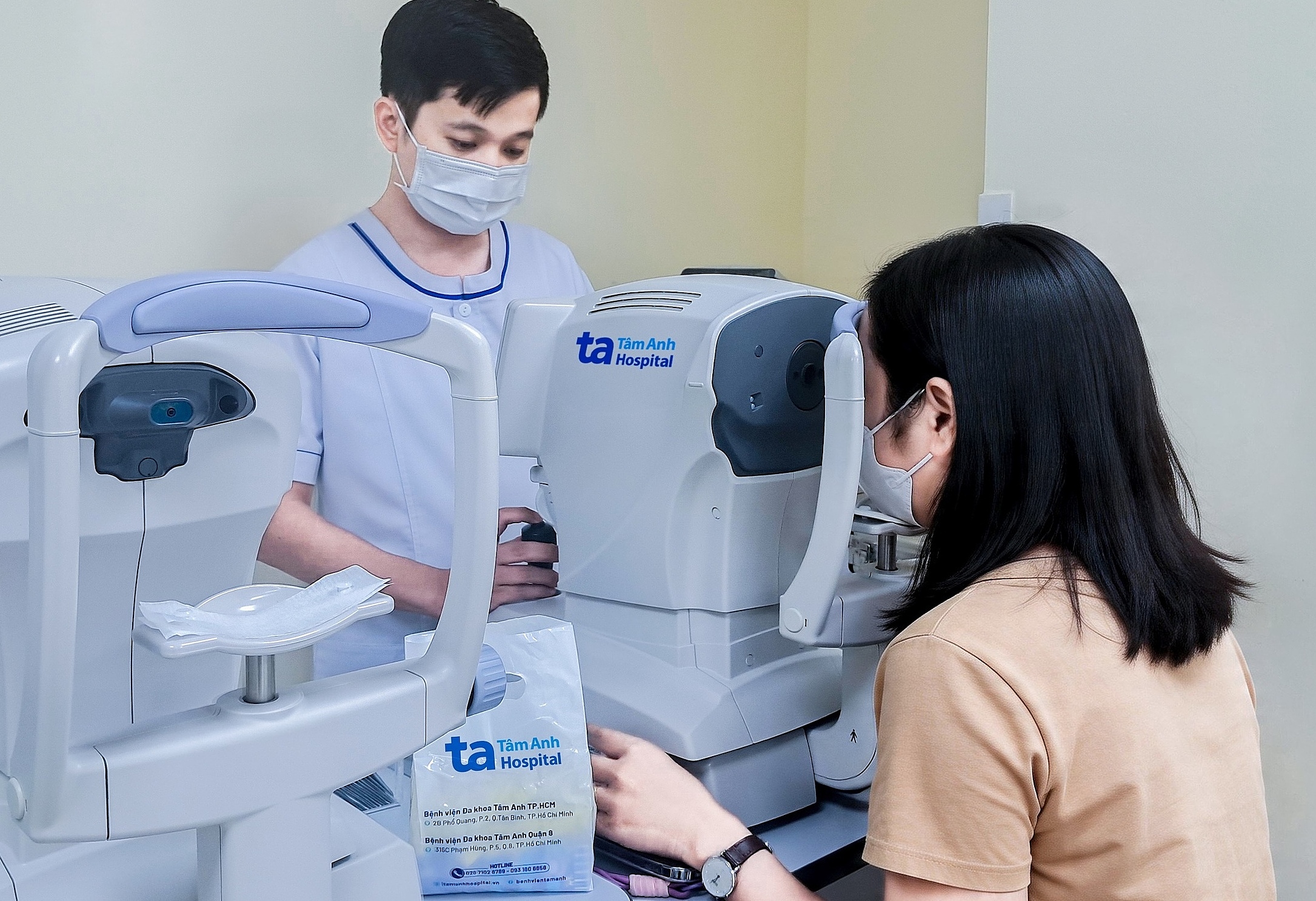 |
Linh undergoes a refractive error measurement before surgery. *Photo: Tam Anh General Hospital* |
Phakic ICL surgery can correct nearsightedness up to 18 diopters, farsightedness up to 10 diopters, and astigmatism up to 6 diopters, applicable to individuals aged 21-45. If necessary, the intraocular lens can be replaced to match updated refractive error parameters. ICL lenses are made from collamer (a combination of collagen and polymer), offering high biocompatibility, making them suitable for those working in aviation environments or who frequently travel by plane.
One week after her follow-up appointment, Linh's uncorrected vision in both eyes reached 10/10. Doctor Tung advised patients with thin corneas to monitor closely after surgery, limit strenuous work in the initial days, avoid rubbing eyes, intense physical activity, prolonged bending, and adhere to follow-up schedules. Should any abnormalities occur, such as pain, flashes of light, or "floaters" in the eye, immediate medical attention is necessary.
Individuals over 18 years old with stable refractive errors and no underlying eye conditions, who wish to correct their vision, can consider methods such as Lasik, Smile, or Phakic. Comprehensive pre-operative screening is essential to assess corneal thickness, structure, and the amount of residual tissue after surgery. Subsequently, doctors select the most suitable method, prioritizing minimally invasive techniques to preserve corneal tissue as much as possible.
Ngoc Kim Tham
*Character's name has been changed*
| Readers can submit questions about ophthalmic diseases here for doctors to answer. |