


Associate Professor, Doctor Vu Huu Vinh, Director of the Cardiovascular and Thoracic Surgery Center at Tam Anh General Hospital, Ho Chi Minh City, reported on Mr. Viet's condition. The patient's left renal artery was completely blocked, leading to a loss of function in his left kidney. Additionally, his right renal artery was severely narrowed by approximately 80%. This significant narrowing caused Mr. Viet's prolonged hypertension.
Prior to the intervention, Mr. Viet experienced progressive kidney failure. His glomerular filtration rate (GFR) had dropped to 30-35 ml/min/1.73 m2, which required him to undergo dialysis.
The medical team performed a revascularization procedure on Mr. Viet's right renal artery using a stent graft. Intervention on the left renal artery was not possible because it had been completely blocked for an extended period.
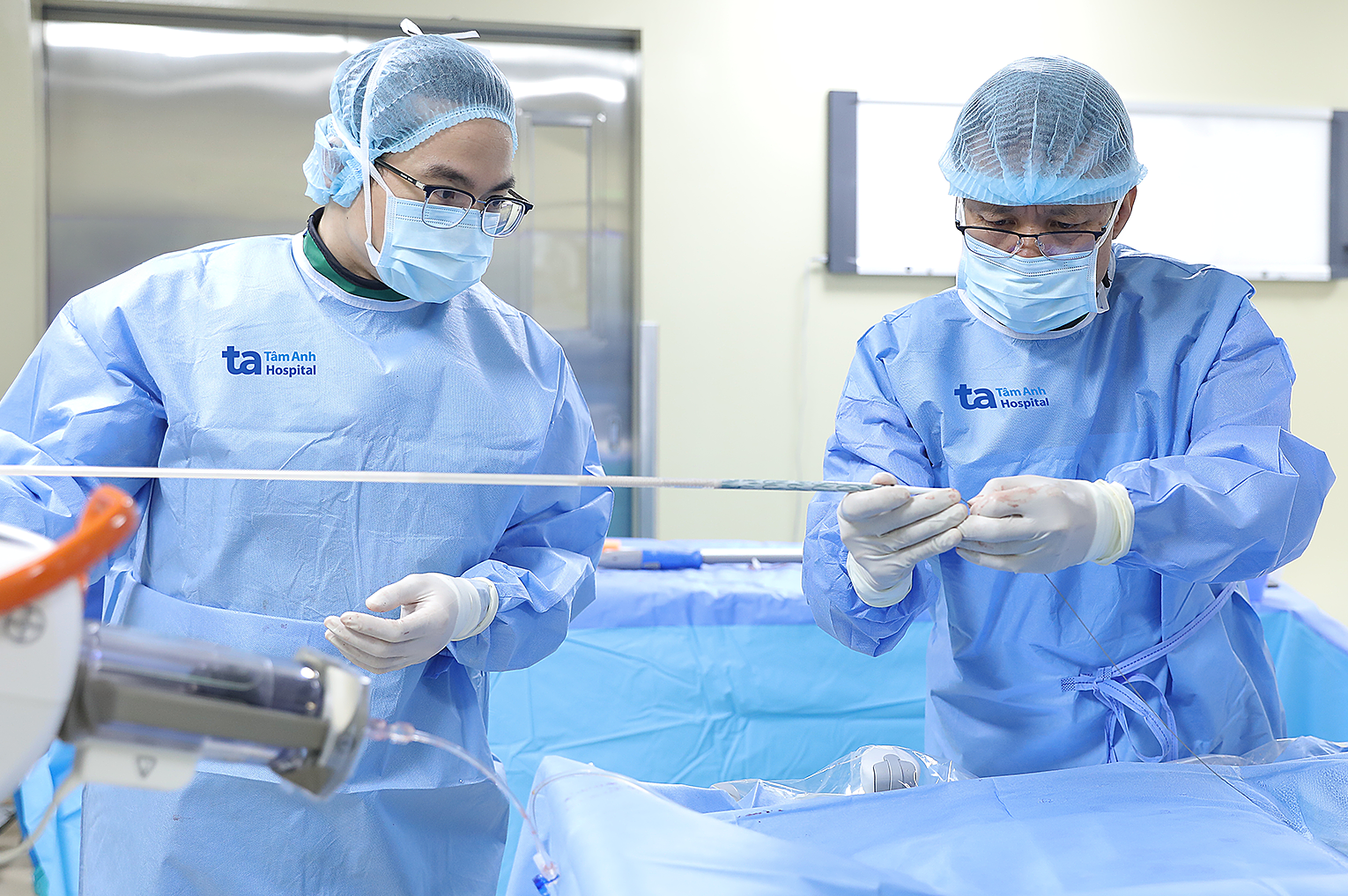 |
Associate Professor Vinh (right) and his team prepare to place a stent graft for the patient. *Photo: Tam Anh General Hospital* |
Associate Professor Vinh explained that the stenosis was located precisely at the renal artery's origin (orifice). This made stent placement challenging and increased the risk of stent displacement and complications after the intervention. To overcome this, the team employed a technique involving two overlapping stents. This method fully expanded the narrowed vessel and ensured a stable attachment.
Four days after the procedure, Mr. Viet's health stabilized, and his surgical pain decreased. He was subsequently discharged from the hospital. Within two to three months, his blood pressure readings returned to a normal range (below 130/90 mmHg). Furthermore, his kidney function improved, and his glomerular filtration rate increased to 80 ml/min/1.73 m2, significantly reducing his risk of stroke due to hypertension.
According to Associate Professor Vinh, renal artery stenosis progresses silently but poses a significant danger if overlooked. Many patients with high blood pressure are treated for years without success because the underlying cause is not correctly identified. Therefore, individuals with a history of difficult-to-control high blood pressure or unexplained kidney failure require specialized screening. Early detection of renal vascular lesions can prevent complications like stroke or permanent kidney failure.
Bao Anh
*Patient's name has been changed*
| Readers can submit questions about cardiovascular health here for doctors to answer |


