Mr. Nhat's right eye had 12 diopters of myopia and 2 diopters of astigmatism, while his left eye had 10 diopters of myopia. Without glasses, he could only count fingers at a distance of two meters with both eyes. Dr. Duong Minh Phuc, from the High-Tech Eye Center at Tam Anh General Hospital Ho Chi Minh City, stated that Mr. Nhat had a thin cornea, measuring 460 micrometers. This made him unsuitable for laser vision correction methods, leading to a recommendation for Phakic ICL surgery.
Mr. Nhat's eye parameters met the requirements for this surgical method. These included a normal endothelial cell density (2,500-3,000 cells/mm²), standard pupil size (2-4 mm), a stable refractive error for at least six months, and no other eye conditions such as glaucoma or corneal scarring.
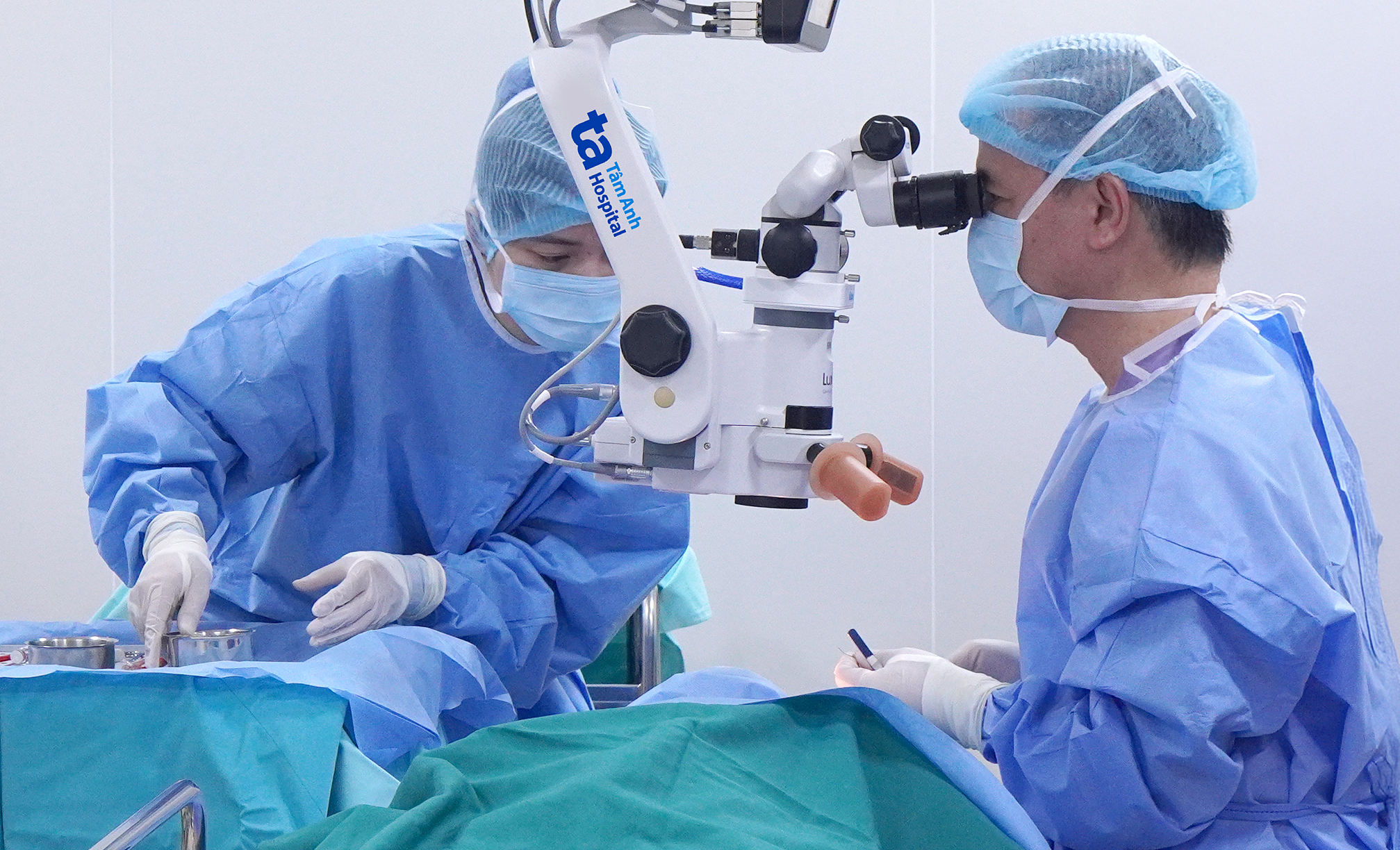 |
Doctors perform intraocular lens implantation surgery to correct Mr. Nhat's vision. Photo: Tam Anh General Hospital |
Phakic ICL is an intraocular lens implantation technique performed through a small incision, only about 2.2-2.8 mm, at the corneal limbus. Doctors use a specialized injector to gently insert the ultra-thin lens behind the iris and in front of the natural lens. This lens is custom-designed according to Mr. Nhat's specific myopia and astigmatism parameters to optimally correct his refractive error.
According to Dr. Phuc, this method can treat myopia up to 18 diopters, hyperopia 10 diopters, and astigmatism 6 diopters, making it suitable for individuals aged 21-45. The technique is minimally invasive, preserves the cornea, and is ideal for those with thin corneas, contributing to less discomfort after surgery and faster recovery. However, since the intraocular lenses are custom-designed for each person and must be ordered from Europe, the preparation time is often longer compared to other methods.
During a follow-up appointment one week later, Mr. Nhat's vision reached 10/10 in both eyes, and he was no longer dependent on corrective glasses.
Dr. Phuc advises that after Phakic ICL vision correction, patients should avoid rubbing their eyes, wear protective eyewear outdoors, limit strenuous activities during the first month, and adhere to their follow-up schedule. If any unusual symptoms appear, such as seeing floaters or flashes of light, immediate medical attention is necessary.
Currently, individuals over 18 years old with stable refractive errors and no other eye conditions can undergo surgery using methods such as Lasik, SMILE, or Phakic. Doctors provide personalized recommendations for the optimal method based on each individual's condition.
Ngoc Kim Tham
* Patient's name has been changed
| Readers can submit ophthalmology questions here for doctors to answer |