"When a patient requires an emergency liver transplant, we have only one option: mobilize maximum resources to save their life in the shortest possible time. This is truly a race against time," Doctor Ho Van Linh from the Department of Hepatobiliary-Pancreatic Surgery shared after a rapid emergency liver transplant on 14/2/2014, the 27th day of the lunar December, just three days before Tet.
The 65-year-old patient, from Hai Phong, had been diagnosed with primary sclerosing cholangitis with cirrhosis three years prior. Recently, her liver function rapidly deteriorated. On 13/2, her condition worsened suddenly, leading to hepatic coma and a very high risk of death.
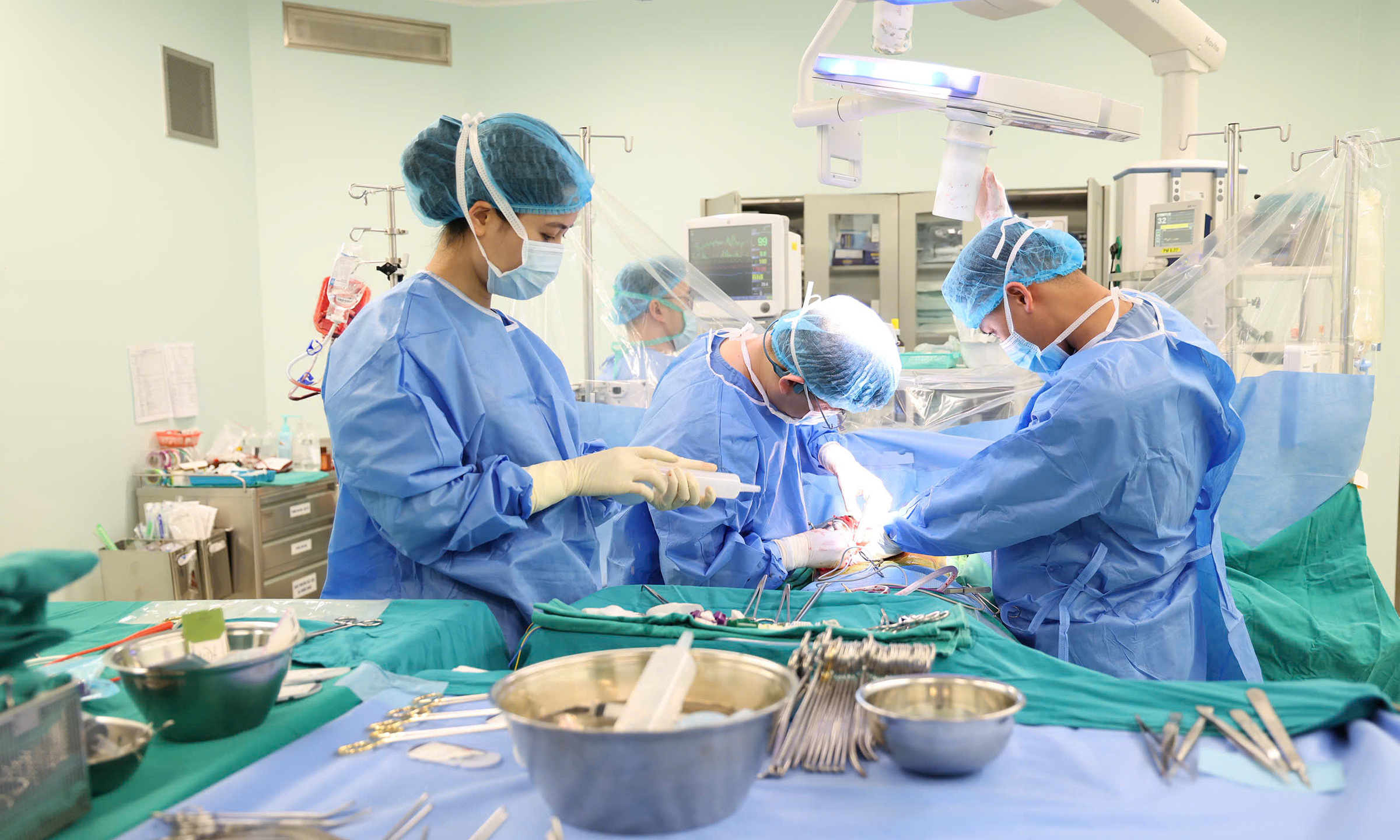 |
Doctors perform a liver transplant to save the patient. Photo: Mai Chi.
On the morning of 14/2, the hospital organized an urgent consultation involving leading experts, chaired by Professor Doctor Le Huu Song, Director of the hospital. The consensus was that an emergency liver transplant was the only measure to save the patient's life and could not be delayed.
The hospital's liver transplant team was immediately recalled. Many who were on leave, already home, or even traveling, promptly returned to the hospital to prepare for the surgery. "For the medical team, a patient's life is always the highest priority, even on the eve of the New Year," Professor Song stated.
The transplant lasted six continuous hours, demanding near-absolute precision and seamless coordination among the surgical, anesthesia and resuscitation, and post-transplant intensive care teams. Notably, the liver graft was retrieved from a living donor using laparoscopic surgery – one of the most complex techniques in surgical practice. This procedure requires in-depth experience from the surgeons, meticulous manipulation, and modern, synchronized equipment.
Compared to traditional open surgery, the laparoscopic method offers the donor less pain, reduced invasiveness, a shorter recovery time, and a better aesthetic outcome, while maintaining comparable graft quality. Globally, only a few leading liver transplant centers in the United States, Europe, Japan, and South Korea routinely perform this technique.
After surgery, the patient was closely monitored. Her health has stabilized, graft liver function is recovering well, and vital signs are strictly controlled.
Previously, in late 2025 and early 2026, the hospital also successfully performed a liver retrieval and transplant from a brain-dead donor, and a multi-organ transplant from a healthcare worker organ donor, reviving five other patients.
Le Nga