Forgetfulness describes situations such as forgetting one's name, the way home, or misplacing objects. In contrast, the early stages of dementia often present with mild symptoms, closely resembling ordinary forgetfulness. This similarity leads to many people confusing the two, causing them to miss the opportunity for early detection and intervention.
Doctor Than Thi Minh Trung, a specialist in neurology and deputy head of the Neuroscience Center at Tam Anh General Hospital TP HCM, identifies five signs of dementia that are easily confused with common forgetfulness.
Getting lost in familiar places
Patients may forget the way to frequently visited places, be unable to determine their current location, or not know how to return home. This situation occurs because their spatial orientation ability is affected. Families often notice this sign when a patient goes to the market, visits relatives, or goes to a familiar place but suddenly does not know where they are.
 |
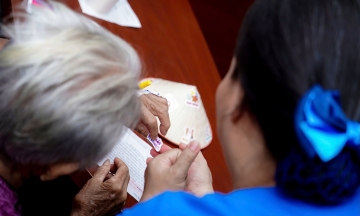
A doctor checks the cognitive abilities and screens for dementia in an elderly person. Photo: Tam An General Hospital
Forgetting recent events
Patients may clearly remember events from many years ago but quickly forget a recent conversation, what they just ate, what they just did, or repeatedly ask the same question. Unlike common forgetfulness, people with dementia may not remember having asked or recounted a piece of information and will continue to repeat it.
Not remembering time clearly
Another early sign is that patients frequently confuse the day, month, or year, or do not know what time of day it is. If someone occasionally forgets but quickly remembers afterward, this condition is usually not a concern. Conversely, frequently losing orientation regarding time can be a sign of dementia that requires evaluation.
Difficulty performing familiar tasks
A person who once cooked, used a phone, managed money, or drove skillfully but begins to struggle with familiar actions may be experiencing cognitive problems. Patients might forget the sequence of steps, not know how to use everyday objects, or take much longer to complete tasks.
According to Doctor Trung, this is an important distinguishing sign compared to common forgetfulness. People with common forgetfulness usually temporarily forget one step but can recall it later, while people with dementia no longer know how to perform or struggle with a familiar task.
Changes in personality and behavior
Dementia not only affects memory but can also alter emotions and behavior. Patients may become irritable, suspicious of others, withdraw, become apathetic, or lose interest in activities they once enjoyed. Some people exhibit unusual behaviors but do not recognize the change themselves.
Doctor Trung recommends that individuals who frequently experience these signs should undergo dementia screening as advised by a doctor. Early detection helps identify the cause, treat potentially reversible factors, and develop a plan to slow disease progression, maintain independence, and improve quality of life.
Doctors examine and assess memory, orientation, language, thinking, and other cognitive functions. Depending on the case, patients may be prescribed tests, a brain MRI, or other specialized evaluations to determine the cause.
Dementia treatment depends on the cause and severity of the disease, and may include medication, management of cardiovascular risk factors, cognitive training, and rehabilitation. Families need to support patients in daily activities, reduce the risk of falls, getting lost, and accidents, and monitor symptom progression.
Trong Nghia
| Readers can submit questions about neurological diseases here for a doctor's response |