Chest X-ray results at Tam Anh General Hospital in Ho Chi Minh City revealed that Hong had mild scoliosis to the left, with her heart shadow shifted to the right and the aortic arch located on the right side of her spine.
Doctor Nguyen Thi Minh Hien, a specialist in pediatrics at Tam Anh General Hospital in Ho Chi Minh City, ordered a comprehensive echocardiogram. The results confirmed mild tricuspid valve regurgitation, which currently does not require intervention. The family received advice on regular health monitoring. Hong needs to see a doctor promptly if she experiences symptoms such as fatigue, shortness of breath, cyanosis, fainting, or reduced physical activity.
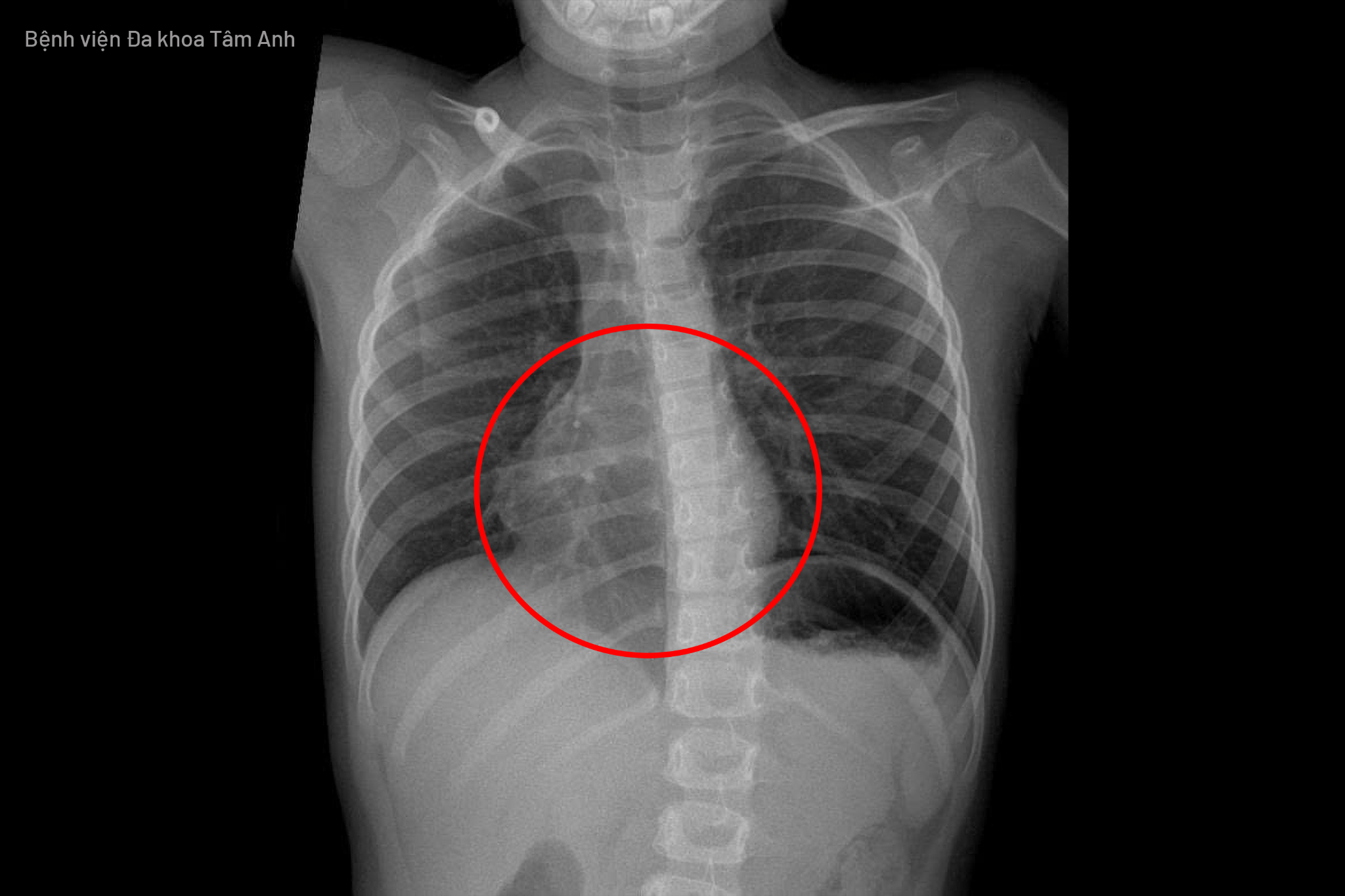 |
X-ray results showed Hong had scoliosis to the left, with her heart shadow shifted to the right. Photo: Tam Anh General Hospital |
According to Doctor Hien, some abnormalities in children may not cause clear symptoms, especially when mild. Scoliosis is an easily overlooked condition because children can still play and carry out daily activities normally without pain. If not addressed early, the condition can worsen significantly during periods of rapid growth.
Parents can observe signs when their child stands upright, such as uneven shoulders, one shoulder blade protruding more than the other, asymmetrical waistlines, a leaning torso, or an abnormal spinal curve. Depending on the case, doctors may order a spinal X-ray and measure the spinal curvature using the Cobb angle to determine the severity of the scoliosis, which then guides appropriate monitoring or treatment.
For Hong, the doctor advised the family to take her to a pediatric surgery specialist for a detailed evaluation of her scoliosis and ongoing monitoring during her development.
 |
Doctor Hien examines six-year-old Hong. Photo: Tam Anh General Hospital |
Doctor Hien noted that in Hong's case, routine tests yielded normal results, while imaging diagnostics uncovered additional abnormalities that had not yet manifested externally. Therefore, parents should arrange regular health check-ups for their children throughout each growth stage, from infancy to school age (especially before puberty). This helps monitor physical and intellectual development and enables early detection of any abnormalities.
Children from six years old enter a period of rapid physical development and require monitoring of growth, nutrition, vision, ear-nose-throat, dental health, spine, and cardiovascular system. Issues such as micronutrient deficiencies, overweight, refractive errors, scoliosis, or certain cardiovascular abnormalities may not be immediately apparent. Regular health check-ups help detect these problems early, allowing for timely monitoring or intervention.
Minh Tam
* Patient's name has been changed
| Readers can submit questions about children's illnesses here to receive doctor's answers |