"Like a miracle", Hai said on 22/5, holding her two sons, nearly 5 months old, who are developing stably after facing the risk of losing both fetuses due to twin-to-twin transfusion syndrome.
 |
Hai's two sons. Photo: Provided by subject |
Hai conceived twins naturally. During a 16-week prenatal check-up in Japan, doctors suspected twin-to-twin transfusion syndrome. At that time, one fetus had polyhydramnios and the other oligohydramnios, but the mother showed no unusual symptoms. Doctors recommended monitoring the high-risk pregnancy and surgical intervention if necessary.
Upon returning to Vietnam, an ultrasound at the 17th week of pregnancy confirmed the monochorionic, diamniotic twin pregnancy was at stage II of twin-to-twin transfusion syndrome, with an anterior placenta.
Doctor Nguyen Huu Cong, from the Obstetrics and Gynecology Center at Tam Anh General Hospital in Hanoi, noted that one fetus had completely lost amniotic fluid, with no visible bladder. The other fetus had a maximum amniotic pocket depth of 63 mm, and the size difference between the two fetuses was approximately 35%.
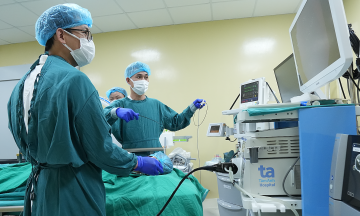
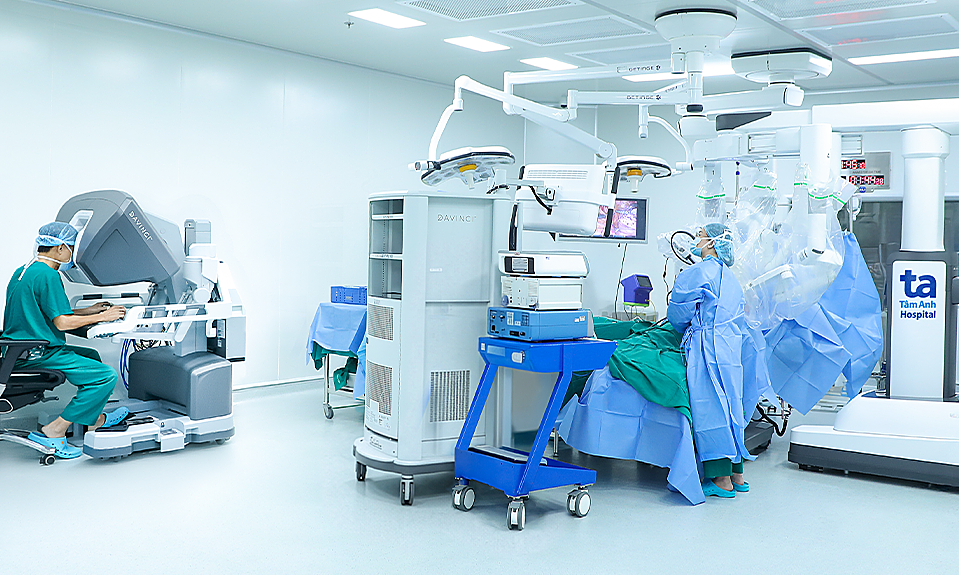
Doctors performed a laser endoscopic amniotic surgery to save the two fetuses. The surgery presented challenges due to the small size of the pregnant woman's uterus, a narrow surgical field, and the anterior placenta, which complicated access to the amniotic cavity.
The team utilized specialized fetal intervention instruments to clearly identify all abnormal communicating blood vessels between the two fetuses. A dedicated laser was used to precisely ablate each connecting vessel. In total, 7 abnormal vascular connections between the two fetuses were treated, completely severing the communicating blood flow. This separated the circulatory systems of the two fetuses, allowing each to develop independently. Concurrently, the team performed amniocentesis on the recipient fetus to reduce pressure within the amniotic cavity.
Post-surgery, the amniotic membrane remained intact, fetal heart rates were stable, and the blood volume and amniotic fluid levels between the two fetuses gradually balanced. One week later, the mother recovered well, the circulation of both fetuses significantly improved, amniotic fluid levels returned to a safe range, and all indicators were stable.
Throughout the pregnancy, doctors monitored fetal heart rate and brain using ultrasound and MRI, detecting no abnormalities. At the 35th week of pregnancy, doctors identified an abnormal fetal heart rhythm, prompting an elective C-section. Two healthy baby boys were born, weighing 1,9 kg and 2,6 kg, and received care in an incubator for three days.
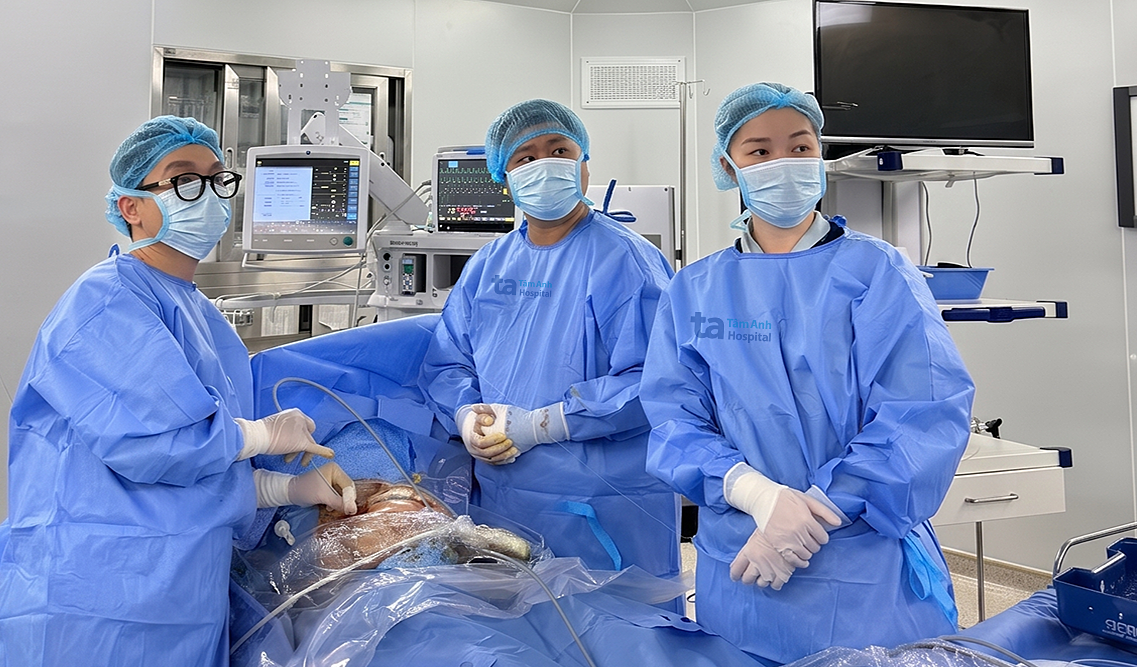 |
Doctor Cong and his team performing surgery on Hai. Photo: Tam Anh General Hospital |
Twin-to-twin transfusion syndrome (TTTS) occurs in identical twins who share a single placenta. It arises from vascular connections within the placenta, causing blood to transfer from a "donor" twin to a "recipient" twin. This leads to the donor twin experiencing anemia and delayed growth, while the recipient twin suffers from circulatory overload, increasing the risk of heart failure and polyhydramnios.
This syndrome often progresses silently with few symptoms. When a pregnant woman experiences abdominal distension, the condition is usually already in a late stage, carrying a high risk of fetal mortality. The most effective time for intervention is between 16 and 26 weeks, particularly before 20 weeks.
Laser endoscopic amniotic surgery is currently the only technique that directly addresses the cause of the disease. Pregnant women carrying monochorionic twins must adhere to a schedule of regular prenatal check-ups. From the 16th week, pregnant women should undergo a doppler ultrasound once every two weeks to detect early signs of abnormality.
Trinh Mai
*Patient's name has been changed
| Readers can send questions about obstetrics and gynecology here for doctors to answer |