Mr. Hoan occasionally experienced mild bloating after meals, which resolved on its own. During a routine health check-up, as he belonged to an at-risk age group, doctors recommended he undergo a gastroscopy.
Associate Professor Doctor Vu Truong Khanh, Head of the Department of Gastroenterology - Hepatobiliary - Pancreatic at Tam Anh General Hospital Hanoi, performed the gastroscopy for Mr. Hoan. The procedure revealed a flat lesion with a small erosion on its surface in the stomach antrum. Biopsy results confirmed it was an early-stage adenocarcinoma, occurring on a background of chronic gastritis with mucosal atrophy and intestinal metaplasia.
Thanks to the very early detection of the cancer, with the lesion confined to the mucosal layer, not deeply invasive, and showing no signs of spreading, Mr. Hoan received treatment using endoscopic submucosal dissection (ESD). This minimally invasive method completely removes the lesion, reduces pain, limits complications, and shortens recovery time.
According to Doctor Khanh, if cancer is detected at a later stage, when the tumor has invaded deeper tissues, patients typically require a gastrectomy, which carries a higher risk of complications and a longer recovery period.
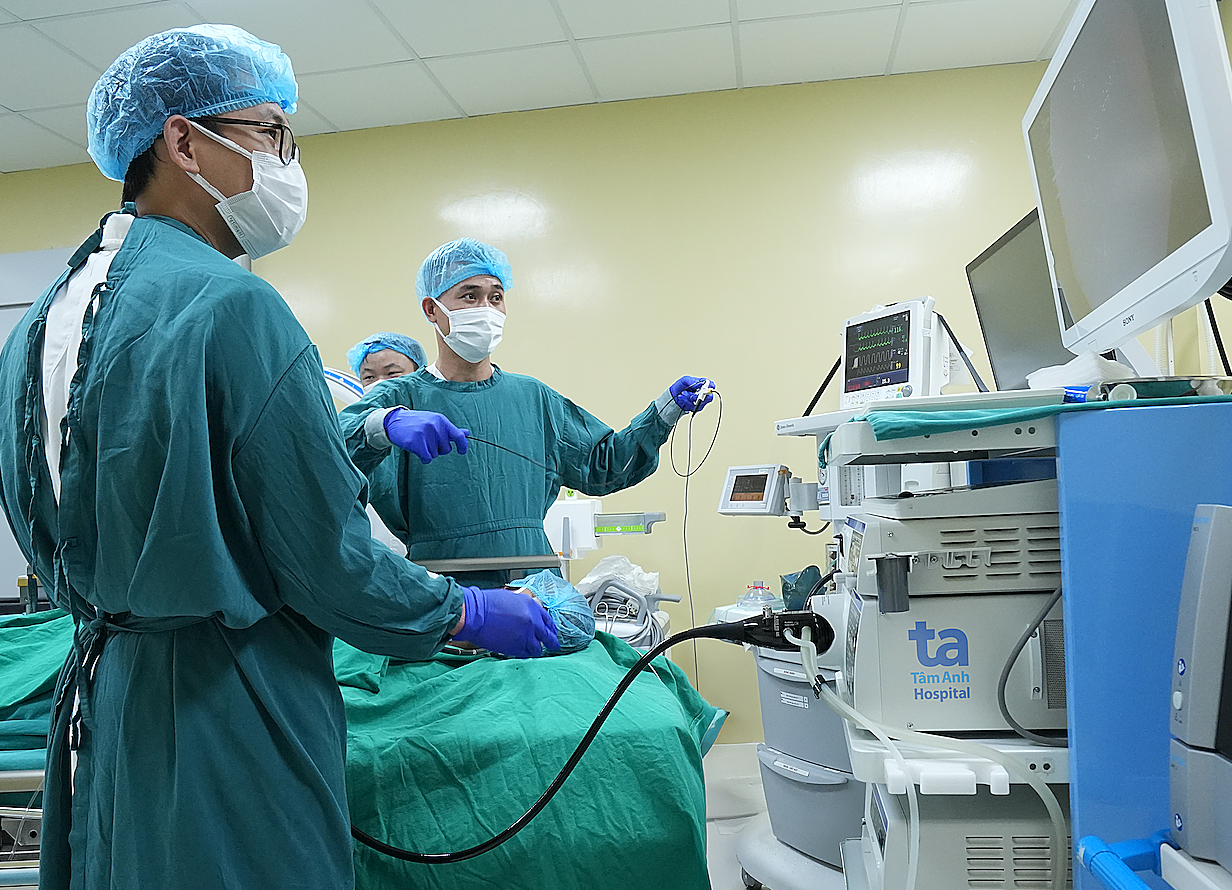 |
The endoscopic submucosal dissection (ESD) team removes the entire lesion for the patient. Photo: Tam Anh General Hospital |
The endoscopic submucosal dissection (ESD) team removes the entire lesion for the patient. Photo: Tam Anh General Hospital
Post-intervention histopathology results indicated that the stomach lesion was a very early-stage adenocarcinoma, approximately 1,8 cm in size (pT1a). The tumor invaded the mucosal layer, with no vascular or neural invasion noted, and the resection margins were clear, showing no residual cancer cells.
Following the procedure, Mr. Hoan recovered quickly. He experienced no abdominal pain, resumed normal eating, and was discharged after one week. The endoscopic dissection achieved the goal of radical treatment, meaning the patient did not require chemotherapy.
Early-stage stomach cancer often presents with no symptoms or non-specific symptoms such as bloating and indigestion, which are easily mistaken for common digestive ailments.
Doctor Khanh advises individuals aged 40-45 to proactively undergo gastroscopy for screening, even without symptoms. High-risk individuals, such as those with gastric mucosal atrophy, intestinal metaplasia, or a family history of gastrointestinal cancer, should undergo regular health check-ups and screening as advised by doctors.
When detected at a very early stage, stomach cancer can be radically treated endoscopically, without the need for surgery or chemotherapy. At advanced stages, patients may have to undergo major surgery combined with chemotherapy.
Ly Nguyen
*Patient's name has been changed
| Readers can submit questions about digestive diseases here for doctors to answer. |