Dr. Nguyen Huu Quang, Deputy Head of the Department of Plastic, Aesthetic Surgery and Rehabilitation, reported that the hospital's melanoma clinic has admitted about 15 cases since early 2026. The woman is one of three recent patients diagnosed with foot cancer. All three cases began with small lesions that patients mistakenly self-treated as common skin conditions.
The patient, a farmer frequently wading in water, observed a minor ulcer with dark pigmentation between her toes. She then applied antifungal medication for an extended period. As the ulcer spread and oozed, a biopsy confirmed it was melanoma, the most aggressive form of skin cancer.
A second patient, a woman over 65, developed a rough black streak on her heel after stepping on a sharp stone. She mistook it for a bruise and used a pumice stone on her cracked heel, which exacerbated the lesion and intensified the calluses.
The third patient, a man nearly 89, discovered a patchy black-brown lesion on the sole of his foot when family members washed and trimmed his nails. The lesion caused no itching or pain, so he was unaware of its onset.
Dr. Quang noted that all three patients were diagnosed with acral lentiginous melanoma, a tumor type that grows on the soles of the feet, palms of the hands, and under the nails. These foot locations are often obscured by footwear and less frequently inspected, leading patients to overlook them or confuse them with calluses, bruises, or foot fungus.
Between 2020 and 2026, the Central Dermatology Hospital recorded over 100 cases of skin melanoma, with an average patient age of 60. Females constituted over 56% of cases. Approximately 90% of tumors were located on the feet and toenails, and over 70% of lesions were already ulcerated. Acral lentiginous melanoma alone accounted for over 94% of these cases.
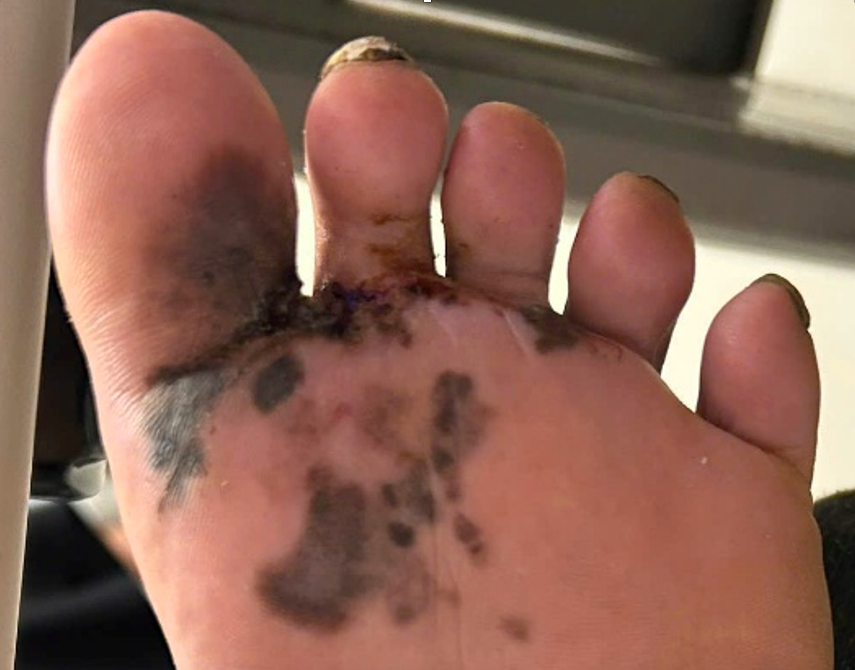 |
A dark patch on the foot can be a warning sign of cancer. *Photo: Hospital provided* |
Globocan data from 2024 indicates nearly 338,000 new cases of skin melanoma and over 58,000 deaths worldwide. Acral lentiginous melanoma accounts for a large proportion among Asian populations. The disease begins as small pigmented spots, then penetrates the epidermis, and can metastasize to lymph nodes and internal organs. Early detection allows for surgical removal of the lesion. In later stages, patients require a combination of immunotherapy or targeted drug therapy.
Experts recommend regular skin checks, focusing on the soles of the feet, between the toes, and around the nails. Tumor warning signs follow the ABCDE rule, including: asymmetrical skin patches, irregular borders, mixed colors (various shades of black and brown), large size, and a tendency to spread over time. Any dark spots causing itching, burning, cracking, bleeding, oozing, or rapid growth warrant examination by a specialist.
If a suspected fungal infection or bruise does not fade after several weeks, patients should stop self-treating and seek medical attention for dermoscopy and a histopathological biopsy to promptly identify any malignant cells.
Le Nga