When the tumor was first detected, tests indicated a low risk of cancer, so Ms. Hien underwent regular monitoring. Follow-up ultrasound and magnetic resonance imaging (MRI) at Tam Anh General Hospital, Ho Chi Minh City, revealed a solid left ovarian cyst, classified as O-RADS 5 (Ovarian-Adnexal Reporting and Data System, for assessing malignancy risk in ovarian and adnexal masses), along with multiple uterine fibroids and free fluid in the abdominal cavity.
Master of Science, Doctor Nguyen Thi Quy Khoa, Deputy Head of the Obstetrics Department at the Center for Obstetrics and Gynecology, stated that a rapidly progressing solid ovarian tumor in women who have been post-menopausal for many years can be an abnormal sign. Normally, ovaries reduce hormone secretion and atrophy after menopause.
Ms. Hien had been post-menopausal for 6 years, and her ovarian tumor exhibited complex characteristics such as a solid tissue type, a rough capsule, and significant vascular proliferation. Doctors assessed a high risk of malignancy, though there remained a possibility of it being a benign tumor with "pseudo-malignant features on imaging".
Doctor, Second Degree Specialist Nguyen Ba My Nhi, Director of the Center for Obstetrics and Gynecology, and her team performed a total hysterectomy, removed both ovaries and fallopian tubes, along with the greater omentum (a part of the peritoneum that surrounds digestive organs) for cell biopsy. Post-operative results confirmed the tumor was benign, measuring 6x6x8 cm. Ms. Hien recovered well, was discharged after about 4 days, and continues with regular check-ups.
 |
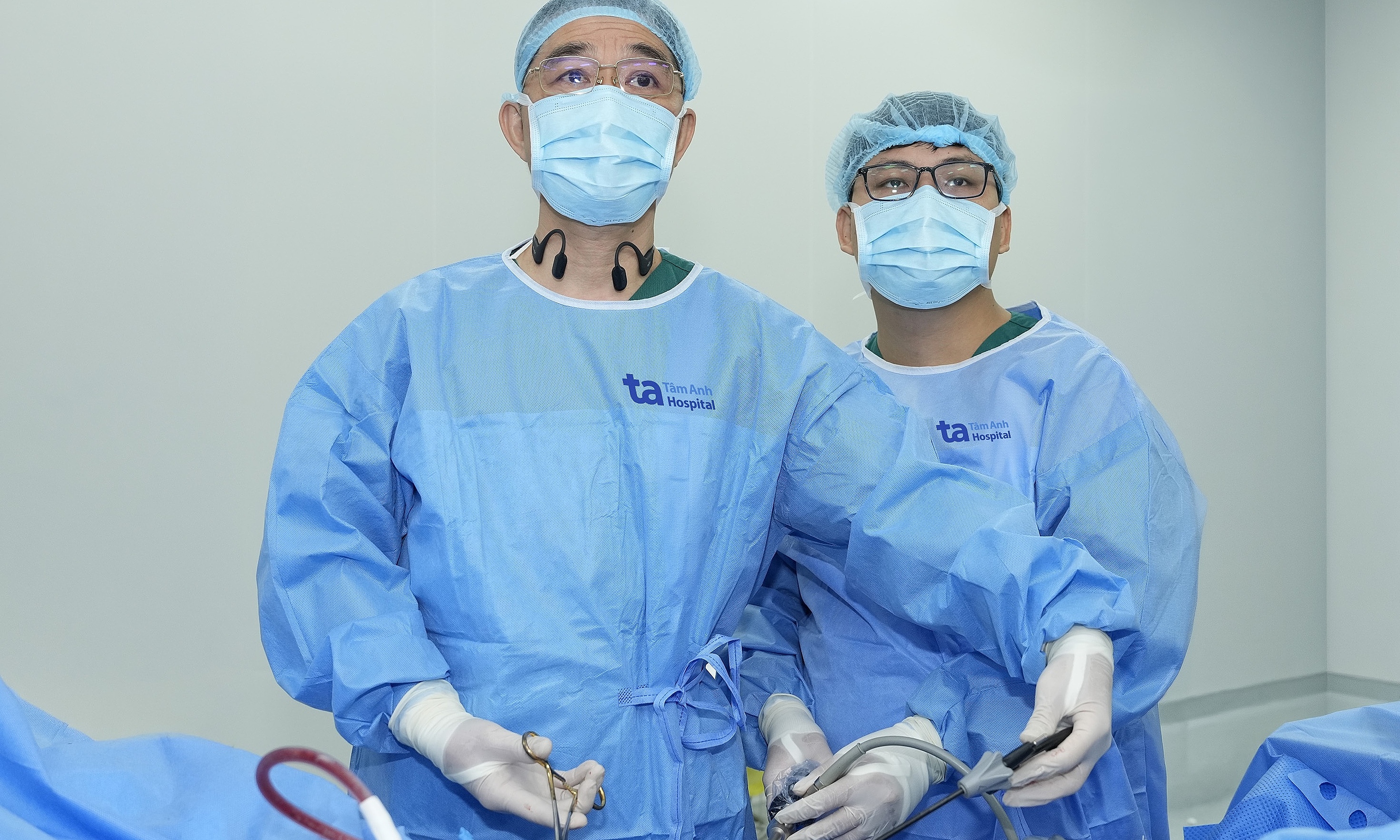
The medical team from the Center for Obstetrics and Gynecology performing surgery on a patient. Photo: Tam Anh General Hospital |
Solid ovarian tumors, also known as solid ovarian cysts (as opposed to fluid-filled cysts), can be found on one or both ovaries. This type of tumor can be benign, borderline malignant, or malignant (ovarian cancer).
The exact cause of the disease is not clearly identified. High-risk factors for the malignant nature of a tumor include menopausal age, chronic endometriosis, a history of breast cancer, colorectal cancer, or inherited diseases. The condition often progresses silently, with symptoms that are typically vague. Many cases are discovered incidentally during routine medical examinations or periodic ultrasounds.
When the tumor grows large, patients may experience symptoms such as abdominal or pelvic pain, abdominal distension, bloating, early satiety, and a palpable hard mass in the lower abdomen. If the tumor compresses the bladder, it can lead to frequent or painful urination; if it compresses the rectum, it can cause constipation or painful bowel movements. Pain during sexual intercourse, menstrual irregularities, and abnormal vaginal bleeding, especially bleeding after menopause, are also related symptoms.
Treatment for solid ovarian tumors depends on the tumor's size, symptoms, and the patient's overall health. For small tumors, patients are typically monitored with regular ultrasounds and gynecological examinations. In cases of large or symptomatic tumors, doctors may surgically remove the mass. If histopathology confirms ovarian cancer, the patient may require additional chemotherapy after surgery.
Doctor Khoa recommends that women in general, and peri-menopausal or post-menopausal women in particular, undergo gynecological examinations every 12 months to screen for dangerous conditions. If symptoms such as rapid abdominal enlargement, abdominal or pelvic pain, or abnormal vaginal bleeding or discharge appear, patients should seek immediate medical attention.
Ngoc Chau
*Patient's name has been changed
| Readers can submit questions about obstetrics and gynecology here for doctors to answer |