Tam's neck had been swollen for almost two months. She only sought medical attention when she experienced difficulty breathing and more pronounced swelling. A CT scan at Tam Anh General Hospital in Ho Chi Minh City revealed a 13x10 cm mediastinal lymph node (in the chest) compressing her airway, along with fluid in the pericardial space, and numerous lymph nodes in her supraclavicular region and on both sides of her carotid sheath. A pleural biopsy and immunohistochemistry confirmed non-Hodgkin lymphoma, large B-cell type, Burkitt lymphoma, poorly differentiated, with a primary mediastinal origin.
Doctor Nguyen Tran Anh Thu, a specialist in oncology from the oncology center, stated that Tam's condition was stage 4A, rapidly progressing. Lymph nodes were present in the anterior mediastinum, neck, and armpits, with pancreatic and lung invasion, and a right pulmonary artery thrombus.
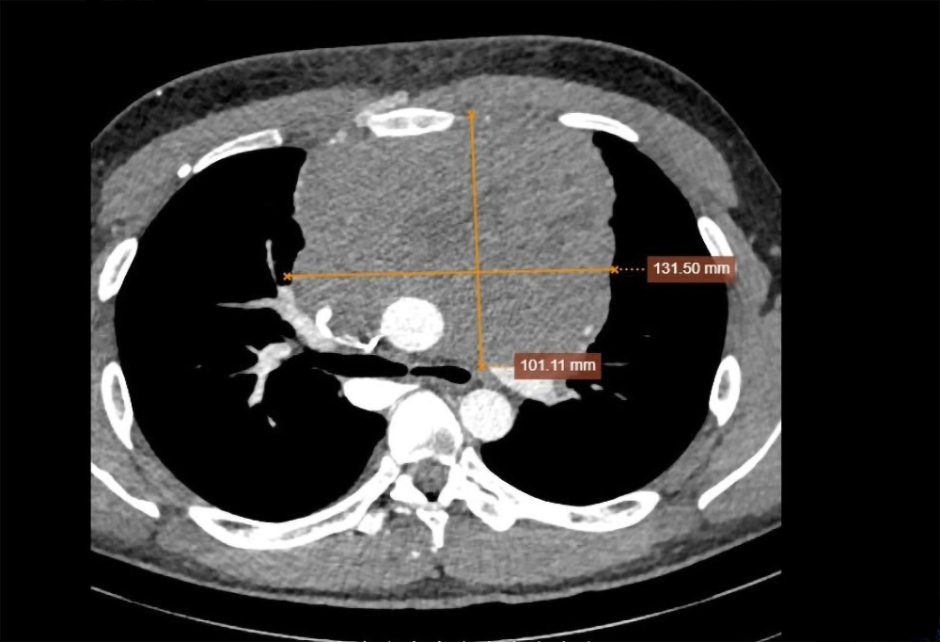 |
Lymph node in Tam's mediastinum at the initial stage. Photo: Tam Anh General Hospital |
Following a consultation, doctors decided on a chemotherapy regimen combined with immunotherapy.
According to doctor Thu, compared to typical chemotherapy regimens involving two or three types of drugs, Tam's treatment plan uses six types. The specific agents in the medication strongly break down tumor DNA, proving effective against rapidly proliferating cancer cells. However, the drugs carry significant side effects, including a risk of granulocytopenia, anemia, and thrombocytopenia. Therefore, doctors must adjust the dosage for each chemotherapy cycle while also administering prophylactic medication for granulocytopenia.
Each chemotherapy cycle is spaced three weeks apart. Before each cycle, Tam undergoes blood tests to assess drug tolerance, allowing doctors to adjust the dosage. This ensures the maximum amount of chemotherapy the patient can withstand, optimizing cancer cell destruction without excessive toxicity or negative impacts on surrounding organs.
After two cycles, Tam's neck swelling decreased. Following 4 chemotherapy regimens, a CT scan showed a 50% reduction in lymph node size. The patient needs two more chemotherapy cycles.
 |
Doctor Thu consults Tam on the combined chemotherapy and immunotherapy regimen. Photo: Tam Anh General Hospital |
Lymphoma results from the uncontrolled division of lymphocyte white blood cells. According to Globocan 2022, Vietnam recorded over 3,500 new cases of non-Hodgkin lymphoma, causing more than 2,200 deaths.
The disease has two main types: non-Hodgkin lymphoma and Hodgkin lymphoma. It can be well-controlled in early stages. However, most patients are diagnosed at late stages due to a lack of symptoms, making treatment difficult and prognosis poor.
Doctor Thu noted that the average age of onset for the disease is typically between 50 and 60 years old. The cause of lymphoma in young people is not yet clear. However, several risk factors include: bacterial infections (Chlamydia psittaci, Campylobacter jejuni), viral infections (Epstein-Barr, CMV, HIV), thymoma, immune deficiencies such as organ transplants, rheumatoid arthritis, and exposure to chemicals or pesticides in the workplace. These factors can contribute to DNA alterations in lymphocytes.
Doctor Anh Thu advises everyone to eat a nutritious diet, exercise regularly, and limit alcohol and stimulants to boost health, reduce inflammation, and lower the risk of immune-deficiency related diseases.
Individuals working in polluted environments or exposed to chemicals should use proper protective gear and undergo regular health check-ups at medical facilities with modern equipment for early detection and timely treatment.
Nguyen Tram
*Patient's name has been changed
| Readers can submit questions about cancer here for doctors to answer |