Doctor Nguyen Huu Khanh, from the Neurology Department, Neuroscience Center, Tam Anh General Hospital, Ho Chi Minh City, states that approximately 20-25% of stroke cases occur while patients are sleeping or are only discovered after waking up. This is known as a wake-up stroke, a dangerous type of stroke due to the difficulty in precisely determining the onset time.
Ischemic stroke occurs when a blood clot blocks a cerebral blood vessel, cutting off oxygen and nutrient supply to the downstream brain region. While patients sleep, symptoms often develop silently, preventing prompt recognition. This prolonged lack of blood flow for hours kills millions of nerve cells, resulting in more extensive damage than in cases detected early.
In hemorrhagic stroke, blood leaks from a blood vessel and flows into the brain parenchyma, increasing intracranial pressure and compressing vital brain structures. Sleeping patients may not perceive severe headaches or abnormal neurological signs, leading to delayed hospitalization when they are already comatose or have severe brain damage.
According to Doctor Khanh, besides being difficult to detect, wake-up strokes also present doctors with many treatment challenges. Most revascularization methods, such as administering thrombolytic drugs or performing mechanical thrombectomy, depend on the onset time. With wake-up strokes, doctors only know the last time the patient was healthy before going to bed, while the stroke might have occurred many hours earlier.
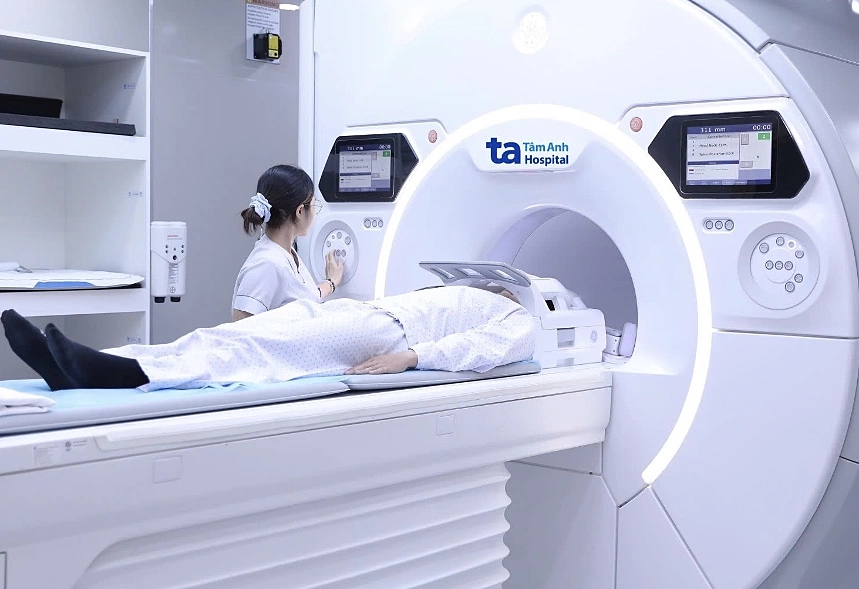 |
3 Tesla MRI imaging helps shorten scan time, providing fast and accurate results for stroke patients. Illustration: Tam Anh General Hospital |
At night, the body undergoes several physiological changes, such as reduced blood pressure, slowed heart rate, and altered blood circulation. In individuals with hypertension, diabetes, atrial fibrillation, atherosclerosis, or dyslipidemia, these changes can promote blood clot formation or destabilize atherosclerotic plaques, leading to cerebral artery blockage.
Conditions like sleep apnea, prolonged loud snoring, hypoxemia, or dehydration after many hours of sleep also contribute to an increased risk of stroke at night. Individuals with sleep apnea syndrome face a significantly higher stroke risk compared to the general population.
Unlike typical emergency stroke cases, which often start with a brain CT, wake-up stroke patients may undergo a 3 Tesla MRI scan first. This precisely identifies damaged and salvageable brain tissue. Modern MRI systems shorten scanning time, providing quick, high-resolution results. This aids doctors in fully assessing the brain's condition, even without a precise onset time, allowing them to decide on treatment with thrombolytic drugs or mechanical thrombectomy, thus improving patient recovery.
To reduce wake-up stroke risk, doctors advise managing underlying conditions, maintaining a healthy weight, limiting tobacco and alcohol, and getting sufficient sleep. Individuals who frequently snore loudly, experience daytime sleepiness, or suspect sleep apnea should seek early medical evaluation for diagnosis and treatment.
If, after waking up, symptoms such as facial drooping, limb weakness or paralysis, difficulty speaking, blurred vision, or severe headache appear, patients should go to a hospital with a neurology specialty for examination.
Stroke risk factors, including carotid artery stenosis, cerebral vascular malformation, cerebral aneurysm, or silent cerebral ischemia, can be detected early through 3 Tesla MRI, 1975-slice CT, or 100,000-slice CT scans. Regular screening helps doctors assess risk and implement preventive treatment before an event occurs.
Trong Nghia
| Readers can ask questions about neurological conditions here for doctors to answer. |