The Supreme People's Court has issued a clarification addressing issues raised by lower courts during the trial of cases involving violations of road traffic regulations. This guidance aims to standardize the interpretation and application of law across the judicial system.
The clarification stems from a specific scenario presented by a lower court: a defendant claimed they had not consumed alcohol before driving. Expert analysis confirmed an alcohol concentration of 0,282 mg/100 ml in their blood, but the source of the alcohol could not be determined. Consequently, the lower court questioned whether the framing detail under point b, clause 2, Article 260 of the Penal Code could be applied in such a case. This regulation applies to situations where a person is "under the influence of alcohol, with an alcohol concentration in their blood or breath exceeding the prescribed limit".
In its written response, the Supreme People's Court stated that this detail should only be applied when there is evidence to confirm the defendant was "under the influence of alcohol". Therefore, to apply this framing detail, expert conclusions must clearly identify whether the alcohol concentration in the blood resulted from alcohol consumption, or other evidence must prove that the offender consumed alcohol. The court clarified, "If there is no basis to determine that the offender consumed alcohol, this detail should not be applied." This guidance underscores that the presence of alcohol concentration in the blood does not automatically mean the offender consumed alcohol.
Commenting on the guidance, lawyer Vu Tien Vinh (Bao An Law Firm, Hanoi) noted that the Penal Code has consistently defined an aggravating circumstance as being "under the influence of alcohol...". He stated that the Supreme People's Court's guidance aims to standardize the interpretation and application of law in trials.
According to Vinh, investigative agencies are responsible for proving that the offender consumed alcohol before an accident occurred. This involves clarifying whether the person drank alcohol, and if so, when, where, and under what circumstances. He emphasized that the burden of proof rests entirely with the investigative agencies, and the accused is not obligated to prove their non-consumption of alcohol. Therefore, if investigative agencies cannot prove alcohol consumption, this framing detail cannot be applied, even if expert results confirm the presence of alcohol concentration in the blood.
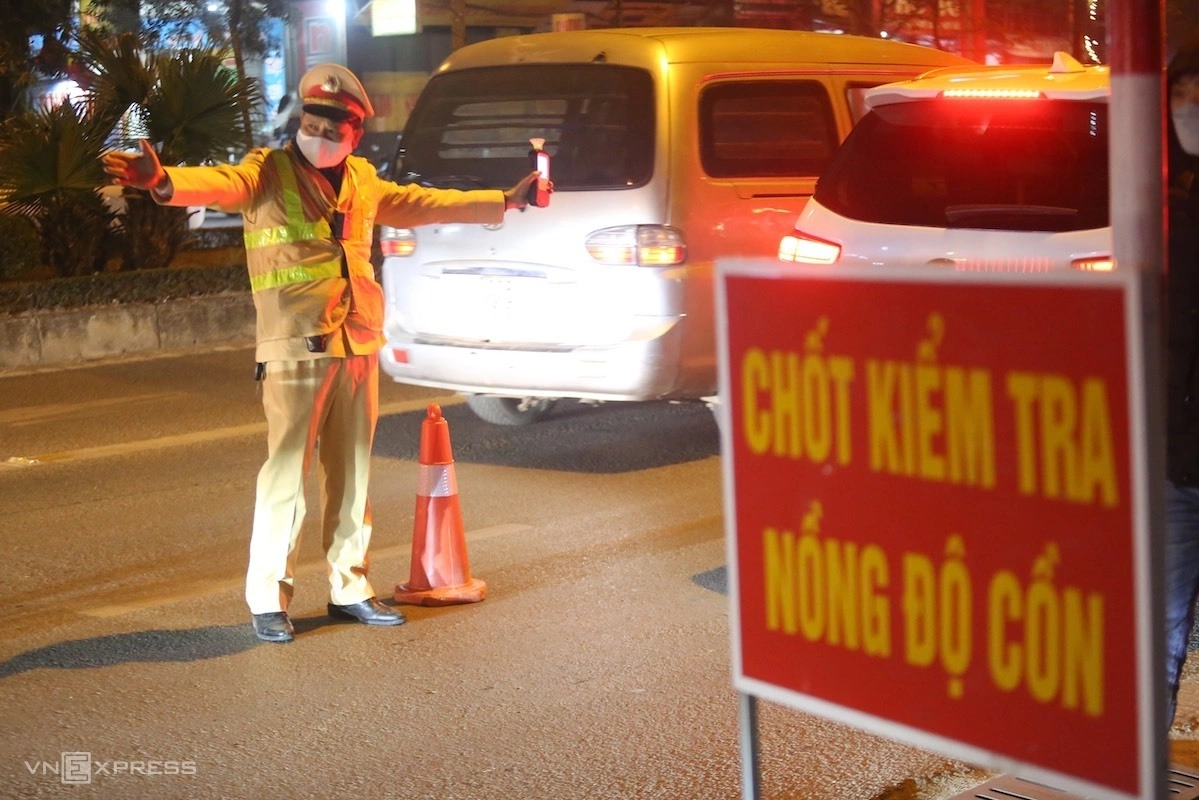 |
Alcohol concentration checkpoint of Hanoi's 141 force. *Photo: Gia Chinh*
Regarding concerns about alcohol presence in blood due to medical conditions or endogenous alcohol without consumption, the lawyer noted that scientifically, endogenous alcohol exists but in very small quantities. In contrast, individuals who have consumed alcohol typically have significantly higher alcohol concentrations in their bodies. However, citing endogenous alcohol would likely not be accepted if investigative agencies provide sufficient evidence to prove the offender's alcohol consumption. Lawyer Vinh concluded, "The accused does not have to prove they did not consume alcohol. But if investigative agencies can prove it, the defendant must accept the evidence collected during the investigation."
Hai Thu