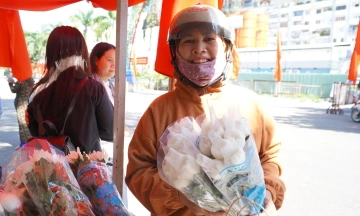
Project Inclusion 2b, launched in 2023, has significantly improved living conditions for 741 people with disabilities. The initiative has specifically supported 147 individuals in developing livelihoods, alongside providing essential medical care and rehabilitation services. An end-of-term assessment revealed positive outcomes: among 64 valid livelihood cases, 58 (90.6%) demonstrated the capacity to reinvest, and 22 (34.4%) reported increased income at the time of evaluation. These results highlight the project’s success in promoting economic self-reliance among participants.
One compelling success story is that of Tran Quang Quang, 29, from Binh Phu commune, Gia Lai. Previously self-conscious and hesitant to communicate due to joint stiffness and limited mobility, Quang has successfully launched a takeaway coffee business. Over three years with Project Inclusion 2b, he received a computer, barista training, and a coffee cart valued at 24 million dong. He now sells approximately 50 cups daily, earning a net income of about 10 million dong each month.
On 15/10, in Quy Nhon Nam ward, the Humanity & Inclusion (HI) organization, in collaboration with the Community Development Research Institute (ACDC), organized a workshop to identify sustainable solutions for supporting people with disabilities. The project is scheduled to conclude at the end of this year but has received a one-year extension to further its impact.
 |
Delegates and people with disabilities pose for a commemorative photo at the workshop, 15/10. Photo: Organizing Committee |
 |
Y Suan, from Dak Mar commune, Quang Ngai province, with her calf, a result of livestock farming after receiving a mother cow and technical guidance from the project. Photo: Organizing Committee |
According to Lieutenant Colonel Tran Duc Hung, Deputy General Director of the National Action Center for Overcoming the Consequences of Toxic Chemicals and Environment (NACCET), livelihood support helps people with disabilities increase income, build confidence, enhance self-reliance, and contribute to their families. However, these models still face challenges related to market access, disease outbreaks, price fluctuations, and participants' health conditions.
Before the project concludes, NACCET proposes several key actions: selecting effective models, identifying long-term support contacts, and integrating these initiatives into existing poverty reduction, agricultural extension, and policy credit programs. Future implementation must prioritize respecting the needs and choices of people with disabilities to ensure the development of suitable and sustainable livelihoods.
Ngoc Oanh