For an air conditioner's indoor unit to cool, its outdoor unit must release heat into the environment. When outdoor temperatures are excessively high, the outdoor unit's efficiency drops, making very low temperature settings ineffective.
"Even if you lower the setting to 18 or 20 degrees, the indoor temperature cannot get cooler because the unit is already running at full capacity", stated Professor Doctor Nguyen Duc Loi, former lecturer at Hanoi University of Science and Technology.
Professor Loi further explained that, based on the "temperature difference" (delta T) principle, residential air conditioning systems are designed to achieve an optimal temperature difference of 8-11 degrees Celsius compared to the ambient environment. With outdoor temperatures at 40 degrees Celsius, an air conditioner maintaining an indoor temperature of around 29-30 degrees Celsius represents its maximum effort. Continuously forcing the compressor to operate at 100% capacity can lead to breakdowns. Lower-quality units may even completely lose their cooling capability.
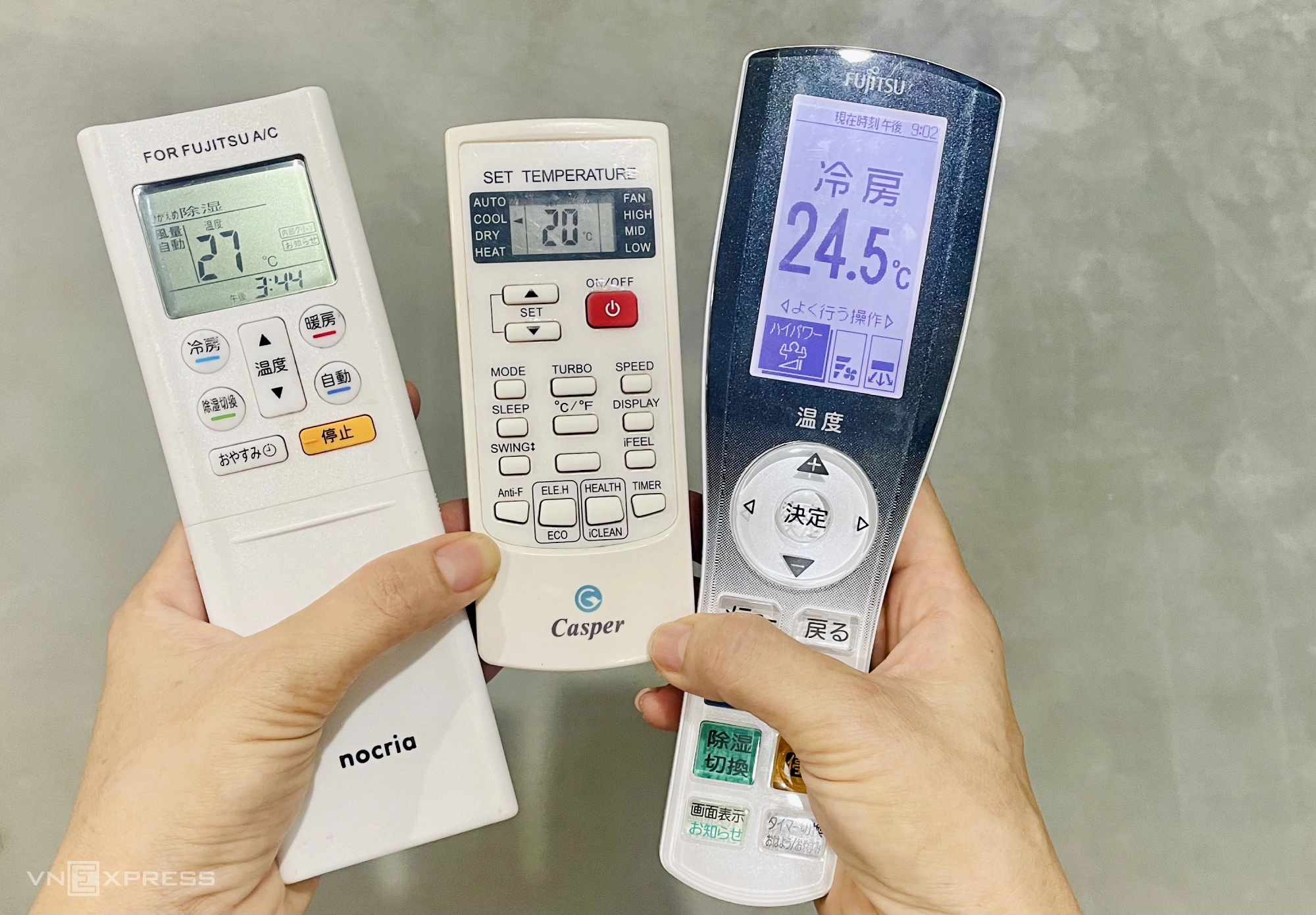 |
When the outdoor temperature is 40 degrees Celsius, setting any temperature on the control unit is meaningless because the air conditioner can only optimally cool the room by 8-11 degrees compared to the outside. *Phan Duong* |
Safe and energy-saving temperatures
Energy organizations and experts recommend an appropriate air conditioner temperature setting of 25-27 degrees Celsius.
Professor Loi advised that the maximum temperature difference between indoor and outdoor environments should be 10 degrees Celsius, with 8 degrees Celsius being the recommended difference to prevent thermal shock. The speed at which a room cools depends on the unit's capacity relative to the room's size and installation location, not on the thermostat setting.
According to experts, for every one degree Celsius the temperature is lowered below 25 degrees Celsius, electricity bills can increase by 1-3%. Associate Professor Doctor Nguyen Xuan Tien, Vice Chairman of the Vietnam Association of Refrigeration and Air Conditioning Science and Technology, noted that a 12,000 BTU air conditioner (consuming approximately 1,2 KW) operating continuously for 8 hours in hot weather will consume nearly 10 kilowatt-hours of electricity. Raising the set temperature by one degree Celsius will help reduce this energy consumption.
Solutions for enhanced cooling efficiency
To ensure air conditioners operate efficiently in 40-degree Celsius weather without overloading, users can apply the following methods:
Protect the outdoor unit: Install a canopy or position the outdoor unit in a well-ventilated area, shielded from direct sunlight. Users can also equip the outdoor condenser with a misting system to lower the surrounding air temperature to 30-35 degrees Celsius, thereby boosting cooling performance.
Combine with electric fans: Operate the air conditioner at 25-27 degrees Celsius in conjunction with a ceiling or standing fan. This circulates air, accelerating sweat evaporation, making users feel as cool as if the setting were 23-24 degrees Celsius, while also saving electricity.
Provide fresh air and humidify: Avoid keeping room doors continuously sealed. It is advisable to open a door slightly every 3-4 hours or install an exhaust fan. Using a humidifier or placing a bowl of water can help prevent mucous membranes from drying out, creating a more comfortable environment.
Block heat sources: Close heat-blocking, light-blocking curtains on west or south-facing windows. Limit the use of heat-emitting appliances during the day, such as ovens and irons. Regularly clean dust filters to ensure optimal airflow.
*Phan Duong*