According to the feasibility study report submitted by the Ho Chi Minh City Department of Construction, the build-operate-transfer (BOT) projects to expand national highways 1, 13, 22, and the north-south axis (Nguyen Huu Tho) will implement a multi-lane free flow electronic toll collection model, without toll booths or barriers.
This solution allows vehicles to travel continuously without having to slow down or stop, ensuring more stable traffic flow at these heavily congested gateways.
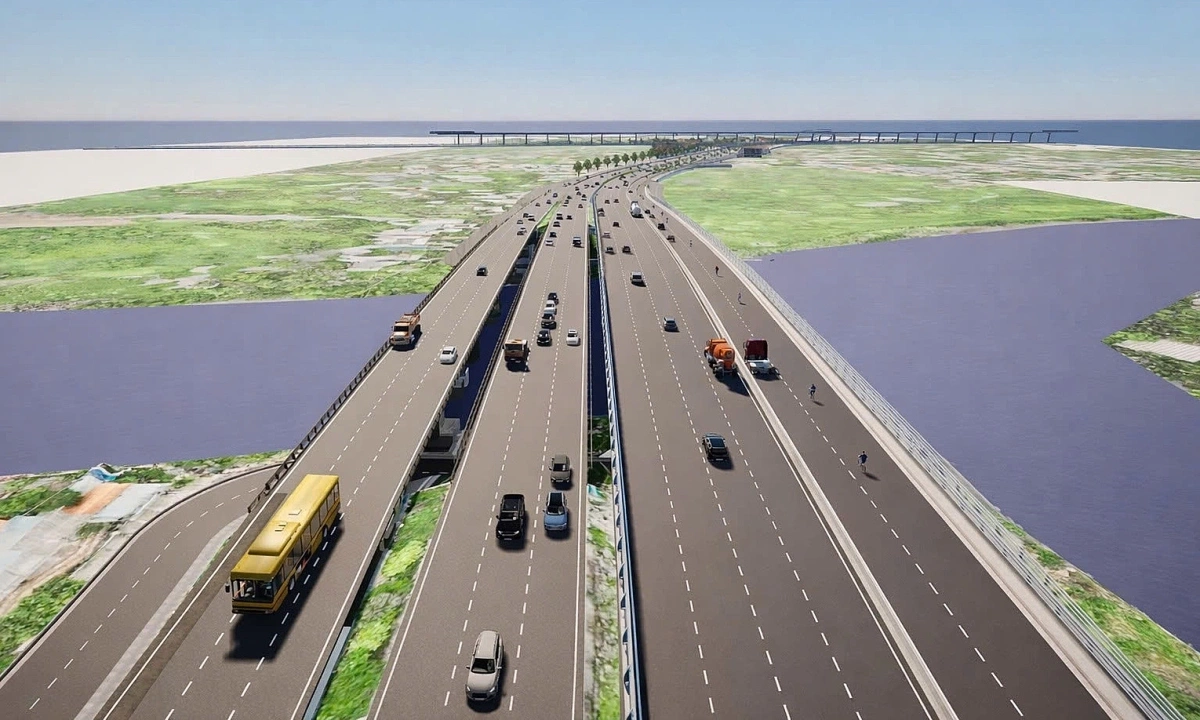 |
An artist's impression of national highway 1 at Ho Chi Minh City's western gateway after expansion. *Photo: Department of Construction*
The electronic toll collection (ETC) system will be installed on gantries and extended along the routes to record transactions. Parallel non-toll lanes will also have identification devices to prevent fraud. If a vehicle cannot pay (due to card error or no tag), camera data will be used for post-auditing.
To operate, the projects will integrate intelligent transportation systems (ITS) including surveillance cameras, vehicle detection devices, electronic display boards, emergency communication, and an operation center.
Currently, about 4,6 million automobiles nationwide have ETC tags, accounting for over 90%. However, because toll booths and barriers are still in place, vehicles often have to slow down, and the risk of congestion persists, especially in mixed-use lanes.
According to the roadmap, electronic toll collection will progress towards a fully multi-lane free flow model. Some expressways, such as Nha Trang – Cam Lam and Cam Lam – Vinh Hao, have already removed entrance barriers, nearing this model.
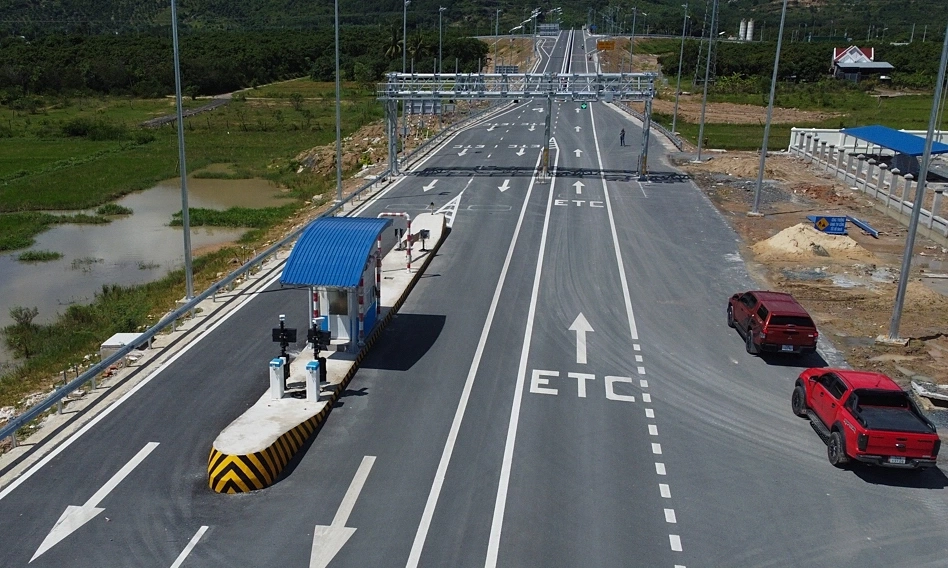 |
The toll entrance (right) has no barrier, while the exit in the opposite direction has a booth and barrier on the Nha Trang - Cam Lam expressway. *Photo: Bui Toan*
The four routes – national highways 1, 13, 22, and the north-south axis – are Ho Chi Minh City's vital gateways, which are currently frequently overloaded. These upgrade projects are being implemented under the build-operate-transfer (BOT) model, applying specific mechanisms from Resolution 98.
Among these, national highway 13 has the largest total investment, nearly 21,000 billion VND; national highway 1 is approximately 16,300 billion VND, national highway 22 is over 10,400 billion VND, and the north-south axis is nearly 9,900 billion VND.
These routes will be expanded to approximately 60 meters wide, accommodating a maximum of 10-14 lanes, two to three times their current capacity. The middle lanes will be for fast-moving, toll-paying vehicles, while the parallel roads on both sides will be toll-free.
Ho Chi Minh City expects to select investors in Quarter II, with early groundbreaking and completion targeted for the 2028-2029 period. Besides reducing congestion, these projects will also contribute to urban beautification and enhanced regional connectivity.
Ha Giang