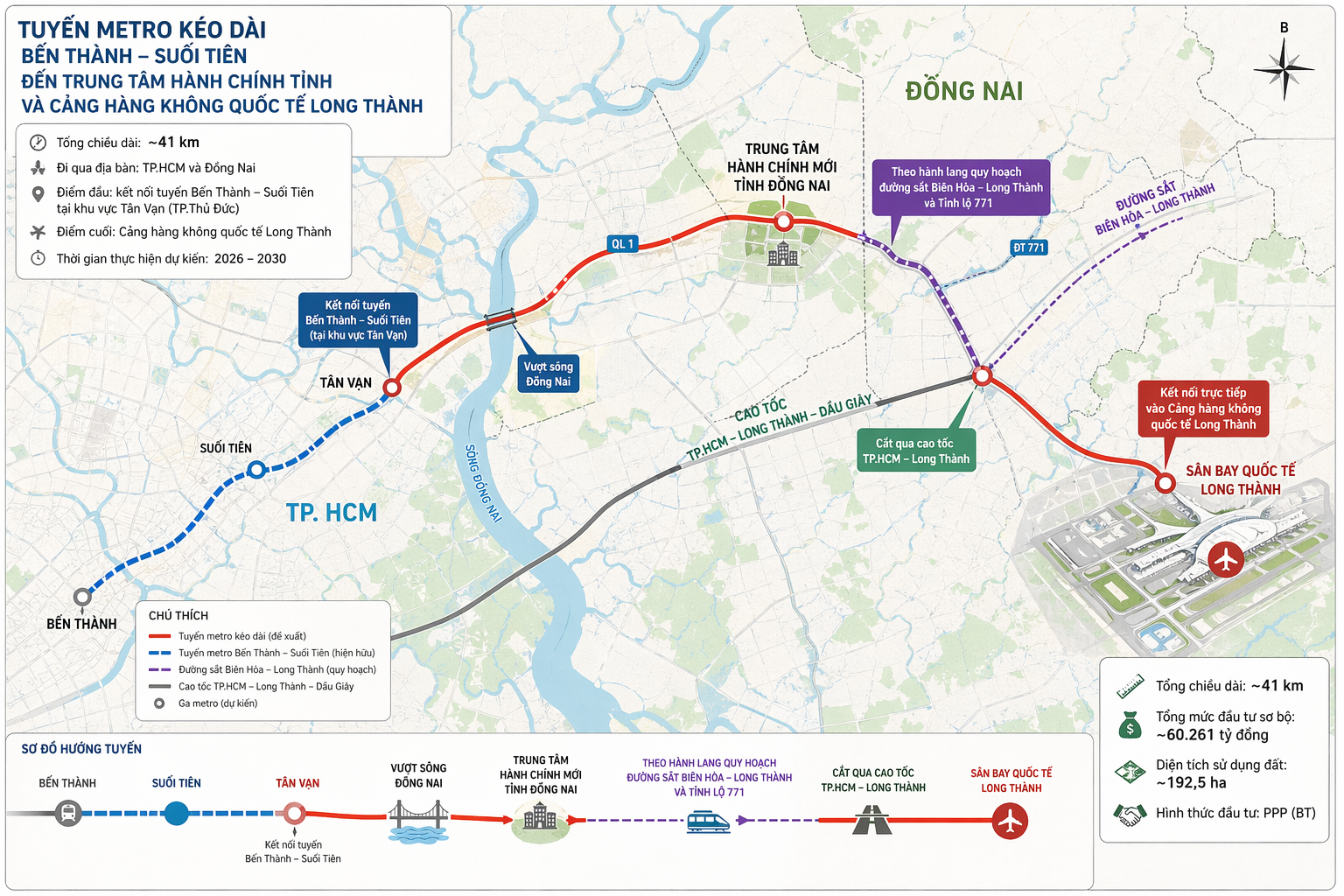
According to a proposal from Dong Nai province, the metro line would start by connecting to the existing Ben Thanh - Suoi Tien line in the Tan Van area. It would then cross the Dong Nai River, follow National Highway 1 into the province's new administrative center, and continue along the planned Bien Hoa - Long Thanh railway corridor and Provincial Road 771. The route would cross the Ho Chi Minh City - Long Thanh expressway before reaching the airport.
The preliminary total investment is estimated at approximately 60,261 billion VND, including about 4,323 billion VND for compensation, support, and resettlement costs. The project would require approximately 192 hectares of land. It is proposed to be implemented under a public-private partnership (PPP) model, specifically a Build-Transfer (BT) contract, where the investor undertakes construction and the state budget covers site clearance. The expected implementation period is 2026-2030.
The existing Ben Thanh - Suoi Tien metro line, nearly 20 km long, has a total investment of over 43,700 billion VND. It features 14 stations, including three underground stations in the city center. This line is expected to commence operation in 12/2024 and will be Ho Chi Minh City’s first urban railway line.
 |
Do hoa co su ho tro cua Al.
According to Dong Nai province, Long Thanh Airport is a national key project. When phase one becomes operational (expected late 2026), travel and passenger transport demand will significantly increase. Currently, connecting infrastructure primarily relies on roads, posing risks of congestion.
In this context, a direct metro line connecting Ho Chi Minh City - Dong Nai - Long Thanh Airport is considered a mass transit solution that will help alleviate road traffic. The project is also expected to promote urban and service development aligned with public transportation.
The People's Committee of Dong Nai province asserts that the project falls under urgent implementation as per the 2020 Construction Law. This is due to its direct service to a national key project and the need for its completion to synchronize with the airport's progress. If implemented through standard procedures, the project would struggle to meet the required timeline.
The province has proposed to be assigned as the lead agency for organization and implementation. The Ministry of Construction would appraise the Feasibility Study Report, including the front-end engineering design (FEED) and subsequent design phases.
 |
Tau metro Ben Thanh - Suoi Tien di chuyen tren xa lo Ha Noi (duong Vo Nguyen Giap). Anh: Quynh Tran
To accelerate progress, the project recommends applying special mechanisms, such as selecting investors in special cases and allowing direct appointment of contractors for items from survey, design to construction, supervision, and acceptance. The investor and relevant parties would be responsible for quality, safety, and costs, while proactively managing implementation.
The project also plans to adopt a "simultaneous design-construction" approach, mobilizing experts, consultants, and legal support to ensure feasibility.
In addition to the above line, Ho Chi Minh City is finalizing investment preparation procedures for the Thu Thiem - Long Thanh metro line, which is expected to break ground in 6/2026.
Anh Duy