The 2026-2031 government, recently consolidated under Prime Minister Le Minh Hung with six Deputy Prime Ministers and 17 ministers and sector heads, faces significant challenges. VnExpress interviewed Dr. Nguyen Duc Kien, former Vice Chairman of the National Assembly's Economic Committee and former Head of the Prime Minister's Economic Advisory Group, to discuss the operational challenges and policy priorities for the new government.
The government begins its term amid global economic volatility and high growth expectations. Dr. Kien highlighted fundamental challenges for governance. The international environment is marked by increasing fluctuation and uncertainty, with many unpredictable factors. Geopolitical conflicts across various regions are not only disrupting supply chains but also directly impacting energy security, which in turn affects production costs and domestic price levels. For example, recent developments in several hotspots have driven up fuel prices, leading to a surge in commodity prices.
Domestically, a greater challenge lies in Vietnam's goal of achieving two-digit growth from the outset of this term and sustaining it for many years. Concurrently, the economy must transition to a new growth model based on science, technology, innovation, and digital transformation, rather than continuing to rely primarily on resources, cheap labor, and processing and assembly.
Furthermore, the political system has undergone extensive streamlining from central to local levels, involving structural changes such as merging ministries and sectors, reducing the number of provinces, eliminating intermediate tiers, and reorganizing grassroots units. After nearly one year, the system is still working to remove bottlenecks for seamless operation. The government faces the specific challenge of completing organizational reforms, ensuring effective governance, and achieving development goals within this new context.
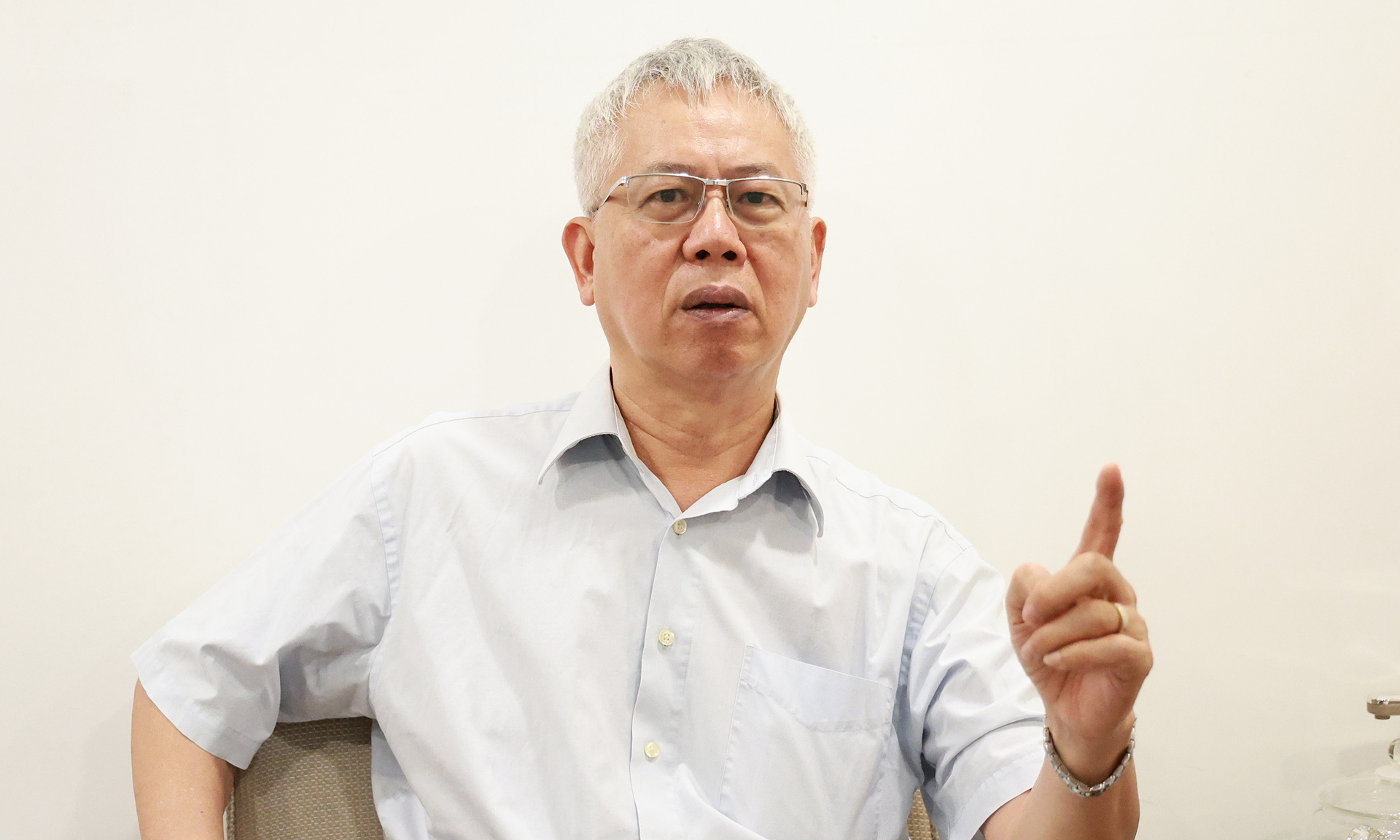 |
Dr. Nguyen Duc Kien, former Vice Chairman of the National Assembly's Economic Committee and former Head of the Prime Minister's Economic Advisory Group, April 2026. Photo: Viet Tuan
The government aims for high and sustainable growth over many years. Dr. Kien emphasized that achieving two-digit economic growth from this year and maintaining it in the coming years is a difficult but essential objective. As Prime Minister Le Minh Hung stated, this is a "development imperative", reflecting the nation's aspirations in this new phase. Failing to seize the opportunity for high growth risks Vietnam falling into the low-middle-income trap, a fate many countries have encountered.
To achieve this goal, Vietnam must first confront the reality of its resources and economic structure. Currently, the country remains heavily dependent on processing and low-cost labor, having yet to develop high value-added, proprietary products. This is evident in exports: in 2025, export turnover reached approximately 475 billion USD, but the actual contribution of domestic enterprises remains limited, particularly in the electronics and manufacturing industries. The foreign-invested sector still accounts for a large proportion. A significant portion of the remainder comes from agriculture, a traditional strength, but primarily in raw or semi-processed forms.
This indicates that growth potential exists, but it comes with substantial work ahead. The most important step is to acknowledge existing limitations to devise appropriate solutions. Dr. Kien believes the core bottleneck is Vietnam's lack of sufficiently large enterprises to lead the market, not just internationally but even domestically. While some sectors like textiles, footwear, and food have achieved a degree of self-sufficiency, they have not yet formed leading enterprises.
Even in agriculture, despite being a world leader in rice and seafood exports, domestic standards for clean and high-quality food are not fully met. This reflects limitations in organizing production, processing, and brand building. Therefore, to sustain high long-term growth, the government must lay the foundation for national backbone enterprises.
Recently, the Politburo issued Resolution 68 on private economic development and Resolution 79 on state economic development, both aimed at establishing large corporations with regional and global standing. However, transforming small businesses into large corporations in a short period is challenging, necessitating a long-term vision. Dr. Kien suggests the government's priority for this term should be to create a solid foundation, so that by 2035 or 2045, Vietnam will have enterprises capable of dominating the domestic market and expanding regionally and globally with "made in Vietnam" products.
To foster national backbone enterprises, Vietnam needs specific mechanisms, primarily by leveraging humanity's existing achievements, effectively "standing on the shoulders of giants". This is particularly crucial now, as Vietnam has opportunities to access new technologies like chip manufacturing and automation. However, these opportunities only translate into capabilities when enterprises are ready to adopt and master them. Therefore, mechanisms are needed to encourage businesses to boldly enter new, high-tech fields.
The state can implement a mechanism of placing orders and purchasing products from enterprises at market prices during the initial phase. With stable output, businesses gain the motivation for long-term investment, taking risks to enter new industries they previously lacked the conditions to join. Additionally, major national projects should be utilized as policy tools. For example, for high-speed railway projects like the North-South line or the Lao Cai - Hanoi - Hai Phong line, the state can proactively acquire control technology copyrights, then assign domestic enterprises to participate in manufacturing, assembly, and progressively master the technology.
This approach helps domestic enterprises quickly access advanced technology and enhance their capabilities, while also enabling Vietnam to gradually master technology for key national projects. A significant advantage now is Vietnam's substantial investment in many critical national infrastructure projects. For these projects, the state can implement a mechanism to prioritize domestic enterprises, while also clearly stipulating the localization rate. For instance, for metro lines in Hanoi and Ho Chi Minh City, it is essential to specify which parts must be imported and which must be manufactured and assembled domestically, assigning these tasks to one or more participating enterprises.
Enterprises granted such opportunities must be accompanied by specific incentive mechanisms, but also bear clear responsibility for progress and quality. This is a prerequisite to ensure efficiency and mitigate implementation risks. Currently, many domestic enterprises thrive through land-related activities or privatization. Therefore, the government needs policies to encourage them to shift direction, investing capital in manufacturing and technology sectors, and embracing new challenges. The overarching principle in this process is to ensure a harmonious balance of benefits among the state, enterprises, and the people.
Beyond forming backbone enterprises, the government must ensure that science, technology, and innovation truly become practical growth drivers. The policy of development based on science and technology is not new; Vietnam recognized the need to apply scientific and technical advancements to economic development decades ago. However, in the current period, this requirement expands to include innovation and digital transformation, becoming the primary engine of growth.
To make this policy effective, it must begin in areas where Vietnam already has a foundation, with agriculture being the clearest example. This sector offers Vietnam a large-scale advantage, yet the application of science and technology remains limited. For many years, Vietnam has been a world leader in exporting rice, agricultural products, and seafood, but most products are still in raw or semi-processed forms. This raises questions about the extent to which science and technology have been applied in agricultural production, processing, and consumption.
Many fundamental issues need addressing, such as the self-sufficiency rate of plant varieties, the proportion of deeply processed products, and the ability to develop consumer products from agricultural produce. Questions like whether to grow two or three rice crops, how to manage saltwater intrusion, or how to build brands for commodities like coffee and pepper still lack clear answers. Developed countries have extensively applied science and technology in agriculture, creating diverse product ecosystems that directly serve consumer needs. In contrast, Vietnam has not effectively transitioned from exporting raw materials to high value-added products. This leads to familiar problems like bumper harvests causing price drops and agricultural product congestion, directly affecting farmers' incomes and the overall efficiency of the sector.
By boosting the application of science and technology across the entire value chain, from seeds, production, and harvesting to processing and distribution, these bottlenecks can be resolved. This would not only enhance product value but also improve farmers' livelihoods. To achieve this, the government needs priority mechanisms for enterprises leading in technology application in agriculture, focusing on automation, deep processing, and product diversification for the domestic market before expanding exports. Concurrently, relevant agencies must reorganize production to foster closer ties between collective economic entities and joint-stock companies, forming robust value chains.
The transition of the growth model from processing and assembly to one based on science, technology, innovation, and digital transformation is a long process requiring steady steps. Agriculture can serve as a suitable starting point. Success in this sector will establish a foundation for expansion into high-tech industries such as chip manufacturing, artificial intelligence, and robotics.
To reduce actual costs for citizens and businesses and create a foundation for backbone enterprises, the government needs to reform administration, starting with the digitalization of all internal processes within state administrative agencies, ensuring seamless operation from central to local levels. When processing stages are synchronously connected, procedures can be implemented through a single-window interlinked mechanism, independent of administrative boundaries. Citizens and businesses would only need to submit documents once and receive results within a predetermined timeframe, instead of having to visit multiple locations and wait through various bureaucratic layers.
Concurrently, there needs to be a significant shift from a licensing mechanism to one of public standards, regulations, and post-inspection. What citizens and businesses are entitled to do must be clearly defined by transparent criteria, rather than requiring them to apply for every type of permit. For example, in some areas like construction, a portion of the licensing procedures could be replaced by specific technical limits, with severe penalties for violations. This would standardize implementation and reduce compliance costs.
Another crucial point is to clearly categorize sectors for targeted reform. For activities involving the use of national resources like land and real estate, procedures must be stringent to protect public interests at the highest level. However, for manufacturing and import-export, procedures should be simplified as much as possible to facilitate business development. Applying the same management approach to all sectors is not feasible. When procedures are designed to be transparent, clearly categorized, and reduce unnecessary pre-inspection, citizens and businesses will save time, opportunity costs, and informal costs. This is also a vital condition for creating a favorable environment for large enterprises to thrive.
Vu Tuan