


Hanoi's air quality index (AQI) reached very unhealthy levels on 27/1, with readings indicating a significant increase in pollution across the city. At 9 a.m., the monitoring station operated by the Department of Environment, Ministry of Agriculture and Environment, located at the gate of Hanoi University of Science and Technology on Giai Phong street, recorded an AQI of 200, classifying the air as very unhealthy.
Simultaneously, other monitoring stations reported similarly concerning figures. The station at 556 Nguyen Van Cu in Long Bien ward registered an AQI of 163, while the Nhan Chinh Park area on Khuat Duy Tien street showed an AQI of 155. Both readings fall into the unhealthy category.
The global air quality monitoring platform IQAir ranked Hanoi as the 3rd most polluted city worldwide, with an AQI of 221, trailing only Delhi, India, which recorded 312. Numerous locations within Hanoi experienced very unhealthy air quality, with the Tay Ho area reaching a hazardous level of 329. Other affected districts included Cau Giay (216), Thanh Xuan (221), Ha Dong (210), and Hai Ba Trung (212).
Pollution began to rise again on 25/1, when calm winds and a temperature inversion caused fine particulate matter (PM2.5) to accumulate near the ground. The AQI reflects air quality and its impact on health; higher index values indicate greater potential health risks. According to authorities, the current pollution is primarily due to PM2.5.
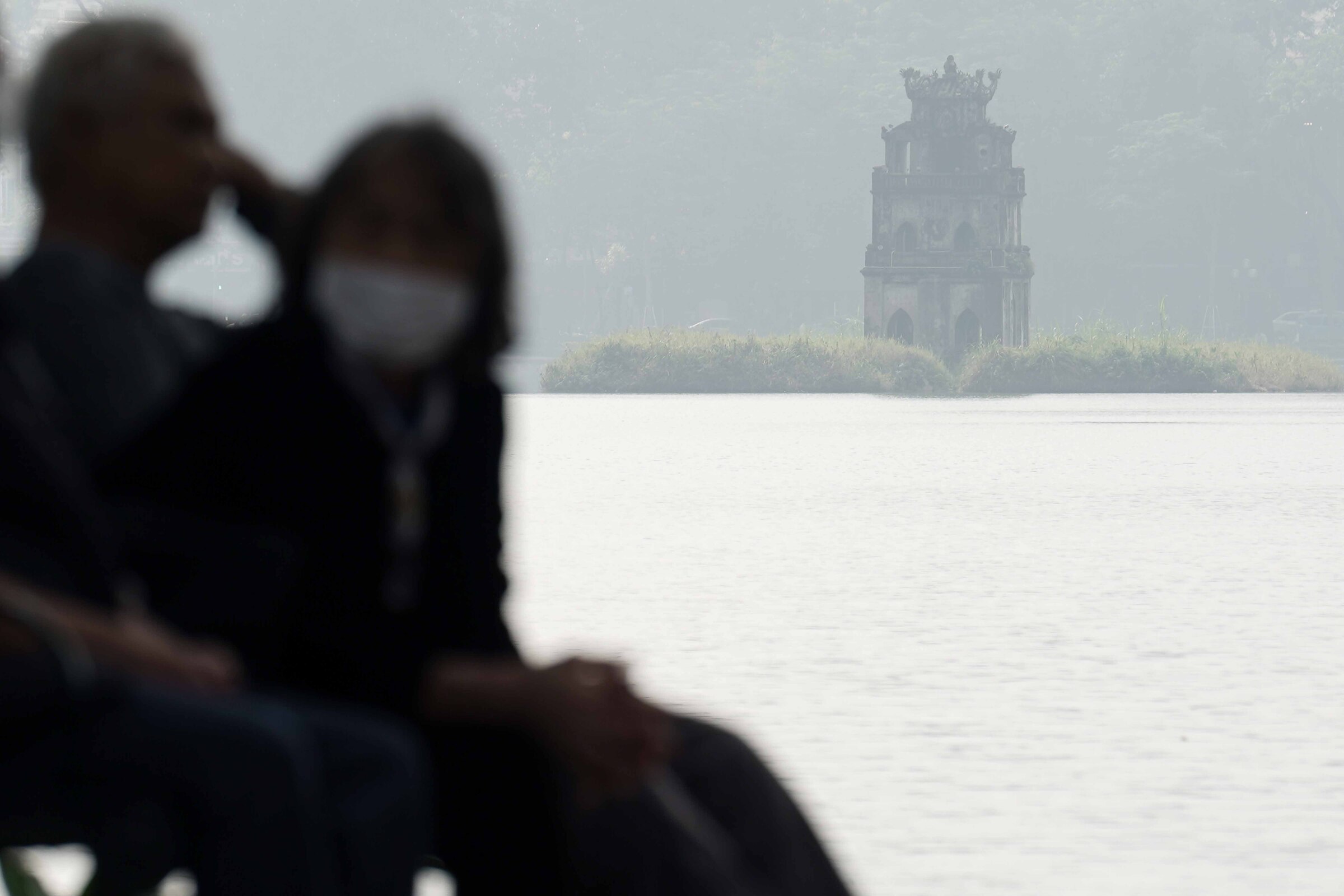 |
Air pollution at Ho Guom Lake. Photo: Hoang Giang.
Beyond Hanoi, the Department of Environment reported that air quality in several Northern provinces also ranged from unhealthy to very unhealthy. Bac Ninh recorded an AQI of 206, Hai Phong 202, Hung Yen 189, and Thai Nguyen 182.
The department forecasts a further increase in air pollution across the Northern region on 28/1. Hanoi, Hung Yen, and Ninh Binh could reach very unhealthy levels, while Hai Phong, Quang Ninh, Bac Ninh, and Thanh Hoa are expected to experience unhealthy air quality. The air quality forecasting system of the University of Engineering and Technology, Vietnam National University, Hanoi, also anticipates that today and tomorrow will be the peak days of this pollution episode.
Gia Chinh


