On 31/12, the Politburo and Secretariat issued a conclusion on the operational status of two-tier local governments. This directive tasks the Central Military Commission and Ministry of National Defense with developing a proposal. The proposal will detail the roadmap, working relationships, and policies for integrating military officers into commune-level military commands, with submission to the Politburo expected by Quarter I/2026.
The Politburo and Secretariat endorsed the policy for selecting and appointing Deputy Commanders and Assistants to commune-level military commands, mirroring the process for Commanders. Local party committees must promptly ensure full staffing for these commands. They are also tasked with reviewing existing Commanders to ensure they meet the university-level basic military education standards, possess advanced political theory qualifications, and align with position planning.
Appointment decisions for Commanders, Deputy Commanders, and Assistants of commune-level military commands will also serve as recruitment decisions for eligible individuals.
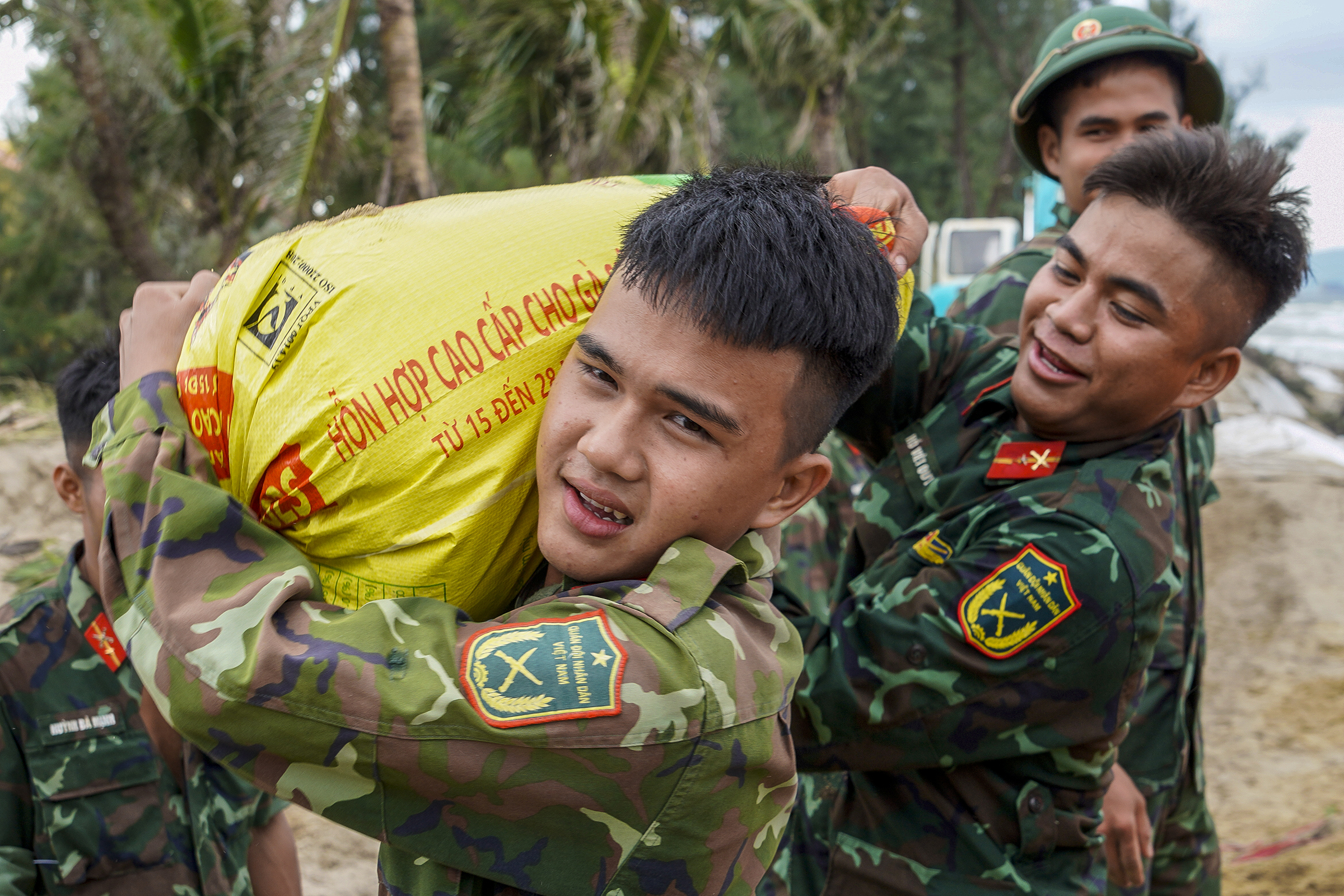 |
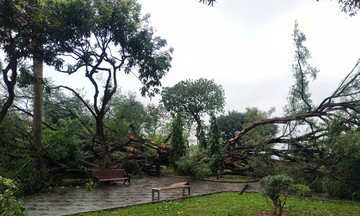
Soldiers assist in addressing coastal erosion in Hoi An, Da Nang city, 4/11. Photo: Nguyen Dong |
Soldiers assist in addressing coastal erosion in Hoi An, Da Nang city, 4/11. Photo: Nguyen Dong
Furthermore, the Politburo and Secretariat mandated enhanced management, inspection, and oversight of the allocation and handling of public offices and assets across agencies, organizations, and units to prevent loss or waste. The Government Party Committee is responsible for promptly issuing decrees to amend regulations concerning specialized agencies at provincial and commune levels, alongside a decree to revise the allowance system for commune-level leadership and management positions.
Regulations governing the classification and resolution timeframes for complex administrative procedures, along with the standardization of multi-step, inter-agency verification processes, and coordination responsibilities and deadlines, also require prompt finalization. Additionally, the authority and operational scope of associations, social funds, and charity funds must be reviewed and refined. This ensures alignment with the policy of transferring Party and State-assigned associations to the Fatherland Front and the two-tier local government model.
The Central Organization Commission is responsible for advising the Secretariat and submitting a document to amend and supplement the salary regime for officials, civil servants, and public employees across Party agencies, the Fatherland Front, and mass organizations.
Under the 2016 Militia and Self-Defense Law and the 2025 Law amending military and national defense legislation, the commune-level military command functions as the standing agency for national defense work at the commune level. This command consists of: a Commander, who is a civil servant, a member of the commune People's Committee, and a reserve officer (who, in national defense emergencies or war, is called to active duty and continues in their position as regulated); a Political Commissar, a role undertaken by the commune-level Party Committee Secretary; a Deputy Political Commissar, held by the commune-level Youth Union Secretary; and a Deputy Commander and Assistant, both of whom are civil servants.
The commune-level military command maintains its own office or workplace and utilizes its own official seal.
By Vu Tuan