On the afternoon of 28/3, the Prime Minister chaired a meeting of the Government's Steering Committee on Science, Technology, Innovation, Digital Transformation, and Project 06 (Steering Committee).
The government leader called for establishing a unified coordination mechanism at the government level to implement the strategic technology development program. The functions, organizational structure, and authority of ministries and sectors in science, technology, innovation, and digital transformation require adjustment. Policies to attract large technology corporations and foster strategic technologies, especially in semiconductors and artificial intelligence (AI), need to be refined to serve strategic technology development.
"Strategic technology development must keep pace, advance alongside, and surpass, but it must also address Vietnam's practical problems and political requirements," the Prime Minister noted.
Alongside institutional improvements, the Prime Minister requested the early implementation of the Action Program for the 14th Party Congress Resolution; the 5-year plan for the science, technology, innovation, and digital transformation sector; the information and communication infrastructure plan until 2030; and the national digital transformation strategy until 2035.
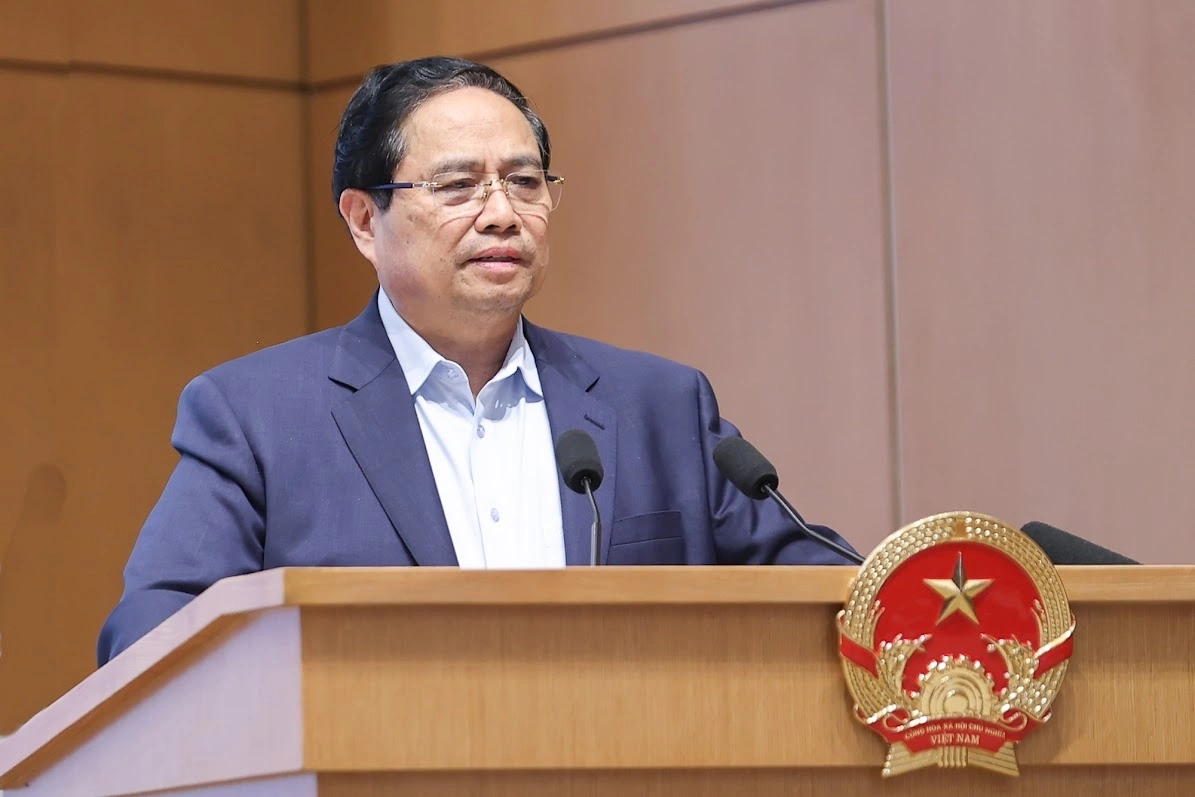 |
Prime Minister Pham Minh Chinh speaking on the afternoon of 28/3. Photo: Nhat Bac
The Ministry of Science and Technology is responsible for developing projects on applied nuclear energy industrial infrastructure, low-earth orbit economic space, and the quantum industry. The ministry will coordinate with the Ministry of Public Security, the Ministry of Home Affairs, and the Government Office to operate a key performance indicator (KPI) monitoring system and publicize results. This system will form the basis for evaluating the responsibilities of individuals and collectives, particularly leaders.
The head of the government called for accelerating telecommunications infrastructure development, aiming for nationwide 5G coverage, and effectively exploiting low-earth orbit satellite projects. He also urged the early operation of one submarine fiber optic cable, ensuring progress in building a semiconductor chip factory, and facilitating foreign investment in several large data centers.
Important national databases, including land, cadres, civil servants, social security, health, and education, need to be completed and cleaned. Alongside encouraging startups and innovation, and promoting domestic technology development, the Prime Minister urged prioritizing the use of Vietnamese digital technology products and services.
Long-standing issues such as junk SIMs and unverified accounts require prompt resolution, along with eradicating fraud tools and strengthening cyberattack defenses. "We must resolutely fight and severely punish acts of illegal personal data trading," the Prime Minister stated.
In parallel with developing high-quality human resources, agencies must focus on developing mid-level skilled labor to meet general digital tasks.
"Enhanced awareness, sufficient funding, exemplary leadership, pioneering facilities, leading businesses, complete data, seamless infrastructure, interconnected systems, professional cadres, an informed society, a benefiting populace, and a developing nation," the Prime Minister summarized as key phrases to promote science, technology, innovation, digital transformation, administrative reform, and Project 06 implementation.
A report at the meeting indicated significant progress in strategic technology and Vietnam's science and technology ecosystem recently. The Vietnam Space Center was inaugurated. The first semiconductor chip manufacturing factory in Vietnam began construction. Some domestic businesses now master up to 65% of the core technology in AI cameras, 5G, and unmanned aerial vehicle (UAV) sectors.
5G network coverage reached nearly 92% of the population, with 22.4 million subscribers. Over 4,200 GPUs have been invested in to support artificial intelligence.
In the first quarter of 2026, the country saw an additional 1,394 digital technology businesses; exports of digital technology products exceeded 45 billion USD, an increase of 32.2% compared to the same period last year.
16 million data records from socio-political organizations have been integrated; 61 million land data records cleaned; and 146.6 million civil status data records on VNeID. The application also provides 50 utilities for citizens and businesses.
Vu Tuan