On 11/5, Prime Minister Le Minh Hung chaired a meeting of the Government Steering Committee for science and technology development, innovation, digital transformation, and Project 06. This was the first meeting of the Steering Committee since the new government was consolidated and all deputy prime ministers were added as vice heads.
Speaking at the meeting, the Prime Minister assessed that since the beginning of the year, science and technology, innovation, and digital transformation have shown clear and positive progress. However, mechanisms and policies remain fragmented, overlapping, and lack specific guidance; controlled experimental mechanisms (sandbox) and ordering mechanisms are either missing or unclear. The progress of data development, connection, and sharing is slow, with many specialized databases not ensuring accuracy, completeness, cleanliness, real-time availability, uniformity, and common use. The reduction and simplification of administrative procedures and the implementation of online public services also remain limited.
Therefore, the government leader demanded that heads of ministries, sectors, and localities directly lead and be responsible for task performance. The spirit is to work effectively and substantively, absolutely avoiding superficial or reactive actions. The results of implementing Resolution 57 and Project 06 will serve as criteria for evaluating the performance of these leaders in 2026.
 |
Prime Minister Le Minh Hung chaired a meeting of the Government Steering Committee for science and technology development, innovation, digital transformation, and Project 06, on 11/5. Photo: Nhat Bac
The Prime Minister emphasized a focus on synchronous digital infrastructure development and comprehensive digital transformation. This includes ensuring seamless data connectivity and sharing, enhancing national governance efficiency, and maximizing convenience for citizens and enterprises. Developing the data economy and artificial intelligence is central to national digital transformation.
"We must vigorously promote the state-institute/university-enterprise cooperation model to unlock resources for technology research, development, and commercialization," the Prime Minister stated.
Strategic technology must be accelerated to achieve concrete results in 2026. The research model needs to shift from fragmented efforts to demand-driven projects addressing major challenges, with specific products, defined markets, unique financial mechanisms, and controlled risk acceptance.
The Ministry of Science and Technology, in coordination with the Ministry of Finance, is tasked with developing mechanisms for ordering, assigning tasks, and accepting outputs for science and technology products, innovation, and digital transformation, with a report due in july. The ministry will also issue economic-technical norms, pricing, procurement, and service rental mechanisms for internal software, digital technology services, and digital data, with a report due in june.
Concurrently, the Ministry of Science and Technology will guide the identification of major challenges and strategic technologies based on the potential and advantages of each ministry, sector, and locality, to be completed in june. Key laboratories require upgrading, utilization, and shared access to support strategic technology development, to be completed in july. Criteria for classifying strategic technology products, non-strategic technology products, and common technology application products must be issued soon.
The Prime Minister instructed the Ministry of Science and Technology and the Ministry of Construction to develop standards and regulations for high-speed railways. The Ministry of Finance is to propose and guide specific spending mechanisms, particularly for strategic technology products and pilot products. The Ministry of Science and Technology must promptly issue economic-technical norms and guidelines for cost estimation and management related to digital data, AI, cloud computing, digital platforms, strategic technologies, and digital transformation tasks.
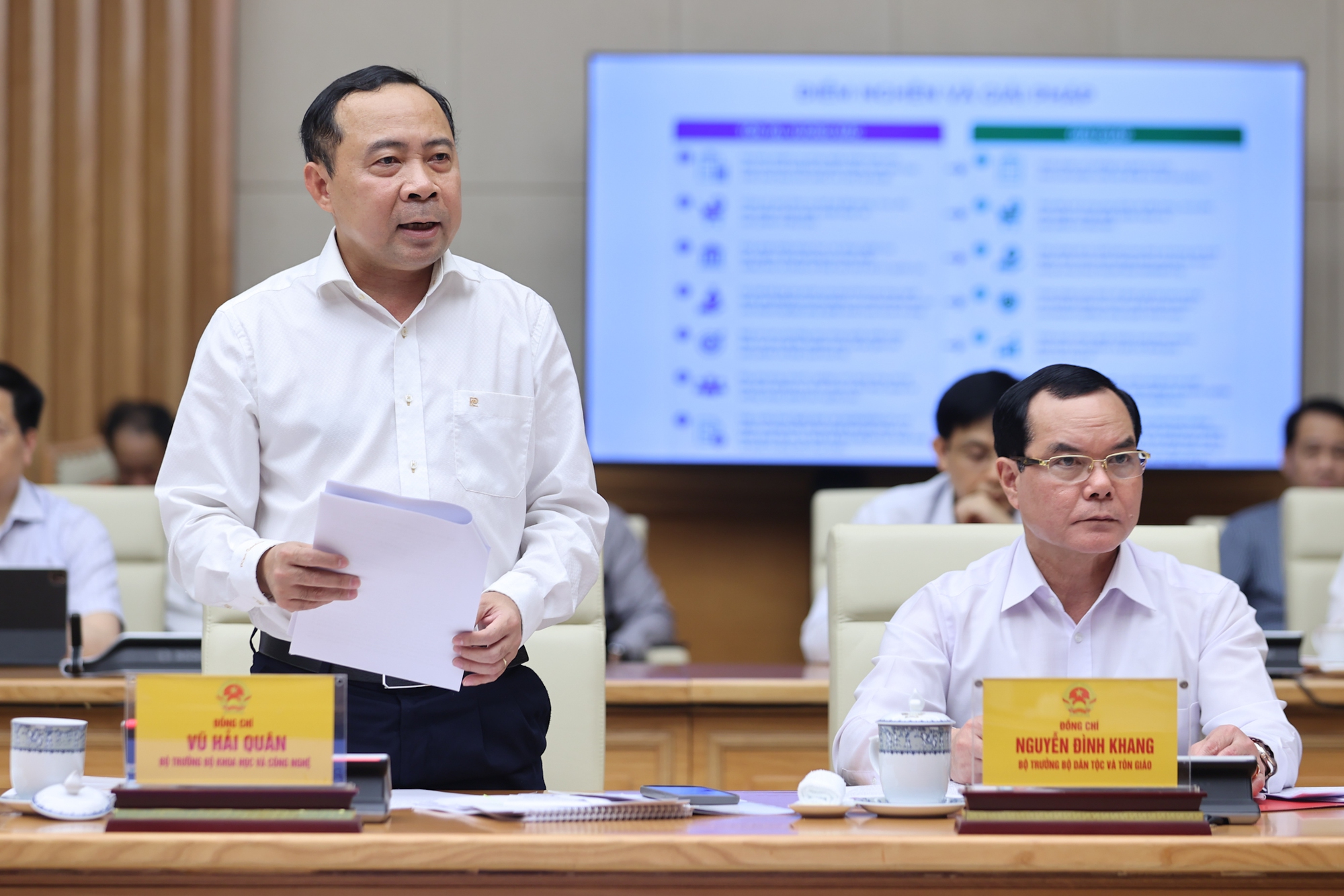 |
Minister of Science and Technology Vu Hai Quan spoke at the meeting of the Government Steering Committee for science and technology development, innovation, digital transformation, and Project 06, on 11/5. Photo: Nhat Bac
The Ministry of Public Security is to quickly operationalize the National Data Center, providing digital infrastructure to ministries, sectors, and localities in june.
According to the report at the meeting, the government has adjusted and approved 10 key strategic technology groups and 30 strategic technology products. International publications increased by 11.3%, and 2,441 standards and regulations have been reviewed. Revenue in the digital technology sector for april 2026 is estimated to reach USD 24 billion.
3G and 4G networks cover over 99% of the population, while 5G coverage reached 91.9% and is expected to reach 97% by the end of 2026. Mobile internet speed ranks 11th out of 104 countries, and fixed internet speed ranks 12th out of 154 countries.
Nationwide, over 27.7 million new-model identification cards have been issued, and over 70.2 million electronic identification accounts have been activated. The VNeID platform now offers 50 utilities, integrating 20.2 million driver's licenses, 7.4 million vehicle registrations, and 26.4 million health insurance cards. It has also verified over 156 million bank customer profiles. The "Binh dan hoc vu so" (Digital Mass Education) platform has attracted over 1.6 million learners.
Eight government resolutions issued on 29/4 have decentralized 136 administrative procedures, abolished 186 administrative procedures, simplified 396 administrative procedures, and eliminated 890 business conditions.
Vu Tuan