The Thang Long Project Management Board recently submitted a pre-feasibility study report for the investment and construction project of Ring Road 5 in the Capital Region to the Ministry of Construction for appraisal. This project is a national key infrastructure, falling under the National Assembly's authority for investment policy decisions.
The proposed route spans approximately 340 km, traversing Hanoi, Hai Phong, and the provinces of Phu Tho, Bac Ninh, Hung Yen, Thai Nguyen, and Ninh Binh. Starting in Yen Bai commune (Hanoi) and connecting with Km367+100 of Ho Chi Minh Road, the route will form a complete loop, ending at its starting point, thereby encircling the Capital Region.
Ring Road 5 will feature six complete expressway lanes. Localities are tasked with planning parallel roads, green spaces, and sidewalks, ensuring a minimum cross-sectional width of 120 meters, equivalent to 10 lanes.
The total estimated investment is 261.68 trillion VND. This includes construction and equipment costs of approximately 145.28 trillion VND, project management, consulting, and other expenses totaling about 10.17 trillion VND, and land clearance costs of around 70.13 trillion VND, with the remainder allocated for contingencies.
According to the proposal, the project preparation will take place during the 2026-2027 period. Land clearance is scheduled to begin in 2027 and be largely completed by 2030. Funding is expected to come from the central budget, local budgets, and non-budgetary capital, utilizing either public investment or public-private partnership (PPP) models.
The Thang Long Project Management Board stated that implementing Ring Road 5 is essential due to the rapid increase in transport demand within the Capital Region and the Northern region. The inter-regional infrastructure system needs synchronous completion to meet high economic growth targets in the coming period.
The route will alleviate pressure on existing transport axes, especially in urban areas of the localities. It will also expand urban, industrial, and logistics development space, enhancing connectivity among provinces and cities in the Northern key economic region.
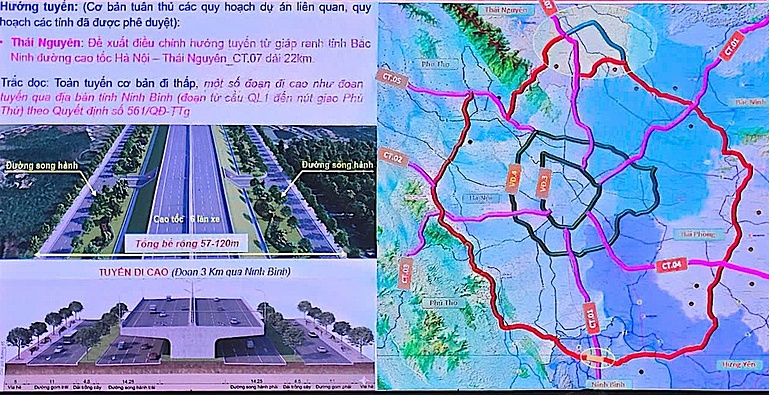 |
Simulation of Ring Road 5's alignment. |
The project is expected to be divided into eight component projects, with priority given to public investment.
At a recent Ministry of Construction meeting, Minister Tran Hong Minh instructed localities to review their planning, determine the route alignment, and prepare resources for the implementation of Ring Road 5 in the Hanoi Capital Region. The Minister agreed on the approach of dividing the project into eight component projects: seven based on administrative boundaries and one dedicated to major bridges spanning two or more localities. This approach aims to facilitate implementation and allocate investment responsibilities effectively.
For parallel roads serving urban and industrial development along the route, the Ministry mandated a minimum standard of class III roads, 12 meters wide. In sparsely populated areas, the arrangement of service roads will be flexibly considered to avoid fragmented investment.
Localities must also develop investment plans for connecting routes from Ring Road 5 to urban areas, industrial zones, and service centers, ensuring synchronous operation upon the road's completion. In the design, the Ministry of Construction requires a focus on underpasses for residents, prioritizing dual tunnel options to ensure access on both sides of the route, along with drainage solutions to prevent flooding.
The Ministry of Construction prioritizes public investment, followed by toll collection to recover capital as per the Road Law. For the main route, given the budgetary constraints of many localities, the Ministry proposed using the central budget to ensure timely implementation.
Ring Road 5 is the outermost ring road in Hanoi's Capital Region transport master plan. Currently, Ring Road 3 is operational, and Ring Road 4 is under construction, expected to be completed in 2027. Upon the completion of Ring Road 5, Hanoi's system of three strategic ring roads will be fully connected.
According to the national road network plan for the 2021-2030 period, Ring Road 5 is designated to have six expressway lanes and be invested in before 2030.
Doan Loan