Japan has long been a closed market for foreign automakers. Domestic giants like Toyota, Honda, Nissan, Suzuki, and Daihatsu collectively account for up to 95% of new car sales.
However, Kia decided this is the right time to enter the market with the PV5 – an electric van available in both passenger and cargo versions, making it the brand's first electric vehicle in Japan.
Foreign brands have struggled in Japan due to both structural and cultural reasons. Japanese consumers are loyal to domestic brands. Dealership networks, built over decades, are deeply rooted in local communities, and domestic manufacturers have spent generations refining vehicles specifically for Japan's narrow urban streets.
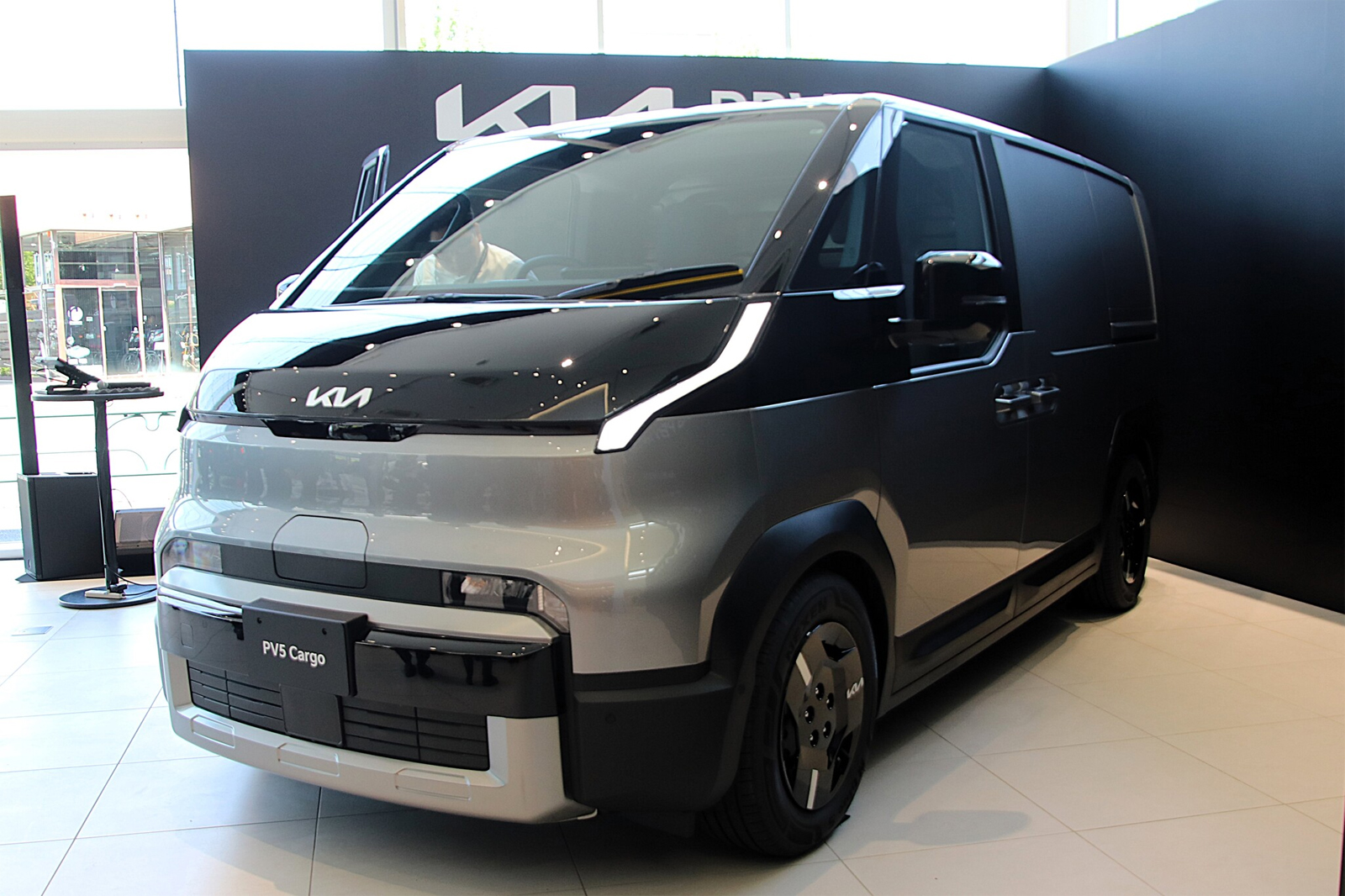 |
The Kia PV5 cargo van version. Photo: Response |
Toyota has long been the top-selling brand, projected to hold about 45% of the market in 2025, followed by Honda and Nissan, while Suzuki and Daihatsu dominate the kei-car segment. Foreign brands have not achieved a comparable foothold.
Instead of directly competing with Toyota in the passenger car segment, Kia identified a different path. Japanese domestic automakers remain cautious about fully transitioning to electric vehicles, instead favoring hybrids. This has resulted in a scarcity of options in the commercial electric vehicle market.
Seizing this opportunity, Kia partnered with Sojitz Group, a major Japanese trading company, to establish Kia PBV Japan as a subsidiary. The venture currently operates 7 dealerships and 52 service centers. By year-end, they plan to expand to 11 self-operated showrooms and 100 service centers, aiming to sell 1,000 electric vans in the 2026 fiscal year.
The PV5 model is designed with dimensions suitable for Japan's infrastructure: 5,040 mm long, 1,895 mm wide, and 1,950 mm high, with a 2,995 mm wheelbase and a small turning radius, making it easy to maneuver on crowded city streets. Kia also equipped it with standard CHAdeMO charging capability, ready for Japan's extensive electric charging infrastructure.
This model has proven effective elsewhere. In the first quarter of 2026, Kia sold over 8,100 PV5 units globally, securing 9% of Europe's electric light commercial vehicle market. By 2030, the company aims to sell 250,000 electric vans annually. Japan, with its high logistics demand and scarce electric alternatives, is central to that ambition.
My Anh (according to Autoblog)