In recent years, global authorities have worked to modernize road infrastructure with advanced toll collection solutions. These efforts aim to reduce traditional methods and alleviate congestion. Collaboration among technology companies, transport management agencies, and financial technology (fintech) firms is driving the adoption of electronic toll collection (ETC) systems.
The concept of ETC was first proposed by American economics professor William Vickrey in 1959. Norway pioneered its widespread application in 1986, while Italy was the first country to implement it on a national scale for highways in 1989. This technology gradually gained traction in other developed nations such as the US, Japan, and European countries starting in the 1990s.
Currently, ETC employs four main technologies, all using wireless systems for automatic vehicle toll collection. These include dedicated short-range communications (DSRC), radio-frequency identification (RFID), automatic number plate recognition (ANPR), and global navigation satellite systems (GNSS).
Taiwan (China) serves as a prime example of successful ETC implementation. The Far Eastern Electronic Tolling Company (FETC) was tasked with building and operating the ETC system across Taiwan's entire highway network.
In early 2006, FETC launched ETC lanes with per-use tolling at 23 stations. At that time, drivers had to purchase an on-board unit (OBU), consisting of a card and a reader, to use the ETC lanes.
In 2012, eTag, a windshield-mounted device utilizing new radio-frequency identification (RFID) technology, was introduced. The adoption rate of ETC then surged, reaching a threshold that allowed Taiwan to implement a distance-based and multi-lane free-flow (MLFF) tolling system, featuring 319 gantries across its road network.
By late 2013, Taiwan became the first place globally to simultaneously replace all fixed-rate toll booths with a distance-based ETC system. Under this system, fees are calculated based on the actual distance a vehicle travels on the highway. This change addressed the unfairness where drivers traveling different distances paid the same fee.
According to Commonwealth Magazine, this economy was also the first in the world to feature an electronic toll collection system spanning a 926 km network, completely transitioning to free-flow collection points.
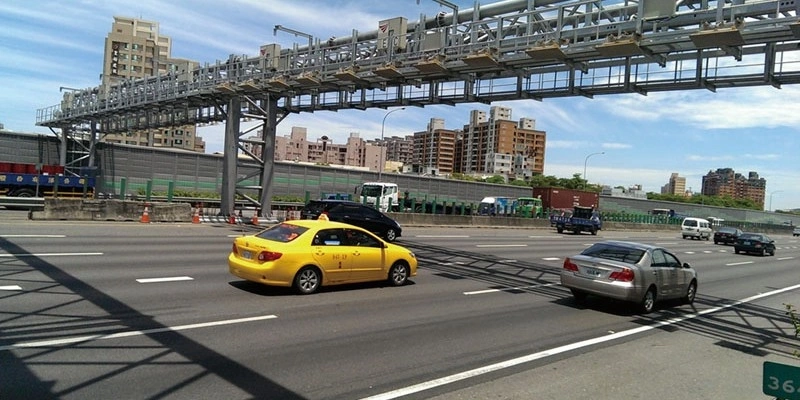 |
Vehicles pass through gantries equipped with sensors to measure distance in Taiwan. Photo: Taiwan Business Topics |
Vehicles pass through gantries equipped with sensors to measure distance in Taiwan. Photo: Taiwan Business Topics
In Taiwan, vehicles receive 20 km of free travel daily across the entire highway network. Beyond that, fees are calculated based on vehicle type and distance, ranging from 0,9 to 1,8 New Taiwan dollars (0,02-0,05 US dollar) per km. eTag users receive a 10% discount, deducted from their prepaid wallet or credit card.
Vehicles without eTag have their license plates captured by cameras at each toll gate. The system then automatically calculates the distance and the amount due. However, these users do not receive the 10% discount. Users can check and pay their tolls after a trip on the FETC website or at kiosks in convenience stores.
FETC has even exported this technology to several countries, including Thailand and India. Since late july, the multi-lane free-flow (MLFF) tolling system has been operational in India. The Indian government plans to convert 140 stations, equivalent to 10% of traditional toll booths, to the new system. MLFF will allow vehicles to pass through toll gates without barriers and without having to slow down.
About 10 years ago, India began implementing FASTag, which uses radio-frequency identification (RFID) technology similar to Taiwan's ETC system. However, drivers still had to stop at stations for the system to recognize their tags.
India's highway system has a total length of 45.000 km, making it the second longest in the world and approximately 48 times larger than Taiwan's highway network. Differences in traffic conditions and high summer temperatures in India also pose challenges for system installation. For instance, India's highways accommodate a wide variety of vehicles, from tuk-tuks to tractor-trailers.
Toll gates are therefore equipped with automatic number plate recognition (ANPR) cameras, capable of identifying vehicle type and chassis, along with LiDAR light sensors to differentiate vehicle types and exclude exempted vehicles.
In mainland China, electronic toll collection (ETC) is currently used in parallel with manual toll collection (MTC). China began using ETC on highways and in parking lots in 1996.
More than 10 years later, the country introduced a national standard for its ETC system, and in 2014, it launched a unified nationwide system.
Vehicles using ETC lanes must have an RFID-enabled device installed on their windshield, linked to a registered account. According to the policy of the Ministry of Transport China, nationwide ETC transactions receive a discount of not less than 5%. ETC gates automatically recognize the device at the entry and exit points of toll stations, allowing vehicles to pass without stopping.
In contrast, MTC lanes feature staff who manually collect tolls at booths at the exit toll station. Fees can be paid by cash or electronic wallets, China Daily reported.
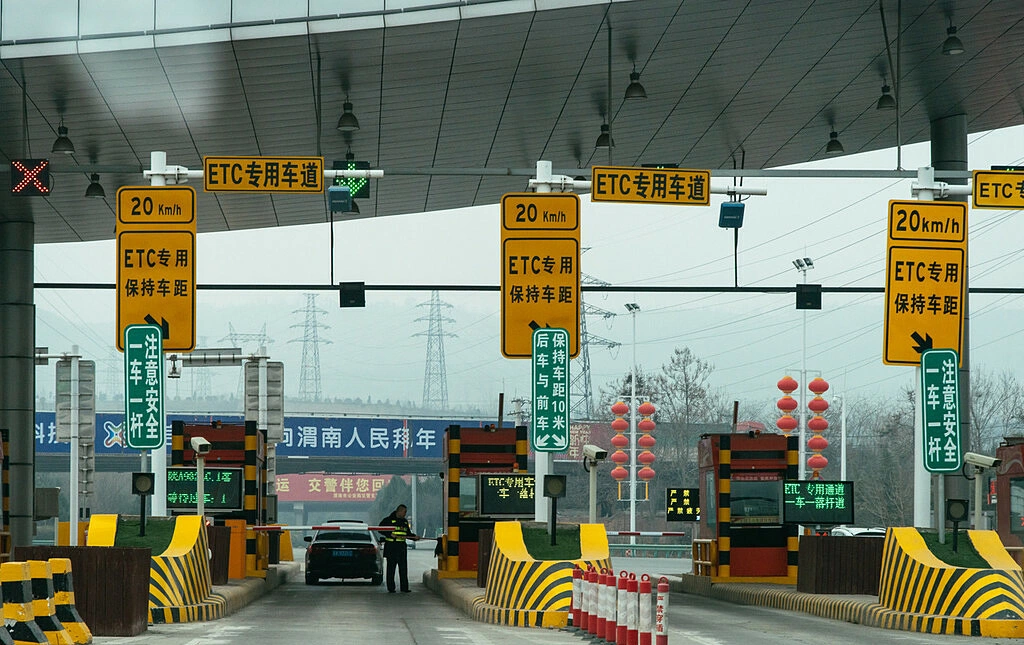 |
Toll booths in China in 2019. Photo: IC |
Toll booths in China in 2019. Photo: IC
In recent years, Chinese officials have repeatedly stated their desire to accelerate the popularization of free-flow tolling to reduce emissions and logistics costs. In 2014, Wang Gang, director of the ETC Center under the Ministry of Transport China, stated that free-flow toll lanes are five times more efficient than MTC lanes, reducing vehicle passage time through a toll station from 14 seconds to three seconds. Currently, China has more than 200 million ETC users.
Meanwhile, some countries, particularly in Europe, employ satellite-based toll collection. Vehicles are equipped with GPS devices to receive satellite signals, determining the distance traveled in toll collection areas. This data is then transmitted to a processing center to ascertain vehicle location, calculate fees, and automatically deduct service charges.
Global Navigation Satellite Systems (GNSS) were first used for road vehicle toll collection in 2001 in Switzerland. This tolling method applies to all trucks over 3,5 tons traveling on the entire road network. These vehicles are fitted with devices capable of receiving GPS signals. The device measures the distance traveled by cross-referencing the vehicle's speedometer with satellite-measured distances.
In 2005, Germany also launched a GNSS-based distance tolling system, applicable to highways and for trucks over 12 tons. An on-board unit (OBU) stores vehicle-related information and automatically determines the vehicle's position on the highway using satellite signals.
The OBU calculates tolls by identifying whether the road segment a vehicle travels on is subject to a fee and applies the corresponding rate. Data is periodically transmitted to a processing center, where billing information is stored and invoices are sent. During its first two years of operation, the system demonstrated an accuracy rate exceeding 99,5%.
The in-vehicle positioning device must be installed by a licensed mechanic. However, drivers can also opt for manual toll collection, accommodating vehicles traveling on highways that have not yet had a GPS unit installed.
Ha Thu (compiled)