The National Assembly, on the afternoon of 22/8, convened to discuss a resolution proposing reductions in personal income tax and corporate income tax for individuals and enterprises.
The government's draft resolution proposes a 30% tax reduction for individuals on business income, specifically for the 2026-2027 tax period, provided their annual revenue does not exceed 10 billion VND. Similarly, enterprises generating up to 10 billion VND in total revenue would also qualify for a 30% tax reduction during the same timeframe.
Minister of Finance Ngo Van Tuan highlighted that following both group and plenary discussions, delegates primarily raised three key concerns: the rationale behind the 10 billion VND revenue threshold for the tax reduction, the proposed 30% reduction rate, and potential worries about businesses artificially splitting revenue to exploit the incentive.
The Minister asserted that the 10 billion VND revenue threshold is broad enough to encompass the majority of small enterprises and business households, ensuring widespread policy benefits. To support this, Mr. Tuan presented Ministry of Finance statistics: over 2.69 million business households, accounting for 99.98% of the total, currently have annual revenues up to 10 billion VND. Furthermore, 865,115 enterprises, representing 81.1% of all enterprises, also fall within this revenue limit.
He further clarified the 30% tax reduction rate, illustrating it with an enterprise generating 10 billion VND in annual revenue, equivalent to an average of 833 million VND per month. Assuming a 12% profit margin, such an enterprise would pay 15-17 million VND in monthly tax. A 30% reduction would result in monthly savings of 4-5 million VND. This 5 million VND saving aligns with the highest average spending among top-income households (based on General Statistics Office data) and the minimum wage for Region I.
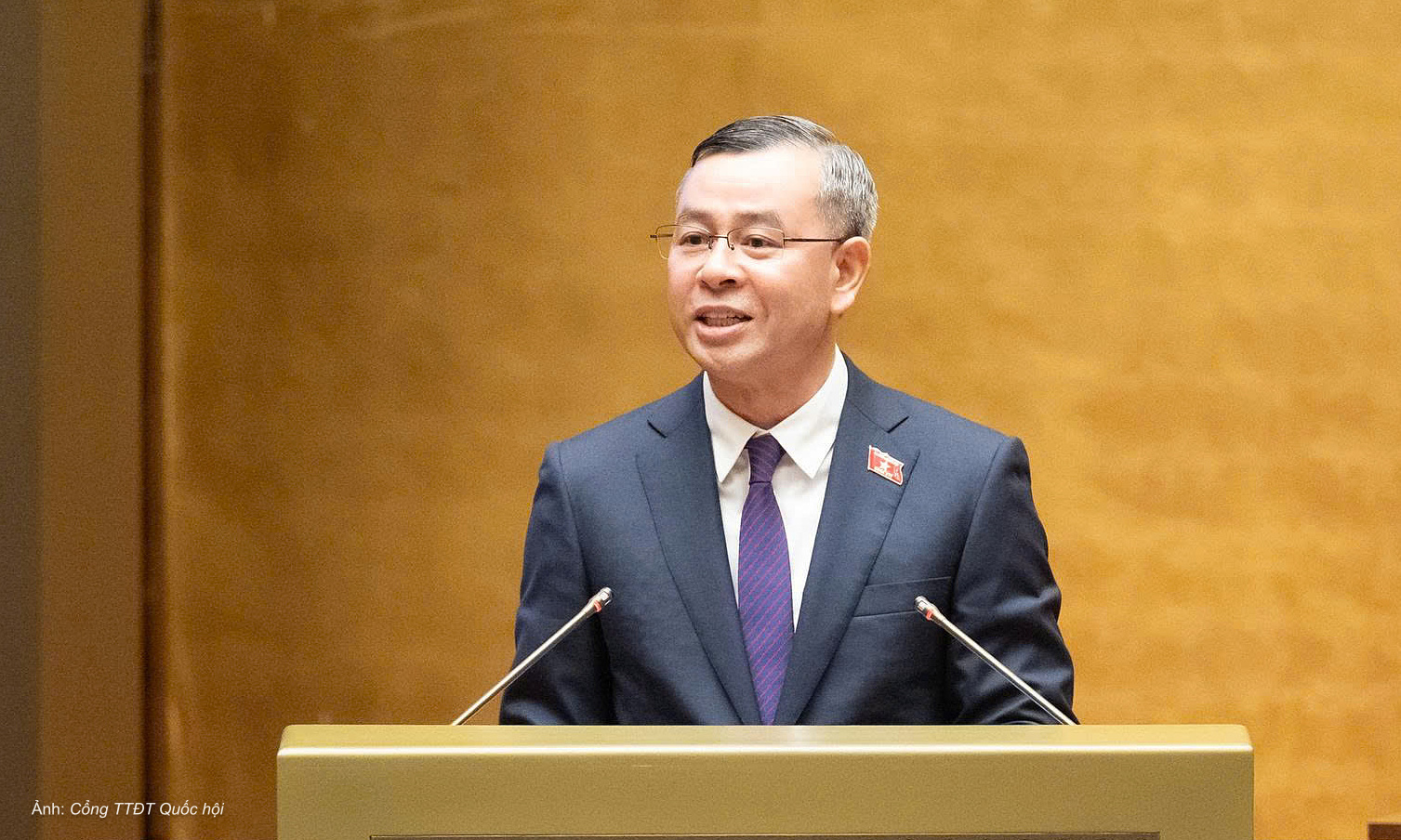 |
The Minister of Finance addresses the assembly on the afternoon of 22/8. *Photo: National Assembly Portal* |
During the session, Nguyen Thanh Trung, Director of Hai Phong Department of Culture, Sports and Tourism, highlighted that business households are struggling not just with tax obligations, but also with compliance costs, the shift from lump-sum to declaration-based taxation, and the adoption of electronic invoices.
"The policy's effectiveness will be incomplete if only the 30% tax is reduced without also simplifying procedures," Mr. Trung stated. He also urged the Government to evaluate the impact and explore expanding the scope of the 30% tax reduction to further assist small and medium-sized enterprises.
Addressing this point, the Minister of Finance observed that following intervention by authorities, business owners have shown a high sense of responsibility, focusing on legal compliance.
Consequently, he believes tax policies must be simplified, a matter to be addressed in the Law on Enterprise Development Support, scheduled for submission to the National Assembly during its regular October session.
The Minister of Finance further informed that the law will raise the revenue threshold for applying the simplified percentage-of-revenue tax calculation method to 10 billion VND, an increase from the current 3 billion VND.
The resolution on reducing personal income tax and corporate income tax for individuals and enterprises is anticipated to take effect immediately upon its review and approval by the National Assembly at the 24/8 session.
Mr. Tuan noted that announcing the tax reduction policy early would allow enterprises to proactively calculate incentives, thus enabling them to develop investment, production, and business plans, particularly during the year-end and Tet Nguyen Dan (Lunar New Year) periods.
Anh Tu