This support is part of a scholarship policy for students in these fields, enacted by the Government on 22/5.
The policy aims to encourage university students, as well as master's and doctoral candidates, in fields prioritized for national development, ensuring their minimum study and living needs. Specific support levels are as follows:
| Field, program | Bachelor's (million VND/month) | Master's (million VND/month) | Doctoral Candidates (million VND/month) |
| Semiconductor microchips, basic science | 4,5 | 6,3 | 8,4 |
| Key engineering, strategic technology | 3,7 | 5,5 | 7,4 |
| Talent programs | 5,5 | 7,4 | 8,4 |
Bachelor's students will receive support for a maximum of 10 months per year, for no more than four years for bachelor's programs and five years for engineering programs. Master's and doctoral candidates will receive support for the full year, according to their program's standard training duration.
The list of 15 basic science, key engineering, and strategic technology fields eligible for this scholarship policy includes:
| Biology | Mathematics | Mechanical and Engineering Mechanics |
| Applied Biology | Statistics | Electrical, Electronic, and Telecommunication Engineering |
| Material Science | Computer Science | Chemical, Material, Metallurgy, and Environmental Engineering |
| Earth Science | Information Technology | Engineering Physics |
| Electrical Engineering, Geophysics, and Surveying | Mining Engineering | Construction |
To be eligible for the scholarship, students admitted to these fields must meet one of two conditions:
- Achieved a first, second, or third prize in national or international excellent student competitions.
- A total high school graduation exam score of 22,5 out of 30 or higher for three subjects (Mathematics and two from Physics, Chemistry, Biology, English), excluding priority or bonus points. Additionally, candidates must be among the top 30% scorers nationwide in their respective field.
However, students in semiconductor microchip programs or those enrolled in talent programs are exempt from these conditions.
For master's and doctoral levels, students must be enrolled in full-time regular programs, with the exception of the semiconductor microchip field. During their studies, they must maintain good conduct and meet specific academic performance criteria to retain the scholarship.
For bachelor's, engineer, and integrated bachelor's-master's programs, students must achieve academic results of "good" or higher, accumulating a minimum of 24 credits after the first academic year and 28 credits for subsequent years.
Master's candidates must complete at least 40% of their total credits in the first year, maintain a grade point average of 3,0 out of 4,0 or higher, and achieve research outcomes and scientific publications as stipulated by the university. Requirements for doctoral candidates are set by their respective training institutions.
If students switch to a field not on the approved list, they must repay the scholarship amount received.
In the 2024-2025 academic year, STEM fields, predominantly technology and engineering, enrolled nearly 686.000 students, accounting for over 33% of total university enrollment. Although this number has steadily increased in recent years, it remains lower than in other countries in the region and globally, such as Singapore (46%) and Malaysia (50%).
Vietnam aims to increase enrollment in these fields to over one million learners by 2030.
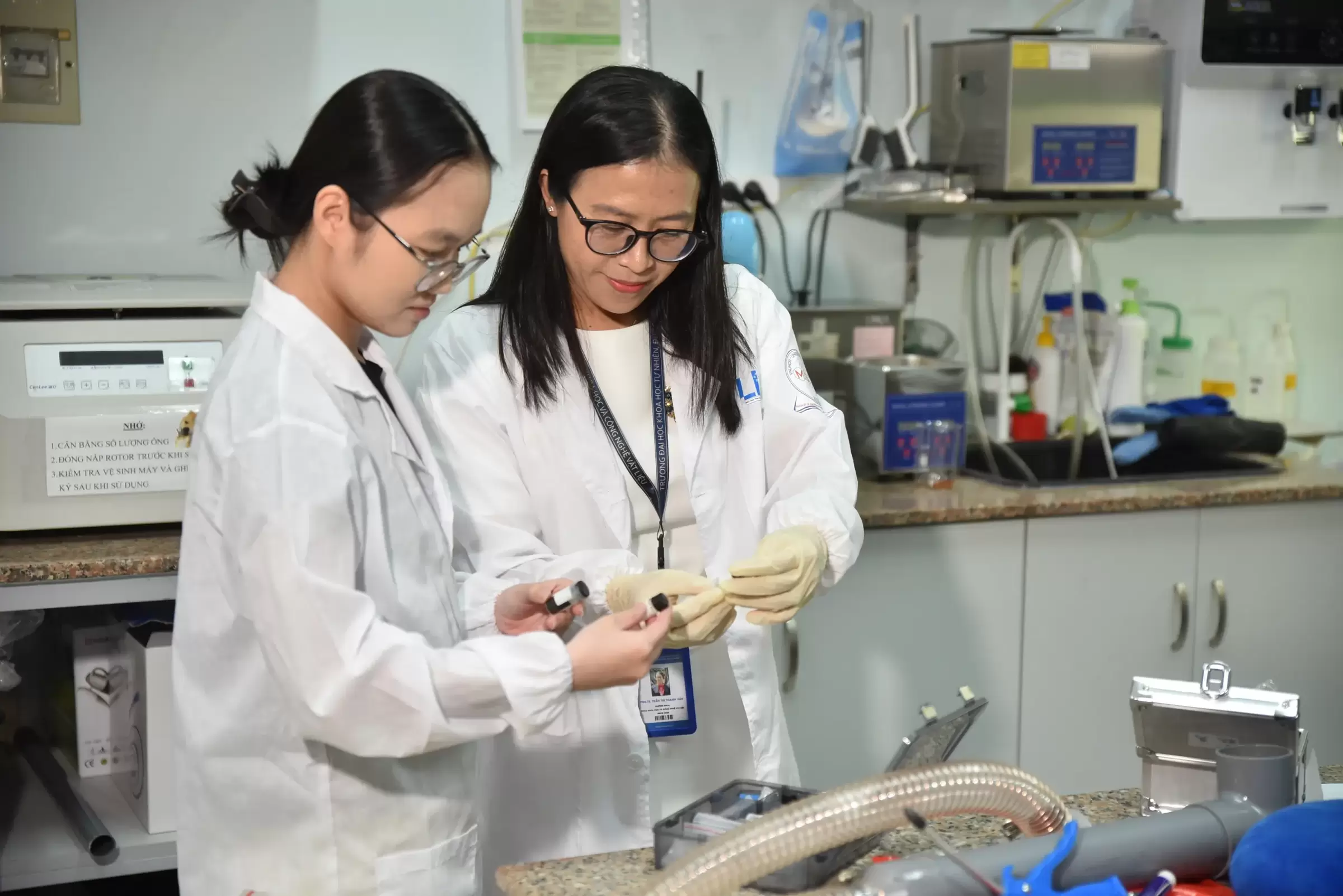 |
Lecturers at the University of Natural Sciences, TP HCM guide students in experiments. Photo: VNUHCM |
Le Nguyen