On 24/8, Doctor Lai Le Hung, a specialist one in the Respiratory Department 1 at Children's Hospital 2, announced that the hospital had received an urgent request for assistance from Children's Hospital of Ho Chi Minh City. The request concerned a male infant suffering from an airway foreign body and progressive respiratory failure, necessitating high-setting mechanical ventilation.
About a week prior, the baby was fed eel porridge by family members. Although the bones were supposedly removed, some fragments remained. After eating, the baby choked, turned blue, and despite attempts to pat his back and manually clear his throat, the foreign body could not be dislodged. He was initially examined and treated at a private clinic, but his coughing and wheezing worsened, leading to his transfer to Children's Hospital of Ho Chi Minh City.
Upon arrival, doctors at Children's Hospital of Ho Chi Minh City performed an endoscopy but could not fully remove the foreign bodies. Children's Hospital 2 then dispatched a respiratory endoscopy team with specialized equipment to assist. The endoscopic procedure was challenging due to the 7-month-old's very small and inflamed airway, which also had significant secretions. The sharp bone fragments were firmly lodged in multiple locations within the bronchial tubes.
"Even a slightly forceful maneuver could tear the airway," a doctor explained, "but if not completely removed, the child's infection and respiratory failure would continue to worsen."
The medical team meticulously cleaned the airway, located each bone fragment, and removed them one by one. One piece was found in the right bronchus, another in the left, and the remaining fragment was lodged even deeper. The foreign bodies were small, sharp, and tightly adhered, demanding precise control from the doctors to prevent the bones from breaking or being pushed further into the airway.
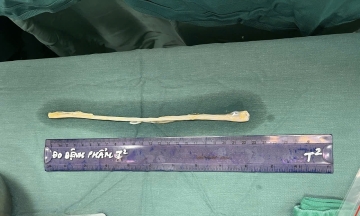
Following the endoscopy, all three eel bone fragments were successfully removed intact. The airway was cleared, and the baby's respiratory condition improved, allowing the ventilator settings to be reduced. The infant is continuing treatment and monitoring at Children's Hospital of Ho Chi Minh City.
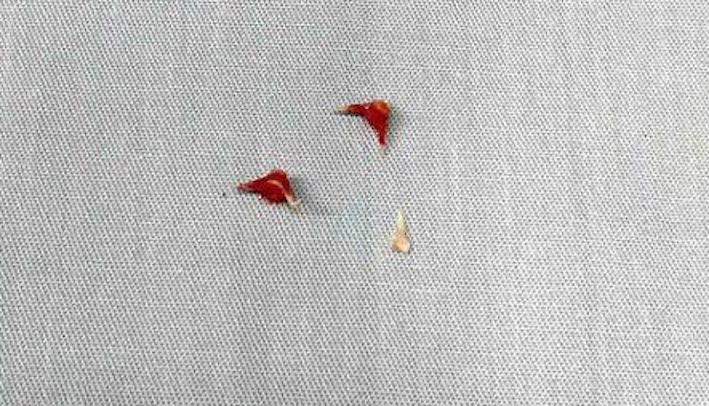 |
Three eel bone fragments removed by doctors. Photo: Hospital provided |
Doctor Nguyen Hoang Phong, a specialist two and Head of Respiratory Department 1 at Children's Hospital 2, emphasized that airway foreign bodies, especially sharp objects like fish or eel bones, can lead to severe complications. Eel bones, despite being small and slippery, possess sharp edges and spines. When inhaled into the airway, these spines can embed deeply, causing scratches, bleeding, or even bronchial tears. If left undetected for several days, the foreign body can result in infection, lung abscess, necrosis, or even airway perforation and mediastinitis.
Infants who are just starting solid foods face a high risk of choking or gagging because their chewing, swallowing reflexes, and airway protection mechanisms are not yet fully developed. Parents must carefully filter out bones and hard shells, and sieve food before feeding it to children. For very young children, food should be chopped, sieved, or blended to an appropriate consistency.
If a child suddenly chokes, coughs, turns blue, or experiences difficulty breathing after eating, it is crucial to seek immediate medical attention. Parents should not attempt to clear the throat with their hands, as this could push the foreign body deeper or cause damage to the airway.
Le Phuong