Master, Doctor Duong Minh Phuc, from the High-tech Eye Center at Tam Anh General Hospital, TP HCM, stated that Ms. Le had grade three cataracts in both eyes. Despite the same degree of opacity, her left eye had 3/10 vision, while her right eye could only count fingers at a distance of one meter.
Optical coherence tomography (OCT) results showed macular edema in her right eye, with damaged blood vessels and fluid leakage causing the macula to swell. According to Doctor Phuc, this was the reason for her blurry vision and distorted images, especially in the right eye.
The macula is the central part of the retina, located at the back of the eye, densely packed with light-sensitive nerve cells. When macular edema occurs due to conditions that damage small blood vessels, causing fluid leakage, the received images become blurry and distorted. When the lens is cloudy, light cannot properly focus on the retina, leading to reduced vision. Doctor Phuc emphasized that having both cataracts and macular edema simultaneously is dangerous. Without early intervention, vision recovery is almost impossible.
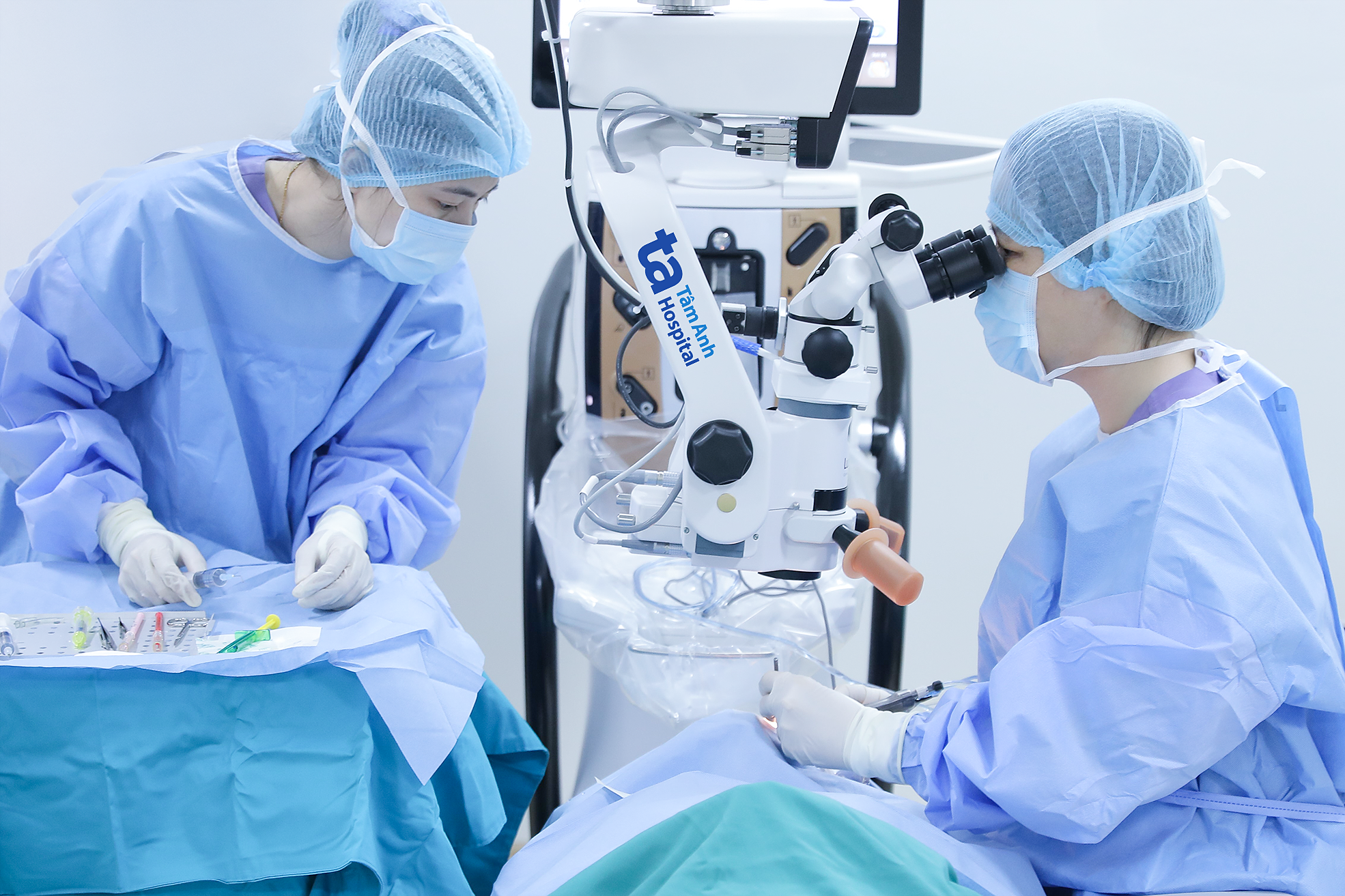 |
The doctor performed cataract surgery on the patient's left eye. Photo: Tam Anh General Hospital
Doctors decided to perform lens replacement surgery on the left eye first. For the right eye, the treatment plan was divided into two phases: intravitreal injections to treat the macular edema, followed by artificial lens replacement once the swelling subsided. If lens replacement surgery were performed while the macula was swollen, the swelling and inflammation would worsen, leading to fluid accumulation and affecting the quality of the operation.
After three intravitreal injections, administered one month apart, the macular edema in the right eye significantly decreased. Doctors then used ultrasound waves (phacoemulsification) to emulsify the cloudy lens, remove it, and replace it with an artificial intraocular lens.
Patients need to avoid getting water in their eyes during the initial postoperative days, refrain from heavy work, dusty environments, and strenuous activities to ensure the surgical wound heals quickly. Two weeks after the follow-up examination, Ms. Le's right eye vision improved to 6/10, and her left eye to 9/10. The macular edema in her right eye was stable, and the surgical wound healed well, allowing her to resume normal activities.
Doctor Phuc noted that many elderly individuals often attribute blurry vision to old age and delay seeking examination, unaware that they may have cataracts or other eye conditions. In addition to regular eye check-ups every 6-12 months, patients experiencing blurry vision, distorted images, or the appearance of a dark central spot should visit a medical facility immediately for diagnosis and treatment.
Nhat Minh
* The patient's name has been changed
| Readers can submit ophthalmology questions here for doctors to answer |