The Duong Long Tower complex, also known as An Chanh Tower, Binh An Tower, or Ivory Tower, is a special national relic. Constructed in the late 12th to early 13th century, it stands on a hill in Binh An commune, Tay Son district (formerly Binh Dinh province).
This cluster of three towers represents a significant work of Champa culture, showcasing the interplay between indigenous architecture and Khmer influences. After more than 800 years, the structures have severely degraded due to war, weather, and human impact.
 |
The Duong Long tower complex began restoration in 12/2025. Photo: Tran Hoa
In late 2025, the Gia Lai Department of Culture, Sports and Tourism initiated a project to restore and embellish the relic, with a total budget exceeding 90 billion VND. This includes an archaeological excavation covering more than 9,000 square meters, costing over 16 billion VND. The project is expected to take one year to complete.
Pham Minh Hung, the chief construction supervisor, stated that the severe degradation necessitated large-scale intervention. However, the highest priority is preserving the "original elements," a core principle in heritage restoration.
"This is not new construction, but high-precision restoration, demanding meticulousness and patience in every detail," Hung said.
Before construction began, the tower's entire original structure underwent thorough surveying. Each brick and wall section was studied to ensure that all interventions would not distort its historical value.
 |
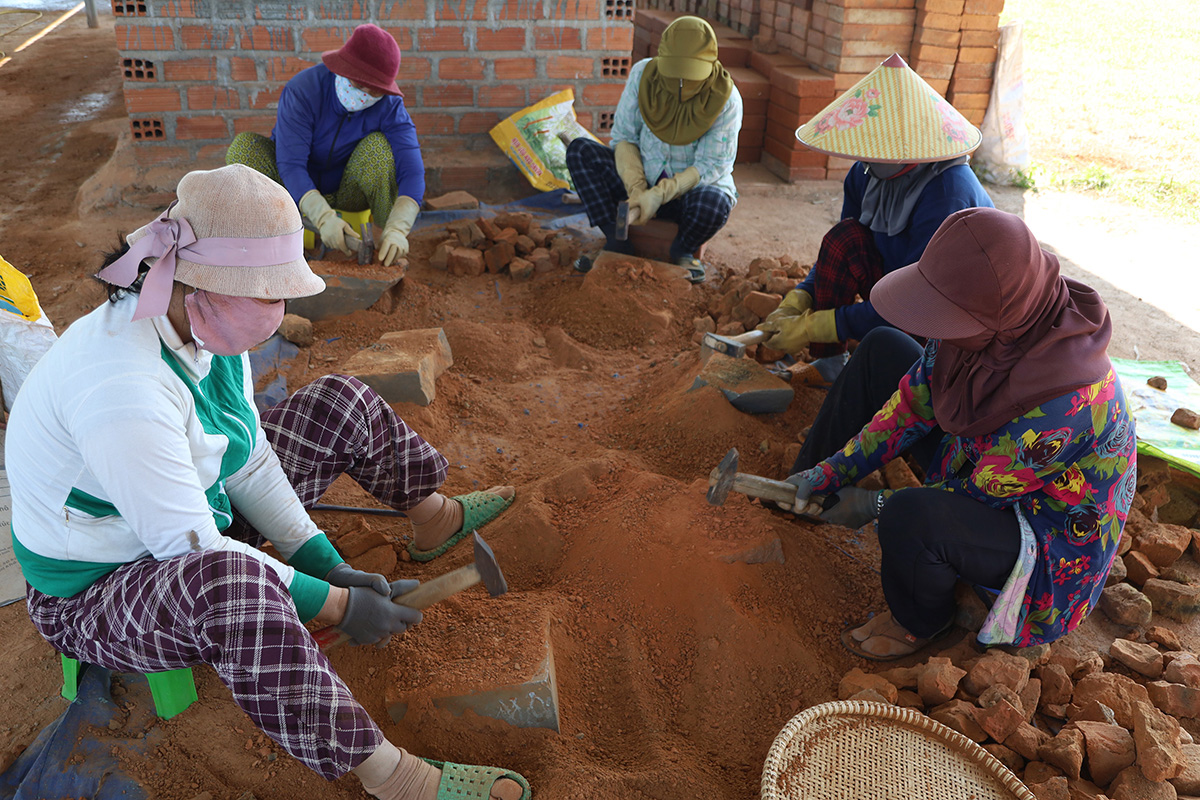
Fallen, damaged, or cracked Cham bricks are collected, ground into powder, and then mixed with lime to create mortar. Photo: Tran Hoa
Approximately 340,000 bricks were custom-produced for the project, with a composition and structure mimicking ancient Cham bricks. This ensures compatibility in color, durability, and adhesion. Each new brick is stamped with the year 2026 to distinguish it from the original parts, enhancing transparency in preservation.
Simultaneously, old materials are maximized. Broken or cracked bricks are ground into powder and mixed with lime to form mortar, helping maintain structural and color consistency between old and new sections.
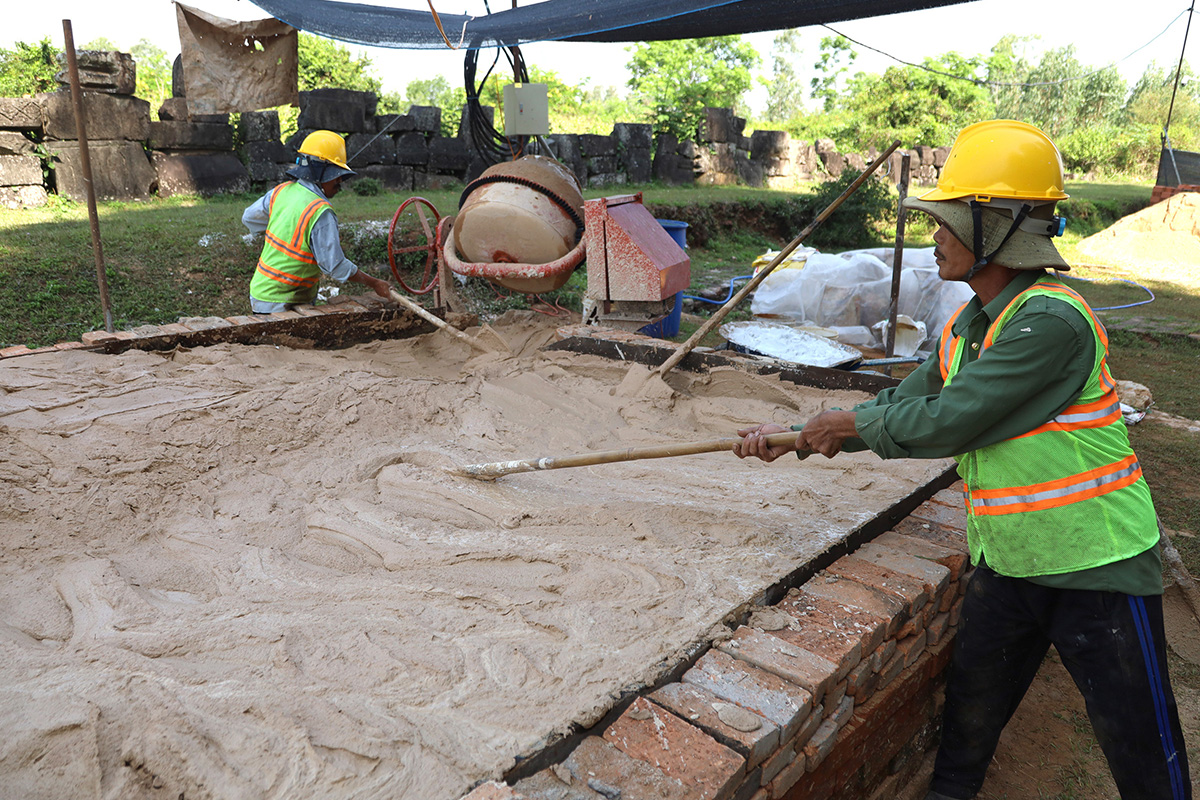
Technically, the tower's core is reinforced with mortar to enhance stability, while the surface layer uses rosin resin—a tree sap once employed by the Cham people as a binding agent. The "grinding and bonding" method, combined with rosin resin, helps recreate ancient construction techniques, many of which remain mysterious today.
The restoration process involves numerous steps: photographing the current state, marking degraded areas, partial dismantling, surface cleaning, removing vegetation growing within the tower, and replacing damaged bricks. Each step is executed carefully to avoid further harm to the structure.
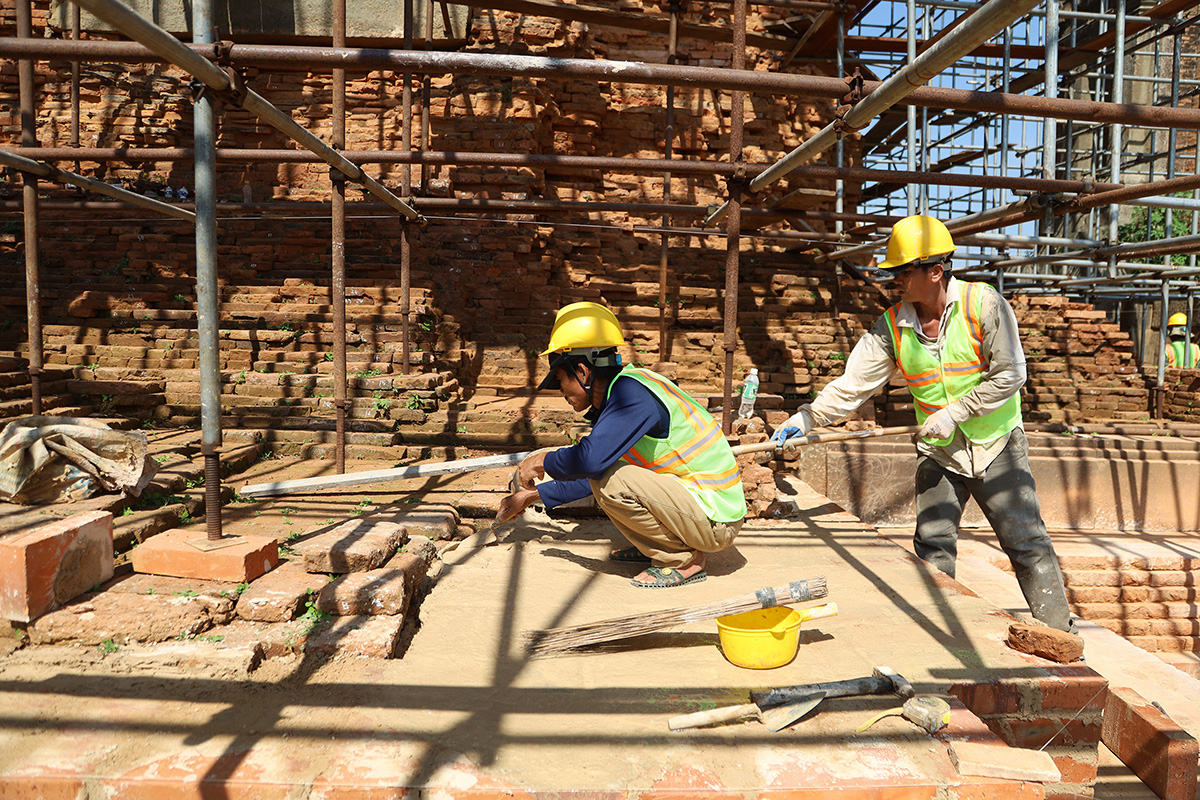 |
The base of the tower is nearing completion of its restoration. Photo: Tran Hoa
Restoring stone details is more complex. Areas with sufficient documentation are reconstructed to their original state. For areas lacking evidence, new uncarved stone blocks are used, prioritizing structural reinforcement over recreating patterns to avoid the risk of "misleading newness" of the relic.
According to Hung, the project operates on a "slow but steady" principle, with the biggest challenge being balancing the preservation of original elements with ensuring structural safety. "The goal is not to make the tower newer, but to help the structure endure in a state closest to its original form," he stated.
The restoration of Duong Long Tower aims not only to preserve an architectural relic but also to safeguard the cultural memory of the Champa kingdom, reflecting the cultural exchange in Southeast Asia during the medieval period.
Tran Hoa