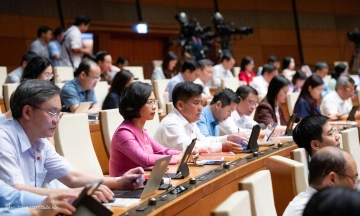
Speaking at the all-military political-military conference on 2/7, Prime Minister Le Minh Hung called on the military to develop a self-reliant, self-sufficient, dual-use, and modern defense industry, establishing it as a spearhead of the national industry.
The military must master the defense industry and strategic supply chains to ensure its ability to respond effectively in any situation. This demand arises from persistent global and regional complexities, presenting new challenges for military and defense operations.
 |
Prime Minister Le Minh Hung speaking at the all-military political-military conference. Photo: VGP |
Assessing the first six months of the year, the Prime Minister noted the military's accurate assessment and forecasting of situations. This enabled timely and flexible advice, maintaining initiative and preventing surprises. Significant progress was also made in the defense industry, particularly in mastering technology, design, manufacturing, and production.
He directed the entire military to continue building a revolutionary, regular, elite, and modern force. This includes enhancing the quality of training, education, and exercises, alongside mastering weapons and equipment to meet new operational demands.
Furthermore, the military needs to improve the quality of strategic advice on military, defense, and foreign affairs. The head of government emphasized, "Look further, prepare earlier, and advise more deeply, forecasting not only military and defense matters but also their impacts on socio-economic, diplomatic, and other areas."
Regarding military rear-area policies, the Prime Minister proposed continued mobilization of combined strength to search for and gather the remains of fallen soldiers, collect information, and identify their identities. He underscored this as a particularly important political task for all levels, sectors, especially the Ministry of National Defense.
According to the conference report, forces have cleared over 4,100 ha of land contaminated with bombs and mines. They also received 1,507 samples of fallen soldiers' remains from provinces and cities, with an additional 7,500 samples from soldiers' graves submitted for DNA identification. In these efforts, 1,255 fallen soldiers' remains and three mass graves were discovered.
Son Ha