Vietnam is developing three strategic railway lines designed to enhance connectivity with China and foster regional integration. The Ministry of Construction is currently overseeing the Lao Cai - Hanoi - Hai Phong railway project, while also advancing plans for the Hanoi - Dong Dang and Hai Phong - Ha Long - Mong Cai lines. These projects are crucial for establishing a seamless railway network between Vietnam and China, laying the groundwork for broader intermodal connections across ASEAN and potentially extending to Europe.
The Lao Cai - Hanoi - Hai Phong railway line, with a main track length of approximately 391 km, traverses six provinces and cities: Lao Cai, Phu Tho, Hanoi, Bac Ninh, Hung Yen, and Hai Phong. The line originates at the cross-border rail link in Lao Cai province and terminates at Lach Huyen station in Hai Phong city. This project will include 18 stations along its route, comprising 15 mixed-use stations for both passenger and cargo trains, and three dedicated marshalling yards.
This line is designed with a standard gauge of 1,435 mm and will utilize electrified rail technology. Passenger trains will operate at a design speed of 160 km/h, while cargo trains will travel at 120 km/h. The initial phase of the project involves constructing a single track, with provisions for future expansion to a double track system. The total investment for this project is estimated at over 203.2 trillion VND. Construction of stations and connecting roads commenced on December 19, 2025, with the feasibility study for the main line construction currently underway. The main line is projected to begin construction in late 2026 and reach completion by 2030.
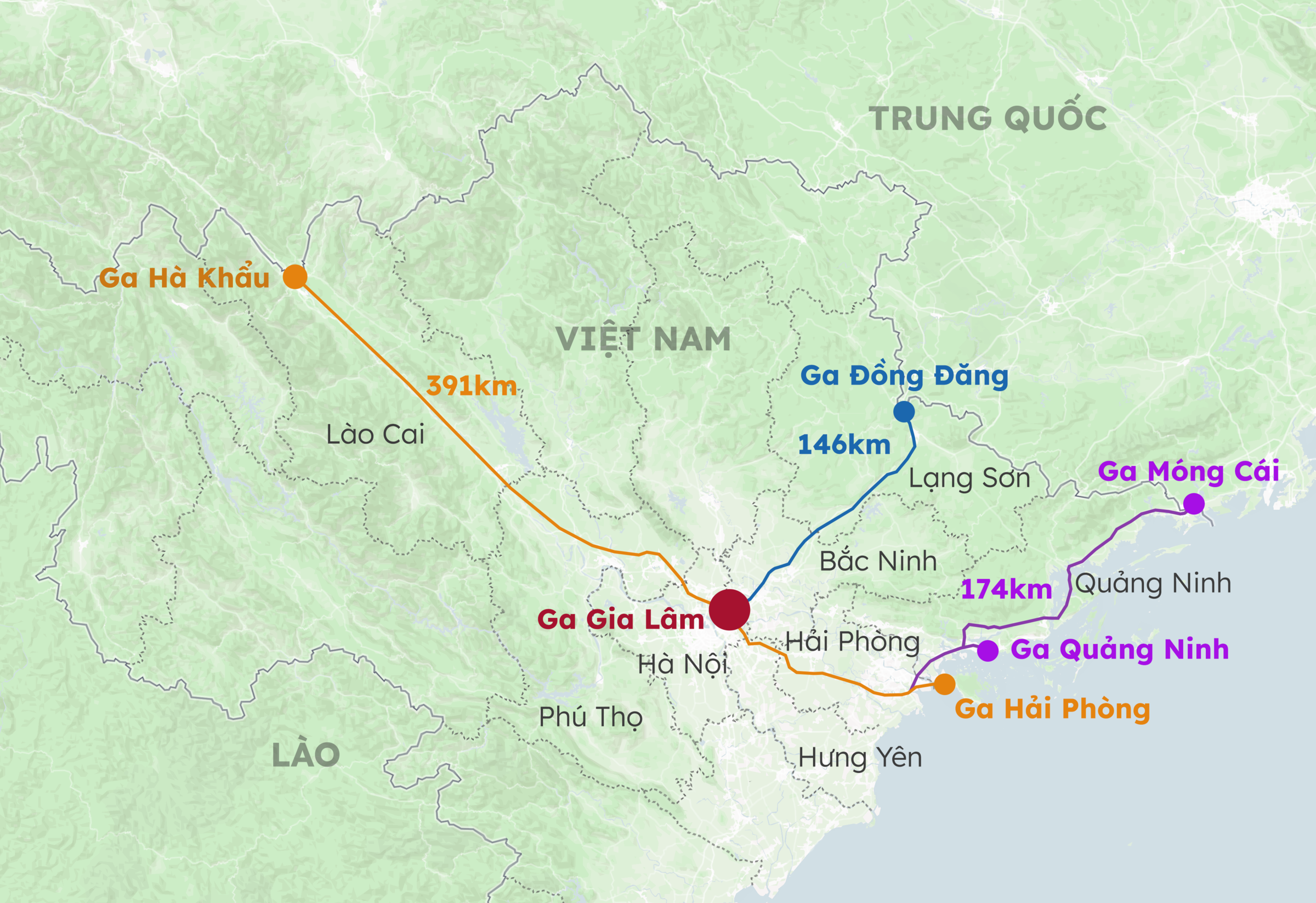 |
Three railway lines connecting China. Graphics: Hoang Khanh |
Concurrently, the Ministry of Construction is expediting the planning for the Hanoi - Dong Dang (Lang Son) railway line. This line will start at Bang Tuong Dong station on China's Nanning - Bang Tuong high-speed railway and conclude at Gia Lam station in Hanoi city. After crossing the China-Vietnam border, the line will pass through Lang Son and Bac Ninh provinces in Vietnam, connecting to Gia Lam station. The border rail link will be strategically located at the common border area. The main line within Vietnamese territory will span approximately 146 km, featuring 31 km of bridges and 9 km of tunnels, with 11 stations planned along the route.
The Hanoi - Dong Dang line is designed to a 1,435 mm standard gauge, Class I, facilitating both passenger and cargo traffic. Its design speed is 160 km/h, with a reduced speed of approximately 80 km/h for the border section. Initially, the project will be built as a single track, with provisions for future development into a double track system.
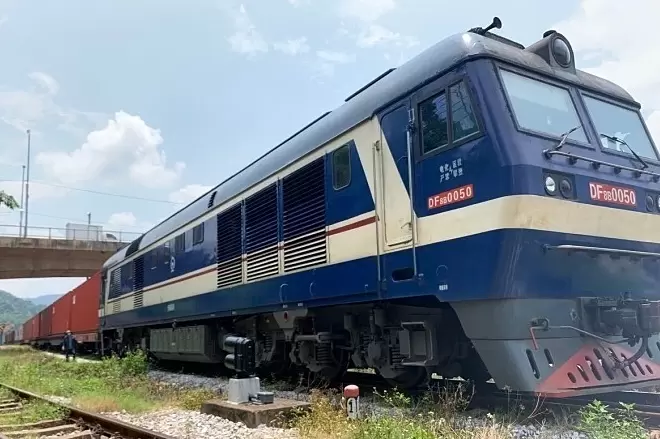 |
Intermodal cargo trains to Europe often depart from Yen Vien station. Photo: Anh Duy |
The third planned line is the Hai Phong - Ha Long - Mong Cai railway, which will begin at Dongxing station in China and end at Nam Hai Phong station in Hai Phong city. Upon crossing the China-Vietnam border, this line will traverse Quang Ninh province and Hai Phong city, connecting to Nam Hai Phong station of the new Lao Cai - Hanoi - Hai Phong railway. The border rail link will also be situated at the shared border area. The main track within Vietnamese territory will cover approximately 174 km, including about 76 km of bridges and 8.09 km of tunnels, with 14 stations anticipated along its length.
This railway line will also adhere to a 1,435 mm standard gauge, Class I, for mixed passenger and cargo operations. It is designed for speeds of 160 km/h, with a potential upgrade to 200 km/h, and a speed of 120 km/h for the border section. Like the other lines, the initial phase will involve a single track, with provisions for future expansion to a double track.
According to Tran Thien Canh, Director of the Vietnam Railway Authority, China is providing support and collaborating with Vietnamese agencies on the planning for these railway lines. Consultant units are currently engaging with local authorities along the proposed routes to finalize planning and complete initial reports. Both sides aim to complete the planning process in 2026.
These three railway lines represent a significant step towards creating seamless connectivity between the railway systems of Vietnam and China. This integration will establish a foundational intermodal network across ASEAN and China. Crucially, all three lines offer the potential for extended connections to Europe, facilitating the organization of intermodal trains from Vietnam through China to European destinations. Beyond boosting regional trade, these projects will enable faster movement of passengers and goods, playing a vital role in unifying the ASEAN railway transport system and realizing standard gauge railway connectivity, thereby accelerating regional integration.
Doan Loan