Dr. Pham Thai Duy, Master of Science, Level II Specialist at the Ear, Nose, and Throat Center, Tam Anh General Hospital in Ho Chi Minh City, performed a throat endoscopy. He observed a hard, opaque white mass in the right tonsil crypt, diagnosing it as a tonsil stone. The patient underwent endoscopic removal of the tonsil stone without anesthesia and felt immediate relief from the sensation of something stuck in her throat after the procedure.
According to Dr. Duy, tonsil stones are typically small, a few millimeters or tiny particles. Large tonsil stones like Nu's are uncommon.
Tonsils have many small crypts and crevices where food particles and dead cells can easily become trapped. Over time, these substances accumulate, combine with bacteria and minerals in saliva, and calcify into solid masses known as tonsil stones. Individuals with a history of chronic tonsillitis, enlarged tonsil crypts, poor oral hygiene, or dry mouth have a higher risk of developing these stones.
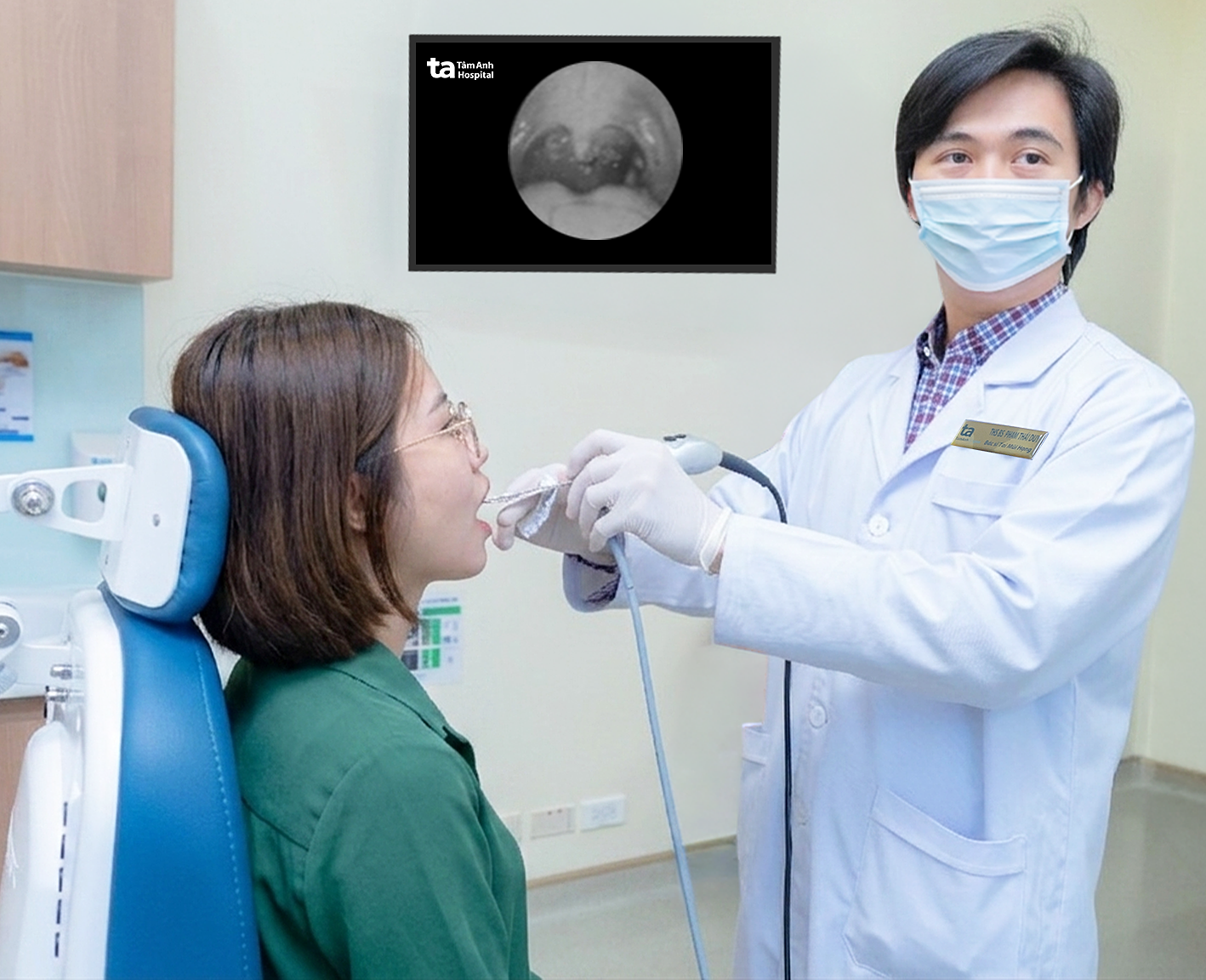 |
Dr. Duy performs an endoscopic removal of a tonsil stone for Nu. Photo: Tam Anh General Hospital
Most small tonsil stones are asymptomatic and discovered incidentally during a throat endoscopy. As stones grow, patients may experience a sensation of something stuck or lodged in their throat, persistent bad breath despite good oral hygiene, a dry cough, and sometimes a foreign body sensation. Larger stones causing inflammation can lead to noticeable sore throat or difficulty swallowing.
For small, superficial stones, doctors can remove them directly in the clinic using specialized instruments under endoscopy, without anesthesia. If stones are large, deeply embedded in tonsil crypts, difficult to access, or if the patient cannot cooperate during an in-office procedure, doctors recommend surgical removal in an operating room under anesthesia to ensure safety.
If tonsil crypts are enlarged, infections recur frequently, or stones repeatedly return, patients may be advised to undergo a tonsillectomy to definitively address the root cause.
Dr. Duy advises thorough oral hygiene, daily gargling with saline solution, and regular ear, nose, and throat check-ups to prevent and promptly detect tonsil stones.
Uyen Trinh
| Readers can submit questions about ear, nose, and throat conditions here for doctors to answer. |