At Tam Anh District 7 General Clinic, endoscopy revealed an ulcer approximately 5-10mm in the middle-lower one-third of Ms. Hao's esophagus.
Esophageal ulcers can result from various causes, including gastroesophageal reflux, infection, chemical damage, or certain medications. After ruling out gastroesophageal reflux and infection, Doctor Le Thi Thuy, from the General Internal Medicine department, discovered Ms. Hao was taking medication for a skin condition and had a habit of taking pills with very little water, then immediately lying down. "These factors likely contributed to the esophageal damage in the patient," Doctor Thuy stated.
 |
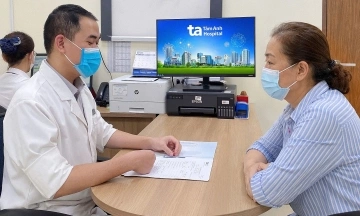
Doctor Thuy explains endoscopy results to the patient. Photo: Tam Anh General Hospital. |
Doctor Thuy explains endoscopy results to the patient. Photo: Tam Anh General Hospital.
Doctor Thuy explained that many active ingredients in medications, particularly antibiotics, are highly acidic. When patients take medication with too little water or lie down immediately after, the pill cannot quickly reach the stomach and easily gets stuck in the esophagus's naturally narrow sections, typically the middle or lower one-third. There, the pill's coating dissolves, releasing potent acidic compounds directly onto the lining. The high concentration of acid, not diluted or washed away by water, accumulates and directly causes burns and deep ulcers in the esophageal mucosa. Prolonged exposure allows the acid to erode deeper, leading to serious complications like esophageal bleeding.
Ms. Hao was prescribed medication to heal the esophageal damage and advised to change her pill-taking habits, especially for antibiotics and anti-inflammatory painkillers. Recommendations included taking medication with a large glass of water, about 150-200 ml. After taking the pill, she should remain standing or sitting upright for at least 30 minutes, avoiding lying down immediately to prevent the risk of reflux or the pill getting stuck and harming the esophagus. Additionally, the patient was advised to eat soft, easily digestible foods and avoid irritants such as sour, spicy, or carbonated drinks.
Following treatment, Ms. Hao's endoscopy showed the esophageal ulcer had completely healed, with a clean surface and epithelization (new skin forming). Concurrently, the gastric antrum was no longer congested, and inflammation of the stomach body's mucous membrane had fully resolved. Ms. Hao no longer suffered from difficulty swallowing, pain when swallowing, or bloating, and resumed normal eating and daily activities.
Thao Vy
*Patient's name has been changed